MedClinics News & Blogs
Why Umbilical-Cord MSC Therapy for Age-Related Frailty Is Gaining Attention
Frailty usually enters life quietly.
Someone who used to walk without thinking about it starts noticing the walk. A small illness leaves more fatigue behind than it once did. Getting through an ordinary day begins to take more planning. Nothing dramatic has happened, but the body feels less generous than before.
That is one reason frailty matters in longevity medicine. It is where aging becomes practical. Not theoretical, not cosmetic, not philosophical. Practical.
A 2026 phase 2 randomized controlled trial has added something important to that discussion. The study looked at intravenous allogeneic umbilical cord-derived mesenchymal stem cell therapy in older adults with frailty and reported promising findings, including improvement in 6-minute walk distance, while also supporting feasibility and a favorable safety profile in the study population.
Table of Contents
Why Frailty Has Become So Important

Frailty is often spoken about too broadly, as if it were simply another word for older age.
It is more specific than that. It describes a body that has less reserve than it once had. Recovery is slower. Strength is easier to lose. Small stressors take more out of the system. Things that were once absorbed in stride start leaving a mark.
That is why mobility matters so much here.
Walking distance in a clinical trial can sound dry, almost administrative. In real life, it points to something much more immediate. Can someone move through the day without feeling limited all the time? Can they keep up with ordinary routines? Can they trust their own body a little more? That is why mobility endpoints in frailty research are not minor. They speak to daily life directly.
Why Umbilical-Cord MSCs Are in This Conversation
Mesenchymal stem cells have been discussed in regenerative medicine for a long time, but frailty gives the subject a much more practical context.
The interest comes partly from how frailty is now understood. It is linked with chronic low-grade inflammation, weaker endogenous repair, impaired tissue maintenance, and a broader loss of resilience across systems. MSC-based therapies have drawn interest because they are being studied not only as cells, but as biologic modulators that may influence inflammatory signaling, tissue environment, and repair-related processes.
Umbilical-cord-derived MSCs have become especially relevant because cord tissue is a practical source and the cells themselves have often been described as attractive for clinical development because of their expansion potential and immunomodulatory profile.
That still does not make UC-MSC therapy a ready-made answer to frailty.
What it does mean is that this is no longer just a speculative idea. There is enough rationale behind it for controlled human trials, and that is already a meaningful step.
What the Newer Study Actually Adds
The important part of this story is not the headline. It is the fact that the evidence has moved forward.
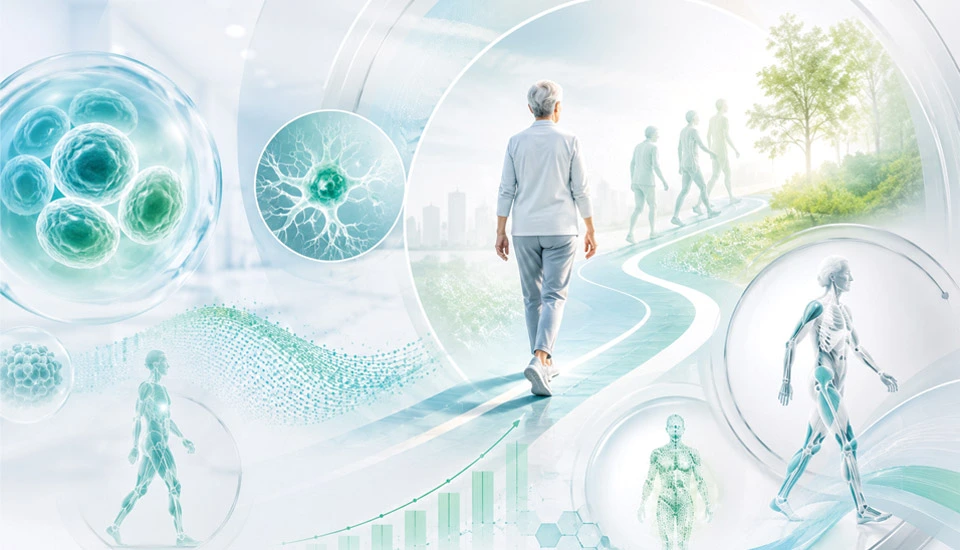
The 2026 phase 2 trial published in EBioMedicine gave the topic more weight because it moved beyond general interest and into controlled human data. Older adults with frailty who received intravenous allogeneic umbilical cord-derived MSC therapy showed improvement in 6-minute walk distance, with the stronger signal seen in the higher-dose groups. The study also reported that the treatment appeared feasible and well tolerated in the trial setting, while making it clear that bigger studies are still needed before the field can draw firmer conclusions.
That matters because it ties the discussion to a measurable functional outcome in a frailty population.
There was already some earlier clinical groundwork before that. A 2024 randomized, double-blind, placebo-controlled study using umbilical cord tissue-derived MSCs in aging frailty had reported improvement in physical quality-of-life measures, including SF-36 physical component scores and EQ-VAS. It also supported a favorable safety profile in the study population. So the 2026 results did not appear in isolation; they added to a line of findings that had already started to take shape.
Taken together, those studies do not settle the field. But they do make the topic harder to dismiss. Frailty is beginning to look like one of the more credible clinical settings in which stem-cell-based therapy is being tested against outcomes that actually matter to patients.
Why This Matters Beyond the Stem Cell Label
A lot of stem cell coverage becomes exaggerated almost immediately.
This story does not need that.
In frailty, a treatment does not have to produce a spectacular headline to matter. A gain in walking capacity, physical function, or quality of life can already mean a great deal in a frail older population. That is where this becomes relevant to longevity medicine. The point is not only survival. It is whether people remain physically capable for longer.
That is what gives this update its weight.
Longevity medicine uses big words all the time: healthspan, resilience, independence. Frailty is one of the places where those words stop sounding aspirational and start sounding concrete. A therapy that may improve mobility in that setting belongs in the discussion, even if the result sounds less dramatic than the kind of anti-aging news people are used to seeing.
What the Current Data Does Not Mean
This is where perspective matters.
The current results do not make UC-MSC therapy a standard treatment for frailty. It does not prove that aging has been reversed. It does not reduce the importance of exercise, protein intake, resistance training, rehabilitation, or broader geriatric care. And it does not answer every question about durability, patient selection, dosing, or long-term use.
That does not make the update less meaningful. It just keeps it in proportion.
The most useful reading is the narrower one: controlled trials are beginning to show that UC-MSC therapy may support physical function in frail older adults, and that is already worth close attention.
Where Exosomes and Regenerative Medicine Still Fit
This update is specifically about umbilical-cord MSC therapy, not exosome therapy directly.
Even so, it still sits within the larger regenerative medicine picture. One reason stem cells remain so central in this area is that the conversation has shifted. The field is no longer focused only on the idea of replacing cells. More and more, the attention is on signaling, immunomodulation, tissue environment, and the body’s ability to maintain resilience across systems. That is also why exosomes keep showing up in related discussions. They are not the same thing as stem cells, but they belong to the same broader scientific effort to understand whether age-related decline can be influenced by supporting repair and coordination more intelligently.
For this particular article, though, the real center of the story should remain the UC-MSC frailty data itself.
How This News Is Best Read
The least useful version of this story is the loudest one.
The better version is simpler: controlled human trials are starting to show that umbilical-cord MSC therapy may improve mobility and physical function in older adults with frailty, and that matters in longevity medicine.
That sentence is less dramatic.
It is also more useful.
Because the real significance of this update is not that it offers a miracle. It is that one of the clearest functional expressions of aging – frailty with declining mobility – is now being studied in controlled clinical trials with results serious enough to follow closely.
A Closer Look at Your Health May Explain More Than You Think
Aging rarely announces itself all at once. More often, people simply notice that recovery takes longer, energy feels less reliable, walking becomes more tiring, or the body feels less resilient than it used to.
If any of that sounds familiar, you are welcome to contact us.
If you already have recent blood test results, you can send them to us together with a short description of what you have been experiencing physically. Fatigue, reduced mobility, muscle weakness, pain, slower recovery, low stamina, sleep problems, or simply the feeling that your body has changed more than expected with age — all of that matters.
Our professors and medical team will review your case carefully and come back to you with an individual assessment and possible treatment recommendations.
The evaluation is free of charge and completely without obligation.
FAQs About Umbilical-Cord MSC Therapy for Age-Related Frailty and Mobility
Is this really news, or just another stem cell topic?
This one is real news. The difference is that it is not based only on theory or lab work. There is newer controlled human data behind it, and the 2026 trial reported a meaningful mobility signal in older adults with frailty. That gives the subject more weight than a typical stem cell headline.
So what actually improved in the newer study?
The clearest reported improvement was in 6-minute walk distance. That matters because frailty is not only about diagnosis labels or biomarkers. It is also about whether people can move better, tolerate daily life better, and keep more independence. The study also reported a favorable safety and feasibility profile in the population studied.
Was this the first time researchers saw something encouraging here?
No. That is one reason the newer study is more interesting. It follows earlier clinical work instead of appearing on its own. A 2024 placebo-controlled study had already pointed in a similar direction by reporting improvement in physical quality-of-life measures in older adults with aging frailty. The 2026 data adds another piece to that picture rather than starting it from zero.
Should this already be treated as established care for frailty?
Not yet. The results are promising, but medicine does not move from one or two positive studies straight into certainty. The field still needs larger trials, longer follow-up, and a much clearer sense of who benefits most, how durable the effects are, and how treatment should be used in practice.
Why do frailty studies care so much about walking and mobility?
Because that is where frailty becomes real to patients. People may never use the word “frailty” about themselves, but they notice when walking becomes slower, harder, or more tiring. If mobility improves, that can mean something tangible: daily life feels easier, confidence returns a little, and independence holds a little longer.
Sources
- Safety and efficacy of allogeneic umbilical cord-derived mesenchymal stem cell therapy in older frail adults: a phase 2 randomised controlled trial. EBioMedicine. 2026.
- Safety and efficacy of umbilical cord tissue-derived mesenchymal stem cells in the treatment of patients with aging frailty: a phase I/II randomized, double-blind, placebo-controlled study. Stem Cell Research & Therapy. 2024.
- Systemic aging delay and anti-aging therapy using allogeneic stem cells. Korean Journal of Family Medicine. 2025.