
Clinical Insights by Prof. Dr. Serdar Kabataş, MD, PhD (C)
Clinical Perspective on Inflammation in Kidney Disease
In kidney disease, what patients feel and what is actually driving the process are often not the same thing.
Most patients think in terms of function.
“How well are my kidneys working?”
“Are my numbers getting worse?”
Those are important questions.
But from a biological perspective, kidney disease is not only about function.
It is about environment.
And in many cases, that environment is dominated by one factor:
persistent inflammation.
Not the kind of inflammation patients associate with pain or infection.
Something quieter.
More sustained.
Often invisible in daily life.
But very active at the tissue level.
Table of Contents
What Inflammation Means Inside the Kidney
Inflammation in kidney disease doesn’t appear as one clear event.
It tends to stay in motion.
The kidney itself is made up of very fine filtering structures, supported by small vessels and constant communication between cells. Under normal conditions, that system is quite stable.
But in chronic disease, that balance starts to shift.
- immune cells become more active
- signaling molecules increase
- stress responses remain switched on longer than they should
At first, this may help the body respond to injury.
But when the process does not resolve, it changes character.
Instead of protection, it becomes persistent irritation of the tissue.
And over time, that irritation contributes to structural change.
From Inflammation to Fibrosis
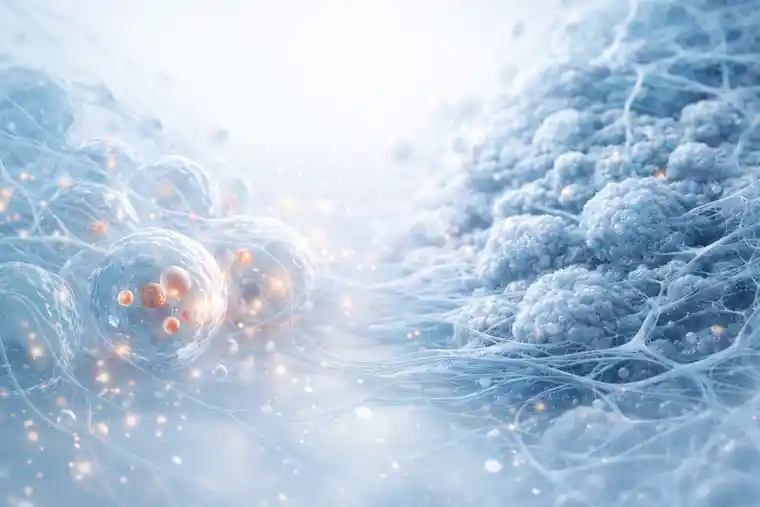
One of the most important transitions in kidney disease is the shift from inflammation to fibrosis.
Fibrosis is not simply “damage.”
It is the result of repeated signaling that tells the tissue to repair — but never fully stop repairing.
- Cells begin to deposit extracellular matrix.
- Normal architecture becomes distorted.
- Functional structures are gradually replaced with scar-like tissue.
This is where kidney disease becomes more difficult to influence.
Because fibrosis is not just active injury.
It is the record of past injury, written into the tissue itself.
And once that record is established, it tends to persist.
Why Inflammation Remains a Target
Despite this, inflammation still matters — even in later stages.
Because in many patients, the process has not stopped.
There is still:
- ongoing immune activation
- continued signaling imbalance
- low-grade but persistent tissue stress
That is why inflammation remains a central focus in kidney research.
Not because removing it will reverse everything.
But because reducing it may slow what continues.
Where Stem Cells Enter the Discussion
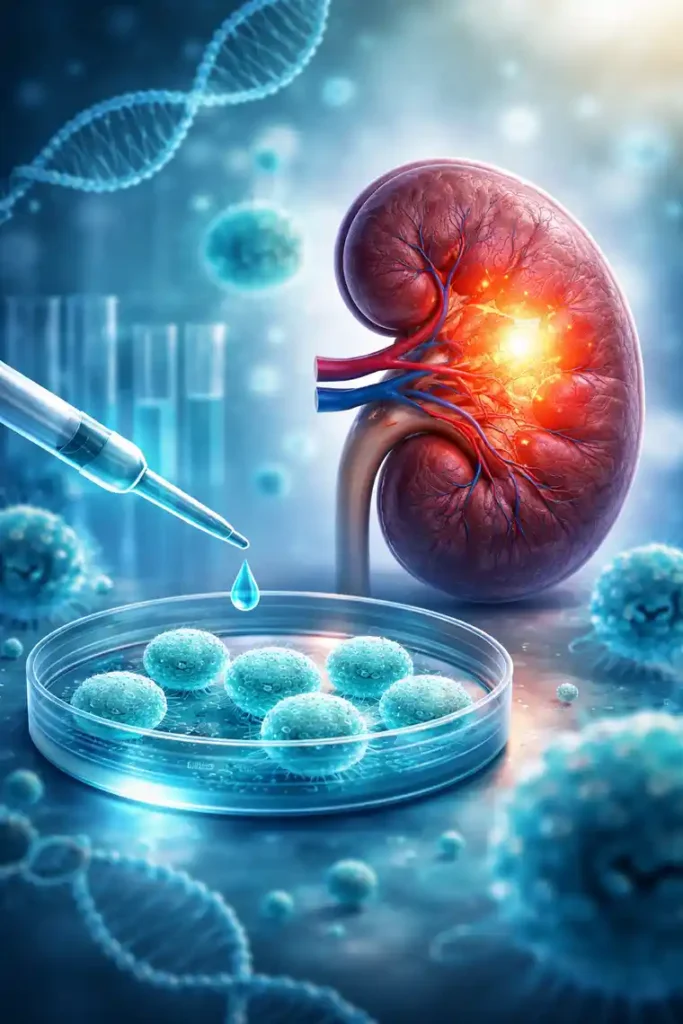
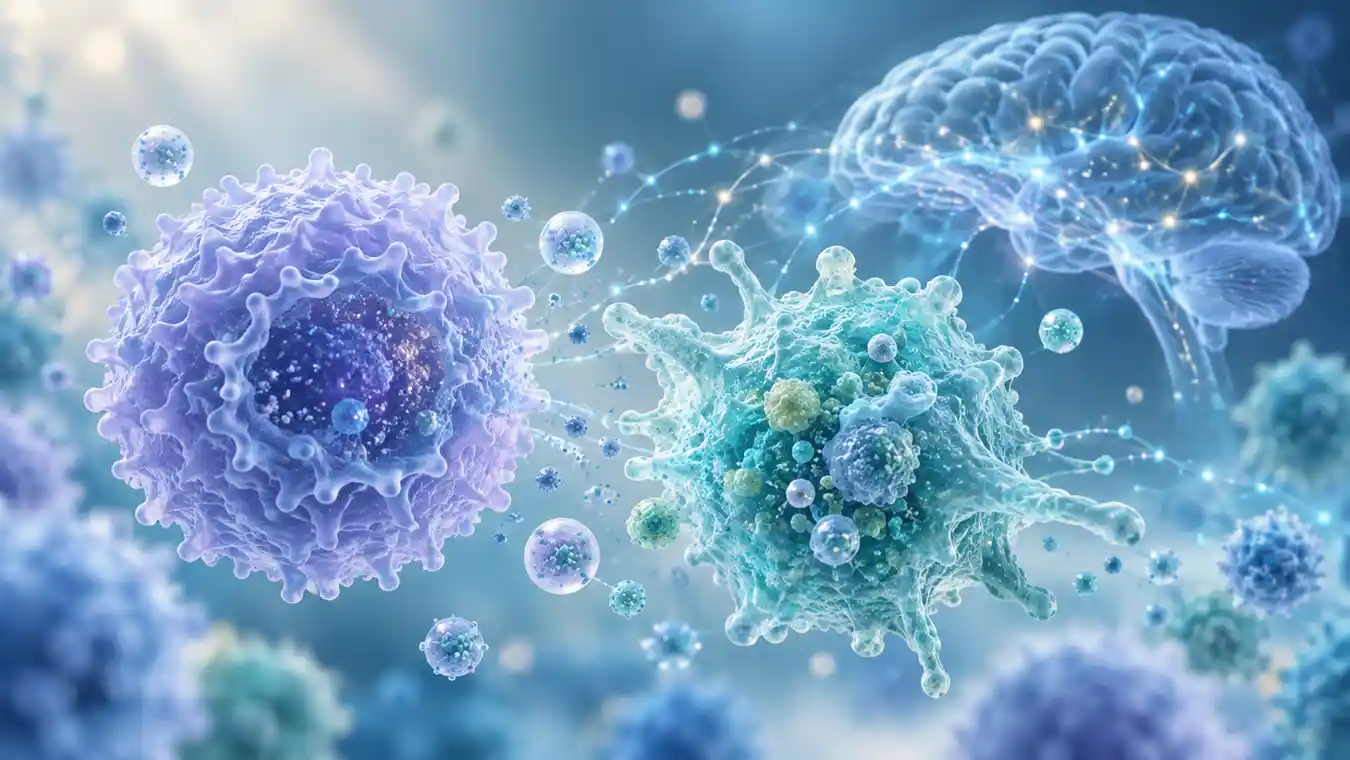
Mesenchymal stem cells (MSCs) are not being studied in kidney disease because they replace damaged kidney structures.
That is a common misunderstanding.
They are being studied because of how they interact with the inflammatory environment.
In experimental and early clinical settings, MSCs have shown the ability to:
- modulate immune cell activity
- reduce pro-inflammatory signaling
- influence cytokine balance
- support vascular stability
- release paracrine factors that affect surrounding cells
This does not rebuild the kidney.
But it may influence how aggressively the damage continues.
MSC Anti-Inflammatory Effects in the Kidney
The anti-inflammatory effect of MSCs is not a single mechanism.
It is a coordinated response.
MSCs do not “switch off” inflammation completely.
That would not be biologically safe.
Instead, they appear to shift the balance:
- from pro-inflammatory to regulatory signaling
- from persistent activation to controlled response
- from tissue stress toward relative stability
This shift is subtle.
But in chronic disease, subtle shifts over time can matter.
Exosomes and Cellular Communication
Exosomes are often discussed alongside stem cells, and for good reason.
They represent one of the ways stem cells communicate.
Exosomes carry:
- microRNAs
- proteins
- signaling molecules
These components influence how recipient cells behave.
In kidney disease, where miscommunication between cells contributes to inflammation, this becomes relevant.
The interest in exosomes is based on the idea that cellular signaling itself may be adjusted, without introducing living cells.
Again, this is not a repair mechanism in the traditional sense.
It is a modulation strategy.
Can Inflammation Be Reduced in Established Kidney Disease?
To some degree, yes.
But not completely, and not in isolation.
Inflammation in kidney disease is tied to:
- metabolic factors
- vascular changes
- underlying conditions such as diabetes or hypertension
That means any attempt to influence inflammation has to sit on top of:
- proper medical management
- blood pressure control
- metabolic stability
- consistent follow-up
Without that foundation, the inflammatory process continues to be driven from multiple directions.
What This Means Clinically
In practice, patients are not asking about cytokines or signaling pathways.
They are asking something simpler.
“Can this be slowed?”
That is the real question.
From a clinical standpoint, targeting inflammation is not about reversing the disease.
It is about:
- reducing ongoing tissue stress
- slowing progression
- preserving functional reserve
That is a more modest goal.
But in kidney disease, it is also the realistic one.
When This Discussion Becomes Limited
There are also situations where the role of anti-inflammatory or regenerative strategies becomes smaller.
If:
- fibrosis is already advanced
- functional reserve is minimal
- systemic disease remains uncontrolled
then the ability to influence the course is limited.
At that stage, the focus often shifts toward stability and support.
Recognizing that boundary is part of responsible medicine.
FAQs on Stem Cells and Inflammation in Kidney Disease
Can stem cells actually calm inflammation in the kidney?
Sometimes that is the idea behind using them. But it should not be misunderstood. We are not talking about “switching inflammation off.” What may happen, in some cases, is that the signaling becomes less aggressive. Clinically, that would mean the environment is slightly less stressful for the remaining tissue.
If inflammation is reduced, does the kidney recover?
Not in the way patients often hope. Once structural changes are there, they usually stay. What can sometimes change is the speed of progression. That is a different goal, but an important one.
Why is inflammation such a big topic in kidney disease?
In practice, it comes up because the process doesn’t really switch itself off. Patients often expect that once things are “stable,” the kidney is also quiet. But biologically, that’s not always the case. There can still be activity in the background, even when nothing obvious is happening. And over time, that ongoing pressure is part of what leads to further change.
Are exosomes basically the same as stem cells?
Not really. They are related, but they don’t behave the same way. Exosomes are more like messengers. Stem cells interact more broadly with the surrounding tissue. In conversations with patients, I usually explain them separately to avoid confusion.
At what point does this discussion stop making sense?
There is usually a point where the situation has already moved quite far. When most of the functional tissue is gone, the room for influence becomes smaller. In those cases, the focus changes naturally toward stability and support rather than intervention.
Conclusion
Inflammation in kidney disease is not a side effect.
It is part of the core process that drives progression.
Stem cell and exosome research does not offer a simple solution.
But it does offer a way to ask a more precise question:
Can the environment in which kidney damage continues be made less destructive?
In some cases, the answer may be partially yes.
Not as reversal.
Not as regeneration in the full sense.
But as measured biological influence on a process that would otherwise continue unchecked.