Regenerative Medicine

Written by Dr. Mehmet Kalcay (DentSpa)
Before placing a dental implant, your dentist needs to know what is happening under the gum, not just what can be seen in the mouth.
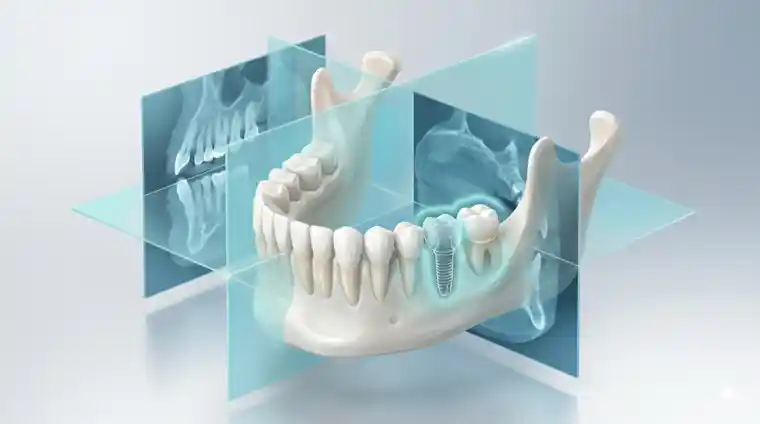
That is where a CBCT scan becomes useful. It shows the jawbone, nearby nerves, sinus area, tooth roots, and surrounding structures in 3D. With this view, the implant can be planned more carefully before the treatment begins.
In this article, we explain why CBCT imaging is often used before dental implants, what the scan shows, and how it helps make implant treatment safer and more predictable.
When it comes to dental implants, dentists don’t rely on guesswork. A lot of planning happens before the actual procedure begins.
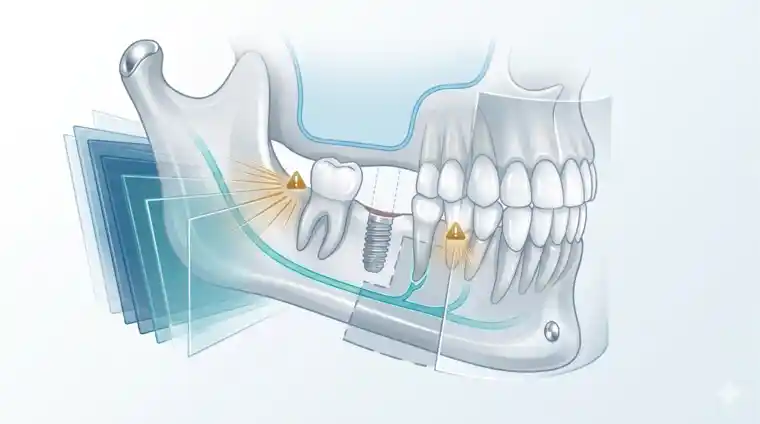
A dental implant needs enough healthy bone around it. Your dentist also has to know exactly where the nerves, sinus spaces, tooth roots, and other sensitive areas are before choosing the implant position.
A CBCT scan helps with this planning.
Instead of showing a flat image like a regular dental X-ray, CBCT gives a 3D view of the mouth and jaw. The dentist can look at the bone from different angles, measure it more accurately, and see details that may not be visible on a standard X-ray.
That makes the treatment plan more precise. It helps the dentist choose the right implant size, the right angle, and the safest place to put it. In implant dentistry, this kind of planning can make a real difference for both safety and long-term results.
CBCT (Cone Beam Computed Tomography) has totally altered the approach many dentists take when planning for their patients’ dental implant placements.
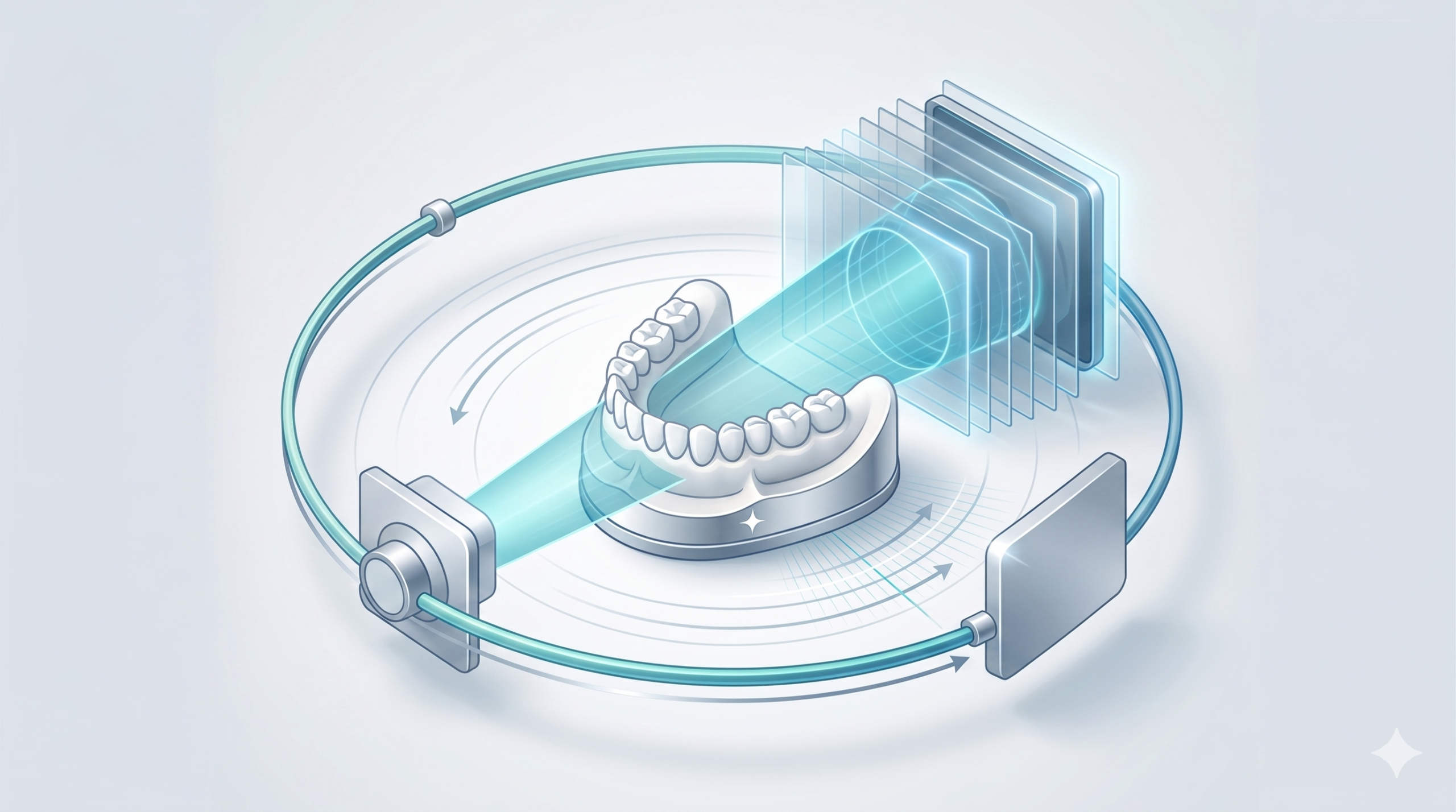
Traditional medical CT technology relies upon an X-ray beam that is very thin and fan-shaped, so as to create enough images of the inside of the patient’s mouth with a complete image being achieved after several rotations of the equipment.
In contrast, CBCT generates its entire 3-D image using a cone shaped beam and captures it within seconds (usually under a minute).
The benefits do not stop there. A significant reduction in radiologic exposure is realized (in some cases up to 95%), and the quality of the images produced are of the highest resolution and extremely clear 3D representations of the bone structure.
So, how does the CBCT scans work? It is simple: You will be seated or standing still while the machines’ arm rotates completely (or 360 degrees) around your head. While rotating, a cone-shaped beam will emit x-rays toward your head.
These x-rays then pass through the head and are detected by a sensor/detector on the opposite side. This process repeats numerous times at varying angles capturing multiple images from each position. Upon completion of the scanning process, the computer takes all the individual images captured and combines them into a single detailed 3-Dimensional model of the anatomical region of interest.
As standard practice, before any dental implant surgery takes place, 3D imaging is often an essential step in the planning process. Below are some of the key reasons why the procedure is non-negotiable.
Implant success often depends on how quickly and solidly it fuses with your bone. This is where 3D imaging, like CBCT scans, makes a big difference.
With these scans, your dentist gets an exact picture of your bone’s height, width, and density, which all matter if you want things to heal right.
From those results, they can tell if you would need bone graft, what type of implant is right for you and the perfect spot to place the implant to ensure long-term stability.
Cone Beam Computed Tomography (CBCT) scanners also come with specialized 3D software that allows dentists to plan the procedure before they even begin.
They do this by feeding the software with data from your CBCT scan and using it to simulate implant placement in a virtual environment. This way, they can test different positions and angles before the actual surgery commences.
The result? Greater accuracy during the procedure and, in many cases, reduced surgical time.
Your jaw and mouth are packed with several vital structures including nerve pathway and sinus cavities which need to be carefully avoided during implant procedures.
With 3D imaging tools like the CBCT scan, your dentist can visualise your entire oral structure and pinpoint where important nerves run through your jaw. Planning this way cuts down on the risk of running into complications during surgery.
3D imaging tools like the CBCT scanner have really transformed dental procedures for the better. Implant treatments that used to take time can now be done much faster, with a lot more precision and far less invasiveness.
With clear, detailed 3D images of a patient’s mouth, dentists can easily map out the whole procedure on a computer before ever picking up a tool. It saves time, reduces the guesswork, and helps patients heal faster.
After your dental implant placement, a CBCT scanner can also be used as a diagnostic tool to detect complications that your typical 2D X-ray scanner may have missed.
For example, the tool can be used to check for the presence of thin radiolucent lines that can affect the healing process, detect early signs of bone loss, and even pick up inflammation or bacterial infections before they become serious problems.
So if your dentist does not scan your mouth prior to your implant surgery, how would that affect you? We will extensively cover that in this section
If your dentist does not have access to a CBCT, he or she essentially works blind and this is dangerous for many reasons. For example, if you drill the wrong spot, damage may occur to nerve tissue and/or the sinuses. Your dentist will also not be able to tell if your bone density is sufficient to support the implant.
The gumline and areas behind your teeth are prime habitat for bacteria and all infection causing pathogens. The problem is, without proper scan, none of them will be discovered. And when an implant is placed without flushing them out first, they will continues to multiplies quietly in the background. Over time, they will start eating deep into the jaw, disrupt healing, weaken the surrounding bone, and eventually cause the implant to fall off
If your dentist skips a 3D scan and at the end of the procedure, complications show up, you could end up spending double of your initial budget.
Here is why: the implant would need to be removed, the underlying infection or issue treated properly, and then a new implant placed. That is and not only expensive, it is also time-consuming and puts you through a much longer recovery process than necessary.
Without 3D imaging, serious issues like root resorption, root fractures and other underlying structural damage can easily be missed or misdiagonised.
The problem with this is that when your dentist doesn’t have the full picture, they may set up treatment plans that don’t truly match what is going on beneath the surface. It is a very risky approach that can lead to unpredictable results or complications down the road.

These differ by quality of imaging produced and intended use. Standard 2D dental xrays provide flat, two dimensional views; CBCT scans provide very good resolution, three dimensional views.
2D Standard Dental Xrays are generally used for routine dental exams; CBCT scans are for a more thorough examination of teeth, jaws and surrounding tissue. Simply stated, a 2D standard xray provides an overview (snapshot), whereas a CBCT scan provides a more detailed representation of the anatomy of the oral cavity
Yes. Although 3D imaging scanners have a higher dose than 2D X-ray, the dose remains safe. In layman’s terms, the amount of radiation is very low and is not dangerous either immediately or on a long term basis.
Additionally, dental clinics have been mandated to follow the ALARA principle (As Low As Reasonably Achievable) which posits that radiation dose be kept to the minimal amount
Definitely! The CBCT machine functions like a planning tool before real surgery even commences. It allows the dentist/surgeon to plan virtually in advance, know where to drill and place the implant and also detect underlying issues. In short, this tool makes surgical procedures faster and more efficient.
Yes. Once your dentist takes the 3D images of your oral structures, you will be entitled to ask for a copy for your own use. As a patient, you have a legal right to view all of your personal medical information, including diagnostic imaging such as 3D CBCT scans. If you want to see a copy of your CBCT scan, you simply need to formally request it from the clinic, at which point they are obligated by law to give it to you.
Ultimately, it comes down to the clinic’s approach. Some clinics treat CBCT scan as a separate diagnostic service, while others consider it part of the overall treatment plan rather, not an afterthought. So, before you schedule an appointment with a clinic, ensure that you check their policy on this.
The importance of advanced imaging technology like the CBCT scans in the evaluation process before the real surgery commences can not be overemphasised. This technology lets dentists plan exactly where to place implants, so the whole thing goes smoother. It also means fewer surprises, both during and after the procedure, which is what every patient wants.
That said, if you have lost a tooth and now require dental implant, choosing the right clinic is just as important as the procedure itself, and this is where DentSpa comes in. Whether you live in Turkey or you’re considering a trip, they handle everything, from high-tech scans to placing the implant and making sure you’re taken care of afterward.
DentSpa’s been at this since 2018, and they haven’t lost sight of putting patients first. In 2024, they even picked up the award for Best Clinic in Dentistry in Europe. That pretty much speaks for itself.