Clinical insights by Op. Dr. Melihcan Sezgiç
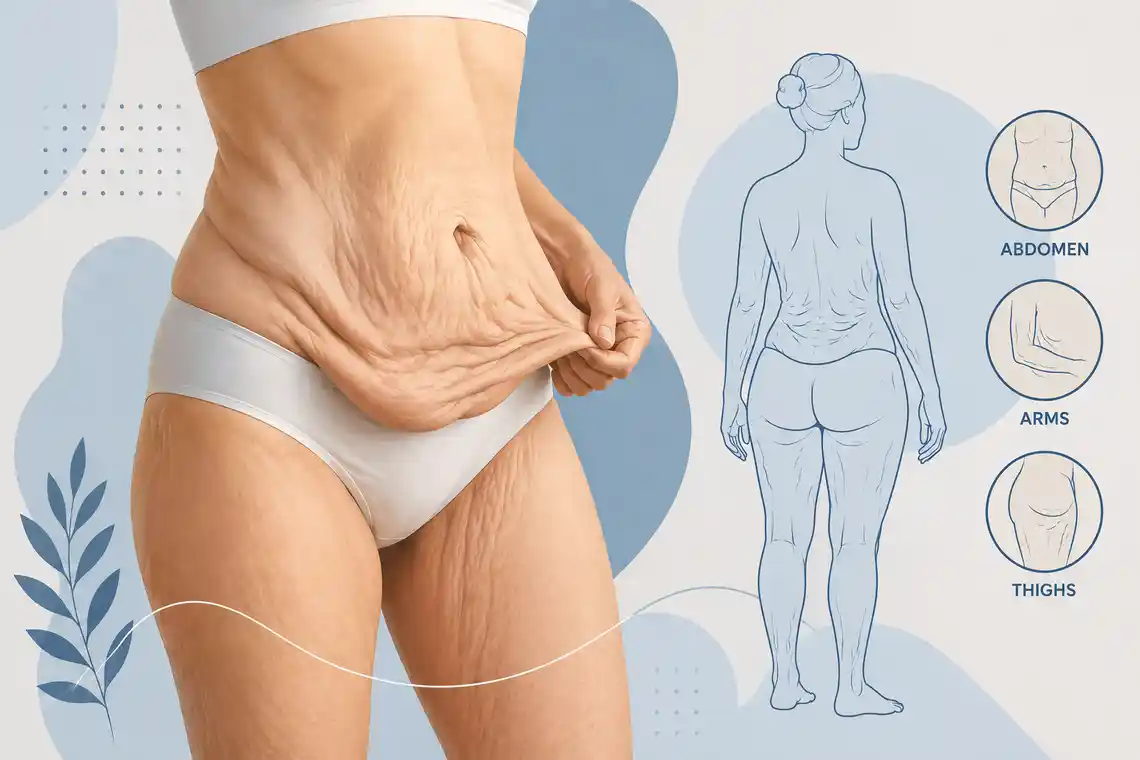
Loose Skin After Weight Loss Can Affect More Than One Area
Reaching a major weight-loss goal should feel like the end of a long process.
For many patients, it does not.
They are healthier and more active, yet the body they see in the mirror may still carry folds of loose skin around the abdomen, chest, arms or thighs. Clothing fits differently, but not always comfortably. Exercise becomes easier, while running, bending or walking can still be affected by skin movement and irritation.
Some patients have lost weight after a gastric sleeve or gastric bypass. Others have done it through diet, exercise or weight-loss medication.
From a surgical point of view, the important question is not only how the weight was lost.
I want to know what has been left behind.
- Does the abdominal skin hang only at the front?
- Does the looseness continue around the waist and back?
- Have the breasts become empty and low?
- Is there excess skin along the arms, chest wall or thighs?
- Are there rashes, difficulty with hygiene or discomfort during movement?
- Which area bothers the patient most?
Loose skin after weight loss is rarely one isolated problem. But that does not mean every problem should be corrected during one operation. The same principles that guide combined cosmetic surgery apply when planning body contouring after major weight loss.
Table of Contents
Will Loose Skin Tighten on Its Own?
A degree of natural tightening can occur after weight loss, particularly in younger patients and when the skin has not been stretched for many years.
The amount varies considerably.
Age, genetics, sun exposure, smoking, the amount of weight lost and the condition of the skin all influence how much retraction is possible. Building muscle can improve body shape beneath the skin. Good nutrition and skin care may also improve texture.
They cannot remove a large hanging fold.
Once the skin has lost much of its elasticity, exercise does not make the excess tissue disappear. Creams and non-surgical skin-tightening treatments may have a role in mild laxity, but their effect is limited when there is a true skin apron or a long fold along the arms or thighs. Surgical excision remains the more predictable option for substantial excess skin.
This distinction should be made early. Otherwise, patients can spend months trying to treat a skin problem as though it were still a fat problem.
What Body Contouring Can Actually Correct
Body contouring is not another form of weight-loss surgery.
The weight should already have been lost. The purpose of surgery is to remove loose tissue, reshape specific areas and improve how the remaining skin sits on the body.
Depending on the pattern of skin excess, the plan may include:
- a tummy tuck
- removal of a hanging abdominal apron
- a lower body lift
- an arm lift
- a thigh lift
- a breast lift
- breast reduction or augmentation
- an upper body or back lift
- chest contouring in men
- limited liposuction where localised fat remains
These procedures do very different jobs.
A tummy tuck treats the front of the abdomen. A lower body lift continues around the waist and treats the trunk more circumferentially. An arm lift removes skin along the upper arm, while a thigh lift deals with tissue that has dropped along the inner or upper thigh.
The name of the operation matters less than whether it matches the actual pattern of looseness.
Why Skin Removal Is Often Better in Stages
Patients sometimes arrive with a clear request:
“I have already been through the weight loss. I want all the loose skin removed at once.”
I understand the reasoning. One operation appears easier to organise than three. There is one period away from work, one journey and one recovery.
But skin removal after major weight loss can involve very long incisions and several large healing surfaces.
The body does not experience this as a collection of small cosmetic corrections. It experiences one major operation.
As more areas are added, several things change:
- the operation becomes longer
- more tissue is removed
- swelling affects a larger part of the body
- getting out of bed and walking may become harder
- there are more wounds to protect
- sleeping positions become more restricted
- the patient may need more help with washing, dressing and daily movement
Recovery instructions can also conflict.
An abdominal operation requires regular walking, but the patient may initially walk in a slightly bent position because the front feels tight. A thigh lift can make each step pull around the groin or inner thigh. An arm lift limits pushing and pulling with the arms, which are often needed to get out of bed after abdominal surgery.
Technically possible does not automatically mean sensible.
Tummy Tuck or Lower Body Lift: The First Major Decision
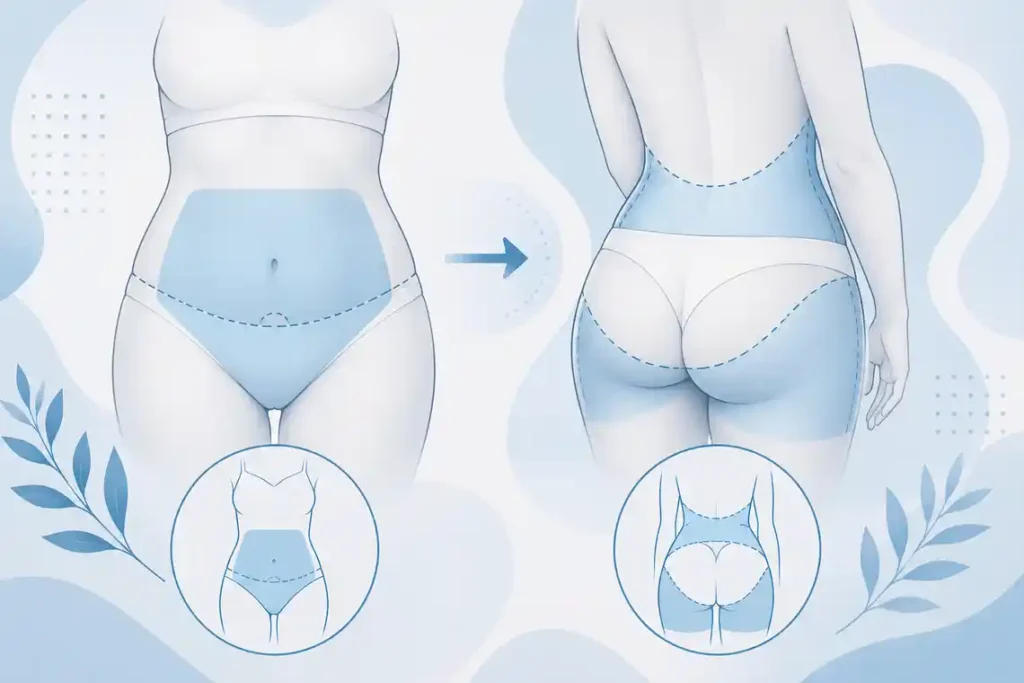
The abdomen is often the first area patients want to correct.
But not every post-weight-loss abdomen needs the same operation.
A tummy tuck may be suitable when most of the loose skin is concentrated at the front. It removes excess abdominal skin and may include repair of the abdominal wall when weakness or muscle separation is present.
A lower body lift is considered when the skin excess continues around the sides and back. The incision usually extends around the trunk, allowing the abdomen, waist, lower back and upper buttock area to be addressed in one circumferential plan. A lower body lift may also improve some looseness along the outer thighs, although it does not replace an inner thigh lift.
I decide between them by looking beyond the front view.
If a tummy tuck is performed on a patient with substantial side and back laxity, the abdomen may improve while heavy folds remain around the waist. On the other hand, a full lower body lift may be more surgery than necessary when the looseness is mainly below the navel.
The operation should not be made larger simply because the patient has lost a large amount of weight.
It should be made large enough to treat the actual problem.
Why a Lower Body Lift Changes the Rest of the Plan
A lower body lift is not simply a longer tummy tuck.
The patient has an incision around much of the trunk. Turning in bed is more difficult. Sitting, standing and lying down all place pressure on different parts of the wound.
It also changes the body contour more widely.
Once the abdomen, waist and upper buttock area have healed, the relationship between the upper body and thighs may look different. A breast or thigh procedure planned from the preoperative body can sometimes be adjusted after the new trunk shape becomes clear.
For this reason, I often prefer to let a major lower body lift stand as the main operation rather than attach several other large lifts to it.
Limited additional work may be reasonable in a carefully selected patient. A large breast lift, full arm lift and extensive thigh surgery added to a circumferential body lift is a very different situation.
The number of areas is not the only issue. The length and demands of each procedure matter.
Why Thigh Lift Surgery Often Deserves Its Own Stage
The thighs can be one of the most difficult areas after major weight loss.
Loose skin may collect at the inner thighs, extend towards the knees or rub during walking. Some patients also experience rashes and difficulty finding clothes that fit comfortably.
A thigh lift can help, but its recovery needs respect.
The inner thigh is constantly affected by movement. Walking separates and closes the legs. Sitting changes the pull around the groin. Swelling can travel downwards, and the operated area is close to lymphatic structures that need careful handling.
This is why I am cautious about combining an extensive thigh lift with a large tummy tuck or lower body lift.
After abdominal surgery, early movement is important. After thigh surgery, every step can place tension on healing tissue. When both areas are tight, the patient may struggle to find a comfortable way to stand and walk.
A limited upper-thigh correction may sometimes be included in a broader plan. A long inner thigh lift extending towards the knee is more likely to need its own stage.
This is not because the thigh lift is less important.
It is because it deserves a recovery in which the patient can protect it properly.
Where a Breast Lift Fits After Major Weight Loss
Major weight loss can leave the breasts with very little upper fullness and a large amount of loose skin.
Some patients still have enough breast tissue and mainly need a breast lift. Others have lost so much volume that an implant or fat transfer may be discussed. If the breasts remain heavy, a reduction may be the better choice.
The same issue occurs in men, although the procedure is different. The chest may become flat but still have hanging skin, displaced nipples and loose tissue extending towards the sides or back.
A breast lift can sometimes be combined with another moderate procedure.
However, post-weight-loss breast surgery is not always a small lift. The skin may be thin, the nipple may need significant repositioning, and loose tissue may continue towards the lateral chest wall.
When breast correction extends into an upper body or back lift, the surgical plan becomes much larger.
In that situation, I look carefully at what has already been planned elsewhere on the body.
Can an Arm Lift and Breast Lift Be Done Together?
Sometimes.
An arm lift and breast lift both treat the upper body, which can make the combination appear logical. In selected patients, it is.
But the recovery can be more demanding than expected.
After an arm lift, patients need to avoid pulling, pushing and lifting. After breast surgery, the chest can feel tight and the arms should also be used carefully. When both procedures are extensive, even simple activities such as getting out of bed, washing the hair or putting on a garment may require help.
The incision pattern also matters.
Loose arm skin often continues through the armpit and along the side of the chest. If the breast lift also includes removal of lateral chest skin, the two surgical areas begin to meet.
That can still be planned, but it is no longer a straightforward breast-and-arm combination.
Which Body Contouring Procedures Can Sometimes Be Combined?
There is no universal list.
The same combination may be reasonable for one patient and excessive for another.
Combinations I may consider in selected patients include:
- tummy tuck with limited liposuction
- tummy tuck with a moderate breast procedure
- breast lift with arm lift
- breast correction with limited upper-body skin removal
- lower body lift with a small additional correction
The word limited is important.
A small amount of liposuction around the waist is not the same as extensive liposuction across the abdomen, back, arms and thighs. A straightforward breast lift is not the same as a complex breast reconstruction with a long lateral extension.
I also consider whether the procedures create compatible recoveries.
Two operations that can be performed safely during the same anaesthetic may still be a poor combination if the patient cannot move, sleep or care for the wounds afterwards.
Which Operations Are More Often Separated?
I am more likely to recommend staging when the plan includes:
- a circumferential lower body lift and extensive thigh lift
- a large lower body lift with several major upper-body procedures
- long arm lifts together with complex breast and back surgery
- extensive surgery on both the upper and lower body
- wide skin removal combined with large-volume liposuction
- several procedures requiring different recovery positions
- a patient with nutritional, mobility or wound-healing concerns
The decision is not made by counting procedures alone.
Three limited corrections may be less demanding than two very large lifts.
How I Decide Which Operation Comes First
The first stage should usually make the greatest practical difference.
For some patients, that is the abdomen. A heavy skin apron may cause rashes, make exercise uncomfortable or interfere with hygiene.
For others, the circumferential trunk is the main problem. Their loose skin continues around the waist, back and buttocks, making a lower body lift more logical than a tummy tuck alone.
A patient may instead be most affected by the breasts, arms or chest. There is no medical rule that the abdomen must always come first.
I consider:
- the area causing the most physical difficulty
- the area that will change the overall silhouette most
- the size of the planned operation
- the patient’s general health
- previous scars
- mobility
- nutritional status
- support at home
- which later operations may be easier to plan after the first result has settled
The thighs are often treated later because the trunk should first be stable and the patient needs good mobility during thigh recovery.
But “often” is not “always.”
When Is the Body Ready for Skin Removal?
Being at the lowest possible weight is not the only requirement.
I want the weight to have stopped changing.
If a patient is still losing several kilograms each month, the skin and body proportions are still changing. Operating during that period makes the result less predictable and may leave new laxity afterwards.
This is particularly relevant after bariatric surgery or treatment with weight-loss medication. Reduced food intake and rapid weight change can also affect protein intake, iron levels and vitamin status. Bariatric procedures may create long-term risks of iron, vitamin B12, folate and other nutritional deficiencies, depending on the operation.
Before a large body contouring procedure, I want to know:
- Has the weight remained reasonably stable?
- Is the patient eating enough protein?
- Is there anaemia or iron deficiency?
- Are vitamin deficiencies being treated?
- Is diabetes controlled?
- Is the patient smoking or using nicotine?
- Has there been a previous thrombosis?
- Can the patient walk normally?
- Is there enough help available after discharge?
A patient can look ready for surgery but still be nutritionally unprepared for several metres of incisions.
That is why blood tests and medical history matter.
Smoking, BMI and Wound Healing
Skin-removal procedures depend on a reliable blood supply along long wound edges.
Nicotine works against that.
Smoking, vaping and nicotine products can increase concern about delayed healing, wound opening and skin damage. For extensive body contouring, stopping nicotine is not a small preoperative suggestion. It is part of deciding whether the operation should proceed at all.
BMI also needs individual assessment.
A patient does not have to match one perfect number, but a higher BMI can make surgery and recovery more demanding. There may be more remaining fat beneath the skin, greater tension on closures and a higher risk of medical complications.
I do not look at BMI alone. Fat distribution, fitness, blood tests and medical conditions can change the picture considerably.
Skin Removal Is Not the Same as Liposuction
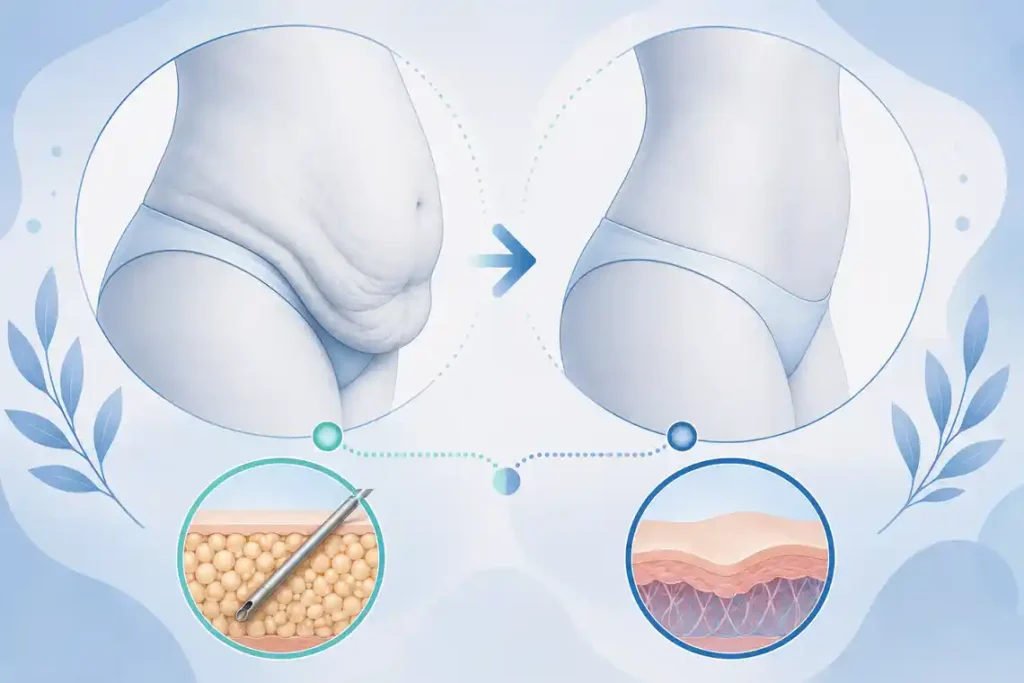
After weight loss, some patients still ask whether liposuction can remove the remaining folds.
It cannot.
Liposuction removes fat from beneath the skin. It does not cut away stretched skin.
When the skin still has good elasticity and the concern is a small fat deposit, liposuction may improve contour. When the skin already hangs, removing more volume from underneath can make the looseness more obvious.
Limited liposuction can be useful around a tummy tuck, breast procedure or body lift to soften transition areas. It should support the main operation, not replace the skin removal that is actually needed.
Liposuction is a contouring procedure, not a treatment for obesity or a substitute for excision of substantial loose skin.
Scars Are Part of Body Contouring
Every skin-removal operation exchanges loose tissue for a scar.
The more skin that needs to be removed, the longer the scar usually becomes.
A tummy tuck leaves a lower abdominal scar. A lower body lift continues around the waist. An arm lift scar may run from the armpit towards the elbow. A long thigh lift may extend down the inner leg.
The aim is to place these scars where they can be hidden as well as possible.
But they cannot be made invisible.
Scar quality also varies. Genetics, skin type, tension, smoking, nutrition, wound healing and aftercare all play a part.
Patients who have lived with heavy skin folds for years may consider this a worthwhile trade. That decision still needs to be made before surgery, not after the incision has healed.
What Staging Changes
Staging means accepting more than one operation and more than one recovery.
That is the disadvantage.
The advantage is that each procedure can be planned around the body that exists at that stage.
After a lower body lift, I can see the new waist, buttock and outer-thigh position. After abdominal surgery, a later breast procedure can be balanced against the new trunk. Once the upper body has healed, arm or back corrections can be refined more accurately.
Staging can also make daily recovery more manageable. The patient has fewer wounds to care for and more unaffected parts of the body available for movement.
It does not mean that every operation should be performed separately.
It means we should stop treating “one recovery” as automatically better than two.
What Body Contouring Cannot Promise
Body contouring can remove a substantial amount of excess skin and improve shape.
It cannot make every area perfectly smooth.
It cannot prevent future ageing, weight fluctuation or pregnancy from changing the result. It cannot guarantee thin scars. It cannot always correct every fold without leaving a scar that the patient may consider worse than the original problem.
It also cannot recreate the body exactly as it would have looked if the weight gain had never happened.
That is not the standard I use.
The aim is to improve proportion, comfort and movement while choosing a surgical plan the patient can recover from safely.
Frequently Asked Questions About Loose Skin After Weight Loss
Does loose skin ever go away after weight loss?
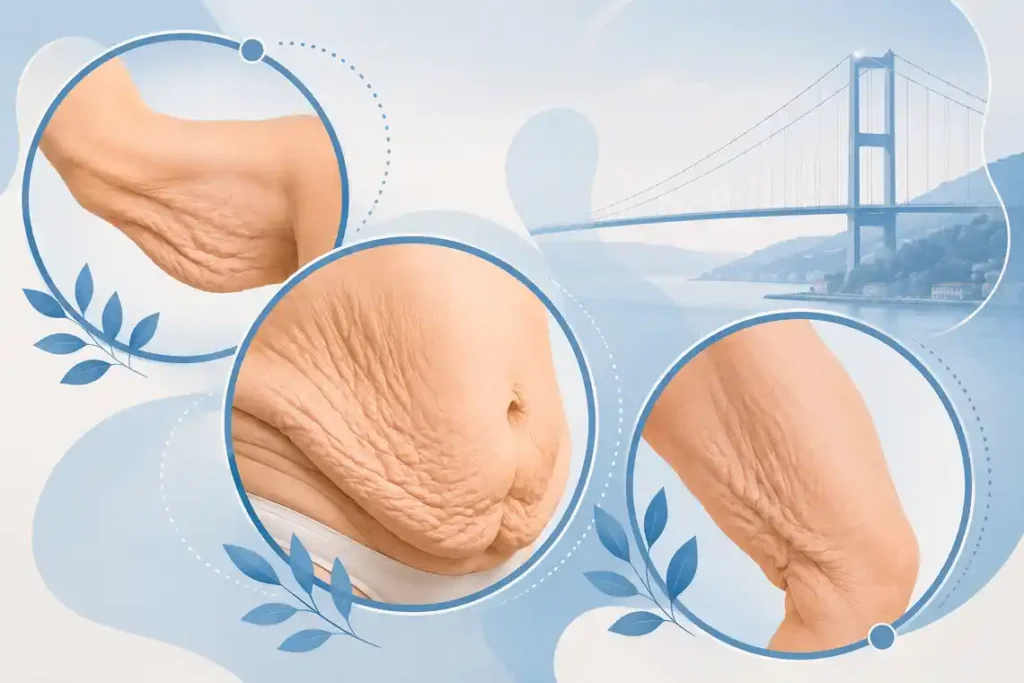
Some of it may improve, especially during the first months after the weight has stopped changing. Once the skin hangs in a clear fold around the abdomen, upper arms or thighs, however, it rarely disappears completely.
Is it possible to tighten loose skin without surgery?
It depends on the amount of looseness.
Exercise can change the shape beneath the skin, and mild laxity may improve slightly with non-surgical treatments. A hanging apron or a fold that rubs during walking will not be removed that way.
When can skin removal surgery be planned after weight loss?
I do not use one fixed waiting period.
What I want to see is that the fast weight-loss phase has ended and the weight has settled. After bariatric surgery, I also check blood results and nutritional status before discussing an operation. A patient may feel ready while the body is still short of iron or protein.
Can all loose skin be removed during one operation?
Sometimes patients come to the consultation hoping to correct the abdomen, breasts, arms and thighs in one day.
That is usually too much.
A few procedures may fit together. A full lower body lift, large thigh lift and extensive upper-body surgery are more often separated. Recovery matters just as much as operating time.
How does a body lift differ from a tummy tuck?
A tummy tuck is designed mainly for excess skin at the front of the abdomen.
A lower body lift goes further. It continues around the waist and may also improve the flanks, lower back and upper buttock area.
The difference is often only clear after looking at the waist, flanks and back as well as the abdomen.
Is a tummy tuck possible after bariatric surgery?
Yes, but reaching the target weight by itself is not enough.
The weight should be stable. Iron, vitamin and protein levels should be checked and corrected first. Deficiencies can occur after bariatric procedures and may slow wound healing.
How noticeable are the scars after skin removal surgery?
They can be long.
A large amount of skin cannot be removed through a tiny incision. The scar is placed as carefully as possible and usually hidden under clothing, but it remains part of the operation.
For many patients, the question is not whether there will be a scar. It is whether the improvement in comfort and body shape is worth it.
Is skin removal surgery painful?
The first days are usually more about tightness, swelling and restricted movement than constant severe pain.
A tummy tuck or lower body lift can make standing, turning in bed and getting up difficult at first. Smaller procedures may be easier, but combining several areas changes the recovery considerably.