
Clinical insights by Op. Dr. Melihcan Sezgiç
When Combined Cosmetic Surgeries Make Sense
Many patients come to the consultation with a list. Breasts, abdomen, legs, eyelids. And then comes the question: “Can we do all of this at once?”
I understand why they ask. One anaesthetic sounds better than two. One recovery period seems easier. Travel, time away from work and family support also have to be organised. Still, the shortest plan on paper is not always the easiest one for the body.
Some operations fit together quite naturally. Others do not. With combined cosmetic surgeries, the recovery plan matters just as much as the operation itself. The decision is rarely about whether two procedures are technically possible. Most of the time, they are.
The more useful question is whether the patient will still be able to recover well afterwards.
- Can she get out of bed?
- Can she walk?
- Can she sleep in a reasonable position?
- Can the wounds be cared for without putting pressure on another freshly operated area?
That is where combined surgery either works or starts to become too much.
Table of Contents
Cosmetic Surgery Combinations I Commonly Perform

Breast surgery and limited liposuction are often a workable combination. The breast procedure may be an augmentation, lift, reduction or implant replacement. A smaller amount of liposuction around the waist, abdomen or hips can usually be added without making the recovery much more complicated.
But the extent matters. A little contouring around the waist is not the same as 360-degree liposuction involving the abdomen, flanks, back and hips. Patients sometimes use the word “liposuction” as if it always described a small procedure. It does not. The larger the treated area, the more swelling, fluid change and physical strain we have to expect.
Breast surgery can also be combined with upper or lower eyelid surgery. I often find this easier than combining two major body operations. Eyelid surgery does not usually stop the patient from standing or walking after the breast procedure. Upper and lower eyelid surgery can, of course, also be performed together.
The same logic applies to facial surgery. A facelift, neck lift and eyelid surgery are frequently planned during the same operation because the areas belong together. Improving the jawline while leaving significant looseness around the neck may not give the balanced result the patient expects.
Rhinoplasty can sometimes be combined with chin correction. This is especially useful when the nose and chin both affect the side profile.
An upper arm lift and liposuction of the upper arms are another common pairing. Liposuction reduces volume. The lift removes the skin that remains loose afterwards. These procedures are performed in the same area and usually support the same goal.
A tummy tuck with limited liposuction around the waist or flanks may also work well. The tummy tuck treats loose skin and, where needed, separated abdominal muscles. Liposuction can refine the outline around the sides. What I do not want is for a limited addition to grow into extensive liposuction of several body areas while the patient is already having major abdominal surgery. That changes the whole operation.
When Multiple Cosmetic Procedures Need More Careful Planning
Combined cosmetic surgeries need more careful planning when both procedures are already extensive.
A tummy tuck – medically known as abdominoplasty – and breast surgery may be performed together. This is often described as a mommy makeover, although that name can mean almost anything. For one patient, it may mean breast implants and a moderate tummy tuck. For another, it may involve a large breast reduction, extensive abdominal muscle repair and liposuction around the body. Those are not comparable operations. The first combination may be reasonable in a healthy patient. The second may be better divided.
A tummy tuck with a smaller area of liposuction outside the abdomen may also be considered, but again, the amount matters.
The same is true for a tummy tuck and upper arm lift. This may sound like an easier combination because the arms and abdomen are far apart. Recovery tells a different story. After a tummy tuck, patients use their arms to push themselves out of bed, stand up and steady themselves while walking. When both upper arms are sore and tight, those movements become much harder.
A body lift and breast surgery also need careful thought. A body lift is already extensive. Depending on the surgical plan, it may involve the abdomen, waist, lower back and buttock area. Adding a large breast operation means more wounds, more operating time and fewer comfortable positions during recovery. Sometimes it is still possible. Sometimes there is no good reason to force both procedures into the same day.
Why Tummy Tuck and Thigh Surgery Are Often Separated
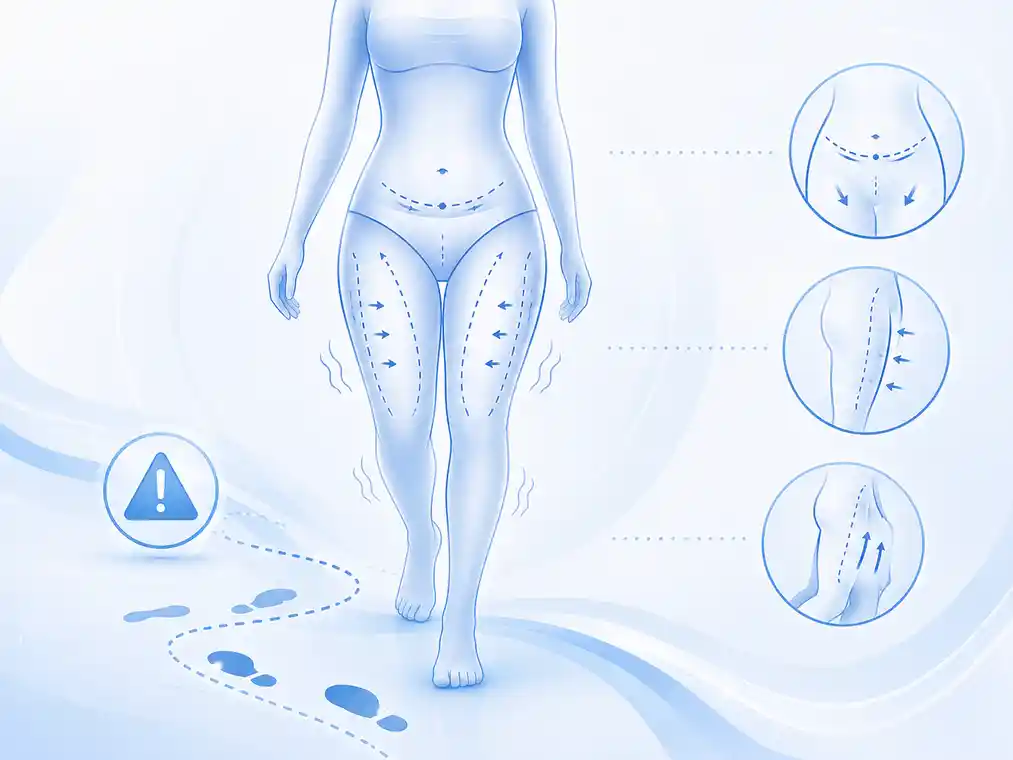
This combination causes a very practical problem. After a tummy tuck, the patient needs to start moving. Not long walks. Not exercise. Just getting up and walking a few careful steps several times a day. This helps the circulation and reduces the problems that can come from lying still for too long. It is also important for thrombosis prevention.
The first days are not easy. The abdomen feels tight, and patients usually walk slightly bent forward. Now imagine that both thighs have also been extensively treated. They may have undergone liposuction, a thigh lift or both. The legs are swollen. The skin feels tight. There may be incisions close to the groin. Sitting down, standing up and taking a step can hurt.
The patient should be walking after the tummy tuck but does not want to walk because of the thighs. That is the main issue. It is not simply that both operations are “too big”. Their recoveries work against each other. This is why combined cosmetic surgeries should be judged by the recovery they create, not only by what is technically possible.
For that reason, I often prefer to perform the tummy tuck first and allow the patient to recover properly. The thigh procedure can follow later, once walking is normal again. The same concern applies whether we are talking about extensive thigh liposuction, a thigh lift or a combination of both.
When One Operation Becomes Too Large
A major breast operation, tummy tuck and 360-degree liposuction are usually too much to view as one simple package. Nearly the entire torso is involved. The patient may have swelling around the breasts, abdomen, waist and back. There may be drains, compression garments and several wounds that all need attention.
- Sleeping becomes difficult.
- Getting dressed becomes difficult.
- Even going to the bathroom may require help.
Large-volume liposuction with several additional procedures creates a similar problem. The body does not see each operation as a separate item on a price list. It has to deal with all of the tissue trauma at the same time.
Several large skin lifts after major weight loss are also commonly divided into stages. A patient may need correction of the abdomen, breasts, arms, thighs and back. Trying to do all of this at once would leave very little unaffected tissue to support movement.
These patients also need nutritional checks. After major weight loss, especially following bariatric surgery, low iron, anaemia, protein deficiency and vitamin deficiencies are not uncommon. Healing may be slower when these problems are not corrected first.
BBL combined with a tummy tuck and further major procedures also deserves caution. After a BBL, pressure on the buttocks has to be limited. After a tummy tuck, lying comfortably on the abdomen is not an option either. The patient may end up with no good position for sitting, resting or sleeping. Adding more surgery does not improve that situation.
Who Is Not a Good Candidate for Combined Cosmetic Surgeries?
Smoking is a major concern. Nicotine reduces blood flow to the skin. This can lead to delayed healing, wound opening and, in more serious cases, loss of skin around the incision.
A high BMI may also increase the risks of wound problems, fluid collections, thrombosis and difficult mobilisation.
Previous thrombosis or pulmonary embolism must always be taken seriously. So must known clotting disorders.
Patients who already have trouble walking may not do well with surgery involving the abdomen and legs at the same time.
I am also more cautious when there is:
- poorly controlled diabetes
- heart or lung disease
- anaemia
- a history of poor wound healing
- long-term corticosteroid use
- very large planned liposuction volumes
- nutritional deficiency after major weight loss
This does not automatically mean that surgery is impossible. Sometimes a medical problem needs to be treated first. Sometimes we shorten the operation. Sometimes two separate operations are simply the more sensible choice.
Why Two Operations May Be the Easier Route
With combined cosmetic surgeries, separating the procedures can sometimes make the entire process easier for the patient.
Patients are not always pleased when I suggest staging their surgery. They came hoping to finish everything at once. But two shorter recoveries may be easier than one very difficult recovery. There are fewer wounds to manage. Movement is easier. The patient can focus on healing one area properly.
There is another advantage. After the first operation has healed, the second plan can be adjusted. The body shape may have changed, and the next procedure can be planned more accurately.
My aim is not to fit the highest number of procedures into one operation. It is to choose a plan that gives the patient a good result without making the recovery unnecessarily hard.
Frequently Asked Questions About Combined Cosmetic Surgeries

Can breast surgery and liposuction be performed during the same operation?
For many healthy patients, this is possible when the liposuction remains limited. Treating a small area around the waist or abdomen is very different from adding full 360-degree liposuction to an already extensive breast procedure.
Is it reasonable to combine breast surgery with eyelid surgery?
Often it is. Eyelid surgery does not usually restrict walking or basic movement, so the two recovery processes rarely work against each other. I would still consider the length and complexity of the breast operation before confirming the plan.
What about having breast surgery and a tummy tuck together?
That depends on what is actually being planned. Breast implants with a moderate tummy tuck may be manageable for a healthy patient. A major breast reduction, extensive abdominal repair and additional liposuction would place far more strain on the body.
Why do you often separate thigh surgery from a tummy tuck?
The first days after a tummy tuck are not meant to be spent completely still. Patients need to get up and take short walks. When both thighs are swollen, painful or tight after liposuction or lifting, even those few steps can become difficult. That is why I often prefer two separate operations.
Does every tummy tuck include liposuction?
No. A tummy tuck is mainly used to remove loose skin and, when necessary, tighten the abdominal wall. I only add liposuction if there is a fat deposit around the waist or flanks that would otherwise remain. For some patients it improves the contour. For others, there is simply no reason to include it.
Can a facelift, neck lift and eyelid surgery be carried out together?
Quite often, yes. The face, jawline, neck and eye area are closely connected, and their recovery periods generally fit well together. However, I only include the areas that genuinely need treatment.
Is one long operation easier than returning for a second procedure?
Not always. A very long operation may leave the patient with several painful areas, extensive swelling and limited mobility. Two shorter procedures can sometimes be much easier to recover from.
Is there a maximum number of cosmetic procedures that can be combined?
There is no useful fixed number. Three small procedures may be reasonable, while two major operations may already be too much. I look at the expected operating time, the size of the surgical areas, blood loss, liposuction volume and how well the patient will be able to move afterwards.