Regenerative Medicine

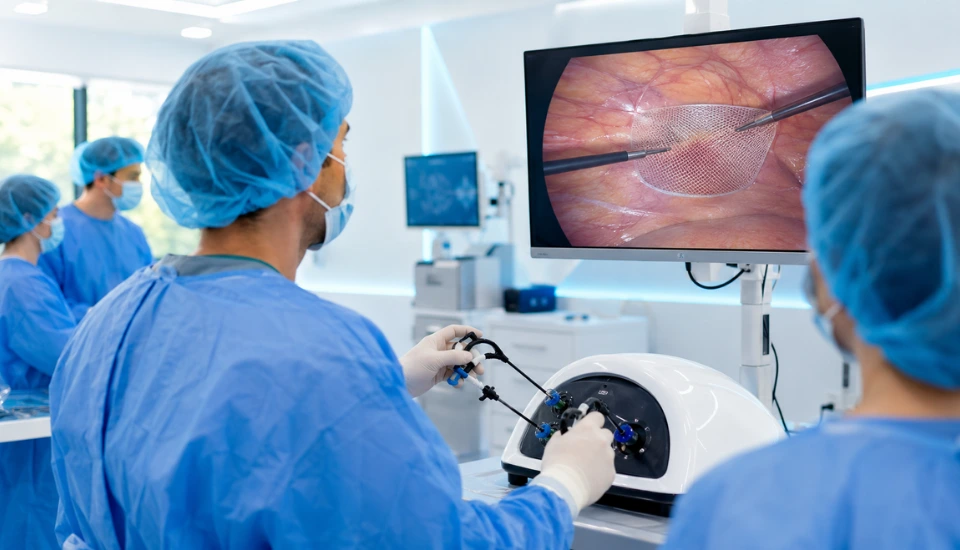
A good hernia repair rarely looks dramatic. Most of the work is in the details that are easy to miss from the outside: the first view, the plane of dissection, the way the tissue is held, the angle of a stitch, the position of the mesh.
For surgeons, those details are exactly where training matters.
The Advanced Hernia Surgery Course 2027 will be held in Istanbul on 8–9 January 2027. It is a two-day hands-on advanced hernia surgery course for surgeons and surgical trainees who want more focused training in laparoscopic hernia repair, including hiatal hernia repair with Nissen fundoplication, TEP inguinal hernia repair, and laparoscopic umbilical hernia repair.
The advanced hernia surgery course in Istanbul is not planned as a lecture day with a practic
al demonstration added at the end. It combines theory, video-based discussion, dry lab training and porcine wet-lab practice, so that the technical parts of hernia surgery can be reviewed, discussed and rehearsed in a more structured way.
Most surgeons learn a great deal by observing experienced colleagues. That will always be part of surgical education. But in laparoscopy, observation has a limit.
A video can show the correct dissection. It can show how the mesh should sit. It can show a clean crural repair or a well-formed fundoplication. What it cannot give is the feeling of working through long instruments while the anatomy is moving on a screen.
That gap between seeing and doing is one of the reasons this course has been designed with both dry lab and wet lab training.
In laparoscopic hernia repair, the surgeon needs more than procedural memory. The operation depends on orientation, instrument control, tissue handling and the ability to stay calm when the view is not ideal. These are not abstract skills. They are practical habits, and they improve with repetition.
The program gives participants a chance to slow these habits down. First in discussion, then in simulation, and then in the wet lab.
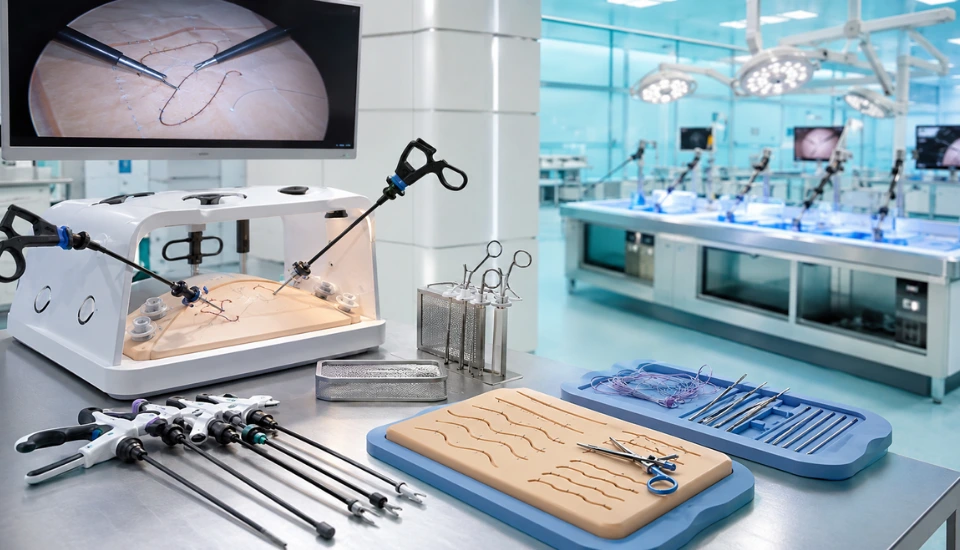
The course centers on three areas of laparoscopic hernia surgery that are important in modern surgical practice.
The first is laparoscopic hiatal hernia repair with Nissen fundoplication. This part of the training looks at the esophageal hiatus, hiatal dissection, esophageal mobilization, crural repair and the construction of a 360-degree fundoplication. The technical challenge is not only reaching the right step, but performing each step with enough exposure and control.
The second area is laparoscopic TEP inguinal hernia repair. TEP has a learning curve that many surgeons know well. The preperitoneal space is not always intuitive, especially at the beginning. The surgeon has to create the space, recognize the landmarks, understand the hernia type and place the mesh correctly without losing orientation. Peritoneal tears, bleeding and difficult anatomy can quickly change the feeling of the operation.
The third focus is laparoscopic umbilical hernia repair. It may look simpler at first, but good repair still depends on patient selection, defect assessment, mesh choice, positioning and fixation. In abdominal wall surgery, a “small” hernia does not automatically mean a simple decision.
These three topics make the course relevant for surgeons who want to strengthen their practical approach to hernia repair rather than only review the theory behind it.
The first day is built around preparation.
Participants begin with theoretical sessions on hiatal hernia repair, Nissen fundoplication, TEP inguinal hernia repair and umbilical hernia repair. The emphasis is on anatomy, operative steps, patient selection and common technical problems.
Video-based learning is an important part of the day. This is not only useful for seeing a standard case. It also helps show the moments where the operation becomes less straightforward: difficult anatomy, limited exposure, peritoneal tears, suturing challenges or decisions around mesh placement.
Later, the course moves into dry lab training.
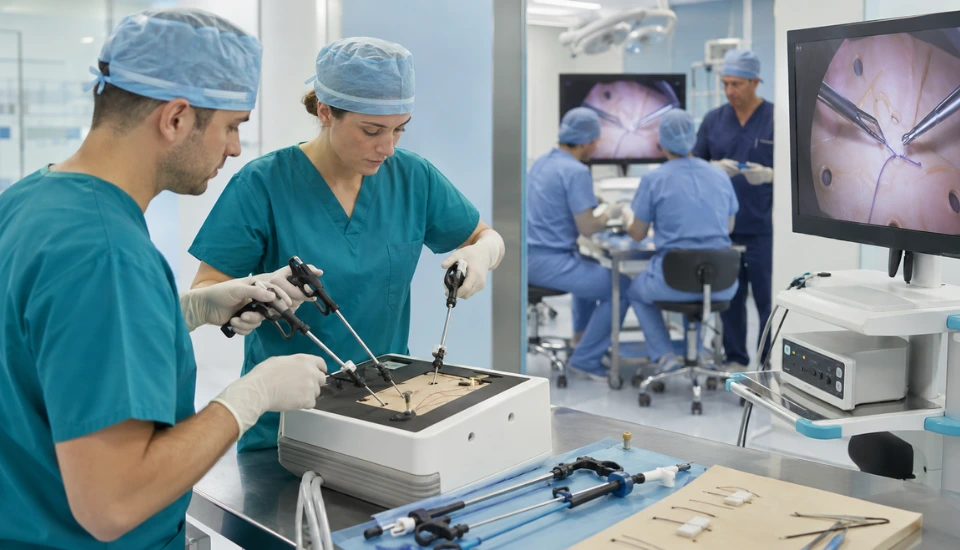
This is where participants work on laparoscopic suturing, needle handling and continuous suturing. These exercises may seem simple compared with a full operation, but they are often where small problems become visible. A needle that is not controlled well in the dry lab will not become easier at the hiatus. A suture that loses rhythm in simulation will be harder when tissue tension is added.
The dry lab gives time for correction without the pressure of a live case.
The second day takes place in the wet lab with a porcine model.
Before the practical work begins, participants receive a briefing on porcine anatomy, anatomical differences, wet-lab safety rules, instrument handling and laboratory workflow. This part is important because wet-lab training has to be organized carefully. It is not just “practice time”; it is a controlled educational setting.
During the wet lab, participants work through selected steps of the main procedures. For hiatal hernia repair and Nissen fundoplication, this may include port placement, liver retraction, hiatal dissection, esophageal mobilization, cruroplasty, fundic mobilization and fundoplication. For TEP repair, the focus includes creation of the preperitoneal space, identification of key anatomy, dissection around the myopectineal orifice, mesh placement and closure. For umbilical hernia repair, participants practice assessment of the defect, reduction of hernia contents, mesh preparation and fixation.
The combination of dry lab and wet-lab training gives the course its practical strength. In the dry lab, participants can focus on laparoscopic suturing, needle handling and instrument control in a structured setting. The porcine wet-lab model then adds another layer by allowing surgeons to apply these skills on live tissue, where tissue response, traction, dissection and laparoscopic angles become more realistic. This gives participants the opportunity to practice not only technical movements, but also tissue handling, bleeding control and the management of possible intraoperative difficulties under expert supervision
For many participants, this is where the course becomes most practical. The tissue does not stay still. The angle is not always comfortable. The stitch does not always behave as expected. Those are exactly the moments that make wet-lab training useful.
This hands-on hernia surgery course in Istanbul is mainly intended for doctors who already have a basic laparoscopic background and want more focused exposure to hernia techniques.
It may be suitable for general surgeons, surgical residents and physicians who want to improve their understanding of laparoscopic hiatal hernia repair, Nissen fundoplication, TEP inguinal hernia repair or umbilical hernia repair.
It may also be useful for surgeons who want more practice with laparoscopic suturing, mesh placement and wet-lab technique in a supervised environment.
The word “advanced” should not be understood as a promise that every participant will leave ready to perform these operations independently. That would not be realistic, and it would not be responsible. In this context, advanced means more focused, more technical and closer to the real details of laparoscopic hernia surgery.
The practical value of a surgical course is not only the number of topics on the program.
It is whether the participant can connect what is being taught with what happens during an operation.
In this advanced hernia surgery course, the theory prepares the hands-on work. The dry lab prepares the wet lab. The video discussions help participants recognize problems before they meet them in practice. The wet lab gives space to apply the technique with guidance.
This type of structure is useful because hernia surgery is not one single skill. Hiatal repair, TEP repair and umbilical hernia repair each require a different way of thinking. The anatomy changes. The working space changes. The mesh strategy changes. The technical risks are not the same.
A course that separates these topics clearly can help participants understand them with more confidence.
Istanbul is a practical location for short-term medical education, especially for physicians travelling from abroad. It is accessible, familiar to many international doctors and active in medical training programs.
For a hands-on surgical course, organization also matters. Doctors need clear communication before they arrive, a structured schedule during the course and support around the practical details of participation.
MedClinics supports this part of the process by helping international physicians connect with medical education opportunities in Turkey and by assisting with the coordination around the training experience.
For doctors who want to stay informed about medical education, treatment options and healthcare developments in Turkey, MedClinics also shares regular insights through its Medical News & Blogs section.
For surgeons interested in laparoscopic hernia surgery, the Advanced Hernia Surgery Course 2027 offers a focused opportunity to review important techniques, practice selected steps and gain more structured exposure to hiatal, inguinal and umbilical hernia repair.
It is a two-day, hands-on advanced hernia surgery course in Istanbul, with practical training in laparoscopic hiatal, inguinal and umbilical hernia repair.
Yes. The program includes theoretical sessions, video-based discussion, dry lab training and porcine wet-lab practice.
It is mainly suitable for general surgeons, surgical residents and doctors with basic laparoscopic experience who want more focused training in hernia surgery.
The main techniques are laparoscopic hiatal hernia repair, Nissen fundoplication, laparoscopic TEP inguinal hernia repair and laparoscopic umbilical hernia repair.
Dry lab training allows participants to practice laparoscopic suturing, needle handling and continuous suturing before moving into the wet lab.
Wet-lab practice gives participants the chance to work with tissue response, traction, dissection and mesh placement under supervision.
Yes. The course includes evaluation and a certificate ceremony at the end of the program.
No single two-day course can promise that. The aim is to support technical development, improve anatomical understanding and give participants supervised hands-on practice.