Clinical Insights from Prof. Dr. Serdar Kabataş, MD, PhD (C)
Why the Confusion Happens: Morbus Crohn vs Ulcerative Colitis
Many patients come with one word already in their mind.
“Colitis.”
Sometimes they say it because they had diarrhea for weeks.
Sometimes because blood appeared in the stool.
Sometimes because another doctor told them there is inflammation in the bowel.
Then they ask:
“Is this Morbus Crohn or ulcerative colitis?”
This is not a small question.
At first, both can look like the same problem.
The patient has diarrhea.
There may be pain.
Sometimes there is blood.
Sometimes weight drops.
Sometimes the patient is simply tired all the time.
So yes, I understand why many patients put everything under one word: colitis.
But after that first impression, the details become very important.
Morbus Crohn and ulcerative colitis do not behave in the same way inside the bowel. One patient may have continuous inflammation in the colon. Another may have disease in separate areas, or even in the small bowel. One patient may mainly struggle with bleeding and urgency. Another may later develop narrowing, fistulas, or abscesses.
That is why I do not like giving a fast label when the findings are still incomplete.
The name matters because the next decision depends on it.
Table of Contents
Why the Name of the Disease Matters
Patients sometimes look surprised when we insist on separating these two diseases carefully.
They say:
“Isn’t it all bowel inflammation?”
In a very simple way, yes.
But medically, that is not enough.
In medicine, where the inflammation is located matters. How deep it goes matters. Whether there are fistulas, strictures, abscesses, or only surface inflammation matters. Whether the small bowel is involved matters. Whether the rectum is always affected matters.
These details are not academic.
They change the treatment.
They change what we look for on MRI.
They change what we expect from colonoscopy.
They change how we think about surgery.
They change how we follow the patient over time.
A patient with ulcerative colitis and a patient with Morbus Crohn may both say, “I have bowel inflammation.”
But the medical path behind that sentence may be very different.
Ulcerative Colitis Usually Starts in the Rectum
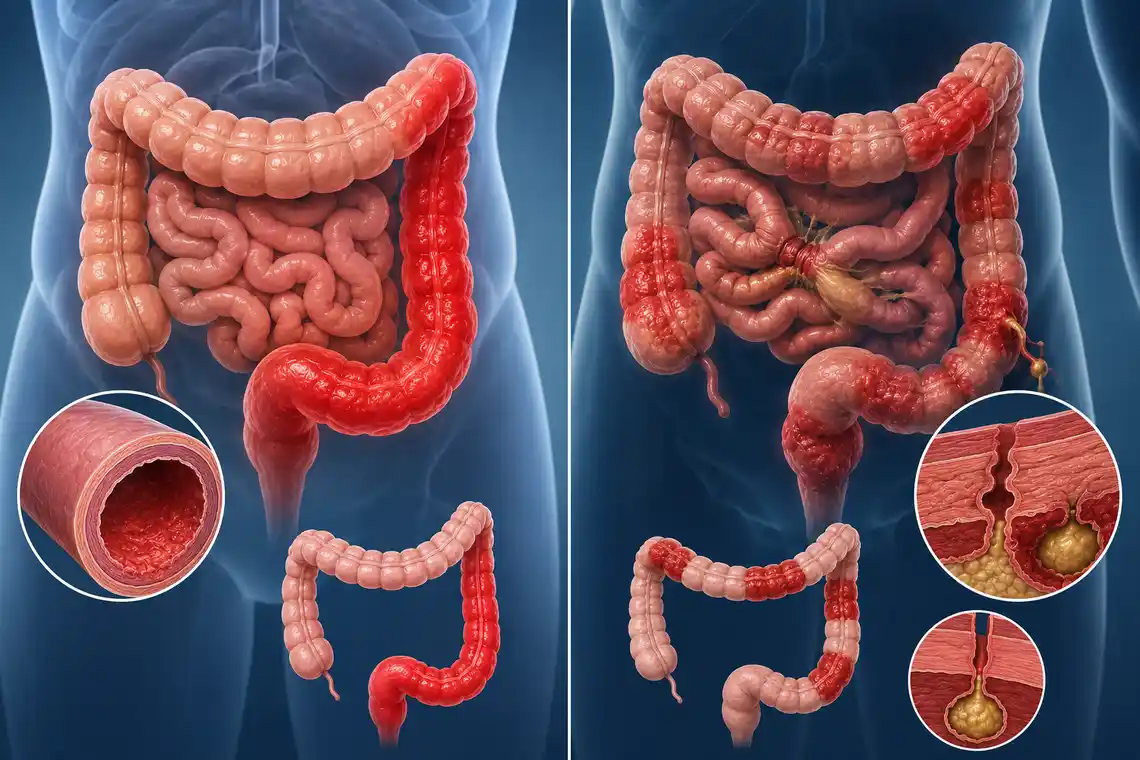
Ulcerative colitis has a more continuous pattern.
It affects the large intestine, the colon. It usually begins in the rectum and then extends upward. In many patients, the inflammation spreads in a continuous way, without healthy areas between inflamed areas.
This is one of the clues doctors look for.
A patient may have urgency.
They may need to run to the toilet.
They may see blood or mucus.
They may feel that the bowel is never completely empty.
When the rectum is inflamed, these symptoms can become very tiring. The patient may plan the whole day around toilets. Some patients are embarrassed to say this.
But it is important.
Ulcerative colitis is not only “diarrhea.” For many patients it is urgency, bleeding, fear of leaving the house, and exhaustion.
Still, the disease usually stays in the colon.
That is one of the main differences.
Morbus Crohn Can Appear in Different Places
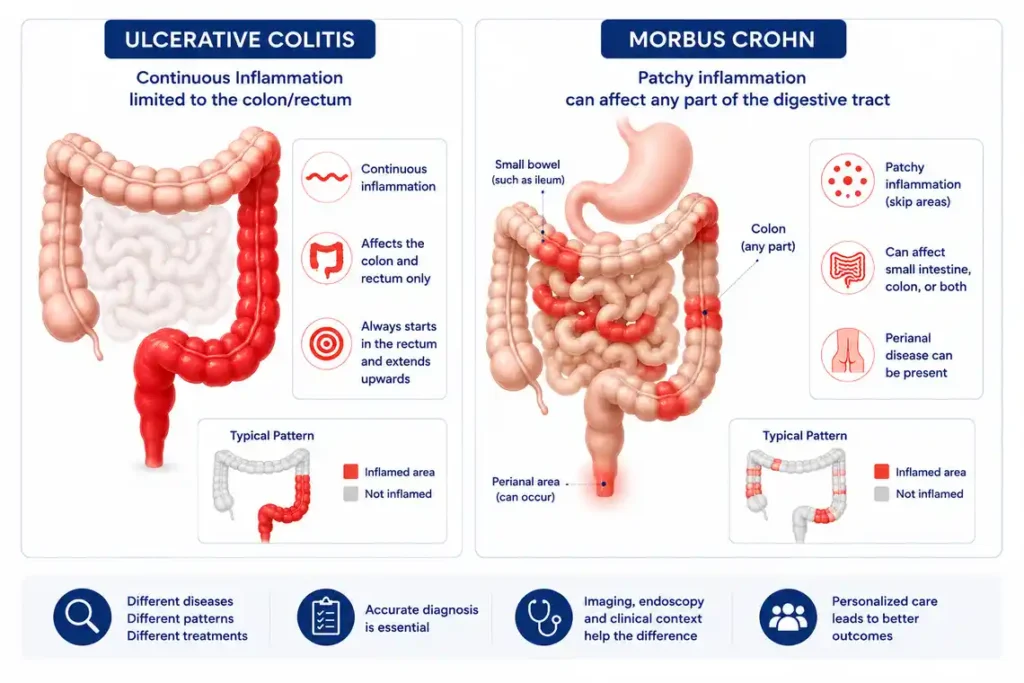
Morbus Crohn behaves less predictably.
It may affect the small intestine.
It may affect the colon.
It may affect both.
In some patients, it can also involve the area around the anus.
The inflammation may not be continuous. There may be diseased areas, then normal-looking bowel, then another diseased area.
This is why doctors sometimes talk about “skip areas.”
For patients, this can feel confusing.
One colonoscopy may show one pattern.
MRI may show another part of the disease.
Symptoms may come from a place that is not easy to see with simple examination.
A patient may have pain after eating because the small bowel is narrowed. Another patient may have drainage near the anus because of a fistula. Another may have diarrhea and weight loss, but not much bleeding.
All of these can belong to Morbus Crohn. This is why Morbus Crohn needs careful mapping. We need to know where the disease is, not only that inflammation exists.
Crohn’s Disease Can Go Deeper Into the Bowel Wall
The depth of inflammation is another major difference. Ulcerative colitis mainly affects the inner lining of the colon.
Morbus Crohn can go deeper. It may involve the full thickness of the bowel wall. This is one reason complications are more common in Morbus Crohn.
A deeper inflammation can lead to scar tissue.
Scar tissue can narrow the bowel.
A narrowed bowel can cause obstruction.
Deep inflammation can also form fistulas.
Infection can collect and become an abscess.
This is where the diseases begin to separate very clearly.
A patient with ulcerative colitis may spend months dealing with bleeding, urgency, diarrhea, and fear of leaving the house. That can be very severe.
But with Morbus Crohn, we also have to think about another layer of problems. Is there a narrowing? Is there a fistula? Is there an abscess? Is there perianal disease? Is the small bowel involved?
That is where the conversation changes.
Symptoms Alone Do Not Always Give the Answer
Patients often try to compare symptoms online.
They read:
Blood means ulcerative colitis.
Pain means Crohn’s disease.
Diarrhea means both.
But real patients do not always follow clean textbook lines.
A Crohn’s patient can bleed.
An ulcerative colitis patient can have severe pain.
Both can feel exhausted.
Both can lose weight.
Both can become anemic.
So symptoms are helpful, but they are not enough.
The pattern matters.
Where is the pain?
Is there bleeding?
Is there urgency?
Is there weight loss?
Is there fever?
Is there a fistula?
Is there perianal drainage?
Is there narrowing in the small bowel?
This is why diagnosis cannot be made from one symptom alone. The body gives clues. The doctor still has to put them together.
Perianal Disease Points Strongly Toward Morbus Crohn
One of the most important clues is disease around the anus.
Perianal fistulas, repeated abscesses, drainage, swelling, and painful openings near the anus are much more typical for Morbus Crohn. Not every patient with Morbus Crohn has perianal disease. But when it is present, it becomes a very important part of the diagnosis.
Patients often wait too long before talking about these symptoms. They may feel ashamed. They may think it is only a skin problem or a hemorrhoid.
Sometimes they say:
“It closes, then opens again.”
That sentence is important.
A fistula may look small from the outside. Inside, it can be more complex. It may branch. It may connect to deeper tissue. It may come with an abscess.
This is not typical ulcerative colitis behavior.
So when a patient has bowel inflammation together with perianal fistulas, Morbus Crohn moves much higher in the discussion.
Why Diagnosis Sometimes Takes Time
Patients like clear answers. Doctors do too. But inflammatory bowel disease does not always reveal itself immediately.
Sometimes the colonoscopy is clear.
Sometimes the biopsy gives a strong answer.
Sometimes MRI shows small bowel disease.
Sometimes the diagnosis is still not fully certain.
There are patients who are first told they have colitis. Later, when more information becomes available, the diagnosis becomes Crohn’s disease or ulcerative colitis more clearly.
This does not always mean somebody made a mistake. It may mean the disease was still showing only part of itself. In some patients, doctors use the term indeterminate colitis when the features do not clearly fit one side.
This can be frustrating for the patient. But guessing too early can be more harmful. The treatment plan should follow the evidence, not only the wish to have a quick label.
Colonoscopy, Biopsy, and Imaging Work Together
No single test tells the whole story every time. Colonoscopy shows the inside of the colon and the end of the small intestine when it can be reached. Biopsies show tissue changes under the microscope.
MRI or CT may show bowel wall thickening, fistulas, abscesses, narrowing, or small bowel involvement. Stool tests can help show inflammation. Blood tests may show anemia, infection signs, or inflammation markers.
Each test gives a piece. The doctor has to ask:
Does the inflammation start in the rectum?
Is it continuous?
Is the small bowel involved?
Are there skip areas?
Are there fistulas or strictures?
Does biopsy support one diagnosis more than the other?
This is why a careful diagnosis may take more than one appointment. It is better to be slow and correct than fast and wrong.
Treatment Can Overlap, but the Plan Is Not the Same
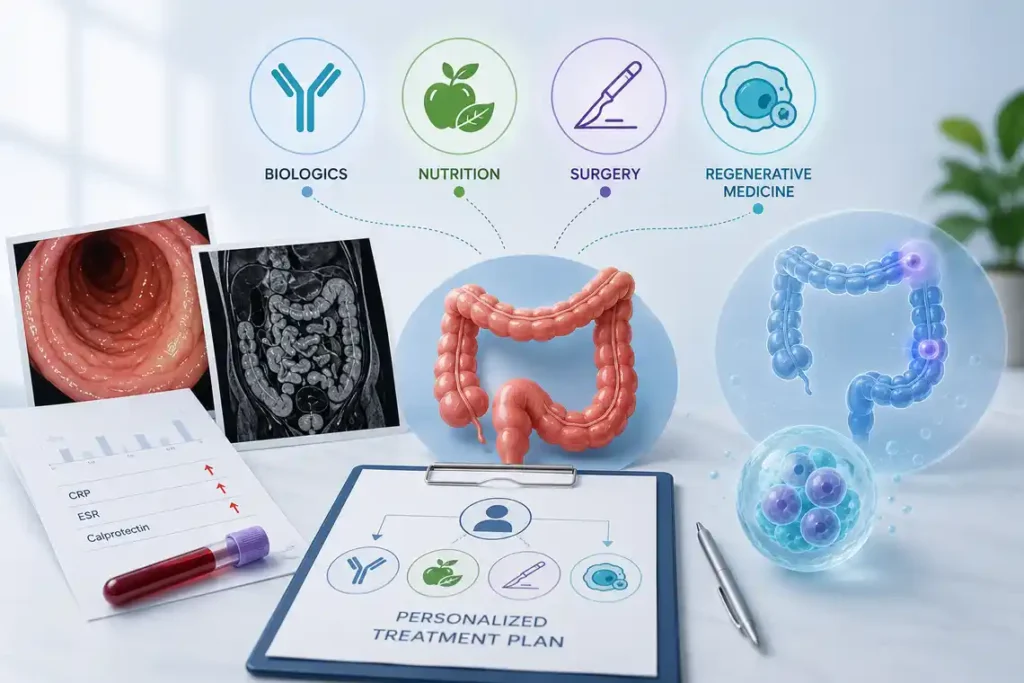
Some treatments are used in both diseases.
Steroids may be used during flares.
Biologic therapy may be used in selected patients.
Newer targeted medications may be considered.
Nutrition, monitoring, and follow-up matter in both.
But the treatment plan is not identical. In ulcerative colitis, the main question is often how well we can control the inflammation in the colon and rectum.
In Morbus Crohn, the question may be wider.
Is the small bowel involved?
Is there narrowing?
Is there a fistula?
Is nutrition becoming a problem?
Has the patient already had surgery?
Is there perianal disease?
So even when the medication name is the same, the reason we use it may not be exactly the same.
One patient may need control of rectal inflammation.
Another may need MRI for a fistula.
Another may need evaluation of a stricture.
Another may need biologic therapy adjusted because inflammation is returning.
The diagnosis changes what we watch. And what we watch changes the treatment.
Surgery Means Something Different in Each Disease
This is one of the clearest differences. In ulcerative colitis, the disease is limited to the colon and rectum. If the colon is removed, the diseased organ has been removed.
That does not mean surgery is easy.
It is a major decision. It affects life deeply. But the meaning is different.
In Morbus Crohn, surgery does not cure the disease.
A surgeon may remove a narrowed segment.
Drain an abscess.
Treat a fistula.
Operate because of obstruction.
Remove a diseased bowel part that is causing repeated problems.
But Crohn’s disease can return in another area or near the surgical connection. So when we talk about surgery, we must know which disease we are talking about.
Two patients may both say:
“I had bowel surgery.”
But medically, the long-term meaning may be completely different.
Follow-Up Is Different Too
Follow-up is not only checking whether the patient feels better.
In ulcerative colitis, the colon and rectum remain central. Doctors follow inflammation, bleeding, flare frequency, medication response, and long-term colon risk.
In Morbus Crohn, follow-up may need to include more areas.
Small bowel imaging may be needed.
Perianal symptoms must be watched.
Nutrition and weight matter.
Strictures may need monitoring.
Fistulas may need repeated assessment.
A Crohn’s patient can feel somewhat better and still have active disease in a place that is not obvious.
This is why symptoms alone can be misleading.
A patient may say:
“My diarrhea is better.”
That is good.
But the next question is:
“What is happening inside the bowel?”
Extraintestinal Symptoms Can Happen in Both
Inflammatory bowel disease can affect more than the bowel.
Some patients have joint pain.
Some develop skin problems.
Some have eye inflammation.
Some feel extreme fatigue.
Some have liver or bile duct problems.
These symptoms may occur with both Morbus Crohn and ulcerative colitis. Sometimes they follow bowel activity. Sometimes they do not.
A patient may visit an eye doctor, rheumatologist, dermatologist, or hepatologist before the bowel diagnosis is clear. This is another reason inflammatory bowel disease care often needs more than one specialist.
The bowel is central. But the whole patient must be seen.
Can One Disease Turn Into the Other?
Patients ask this often. They say:
“Can ulcerative colitis become Crohn’s disease?”
Usually, no. One disease does not slowly transform into the other like that.
What can happen is different.
The first diagnosis may change because new information appears. A patient may initially look like ulcerative colitis. Later, small bowel disease, fistulas, or skip areas may appear and support Crohn’s disease.
Or the opposite may happen: early uncertainty becomes clearer with time.
That is not the disease changing its identity.
That is the diagnosis becoming more accurate.
This distinction helps patients understand why doctors sometimes review old reports, repeat imaging, or ask for previous colonoscopy findings.
Why the Difference Matters Before Advanced Treatment
Patients today read a lot about advanced treatments.
Biologic therapy.
Small molecules.
Stem cell therapy.
Exosome therapy.
Regenerative medicine.
That is normal. But before discussing advanced treatment, the diagnosis must be clear. A treatment discussion without a clear diagnosis is weak.
Two patients may both receive biologic therapy.
On paper, that sounds similar.
But one patient may have ulcerative colitis limited to the rectum and colon. Another may have Morbus Crohn with perianal fistulas and a previous abscess.
Those are not the same clinical problems.
So the discussion cannot be the same either.
The question is not only:
“What treatment exists?”
The better question is:
“What disease are we treating, where is it active, and what problem are we trying to solve?”
Where Regenerative Medicine Fits
Patients sometimes ask whether stem cell therapy or exosome therapy can help in inflammatory bowel disease.
This question needs a careful answer. Regenerative medicine is not one general answer for all bowel inflammation.
In selected complex perianal fistulas related to Morbus Crohn, local mesenchymal stem cell therapy has been studied as a supportive treatment. This does not mean every Crohn’s patient is a candidate.
It also does not mean ulcerative colitis is treated in the same way.
The diagnosis comes first.
Then disease activity.
Then complications.
Then previous treatment response.
Then realistic discussion of options.
If there is an abscess, infection control comes first.
If there is a stricture, the question is different.
If there is only colon inflammation, the treatment path is different again.
Regenerative medicine should not be used as a shortcut around diagnosis. It should be discussed only after the disease pattern is understood.
How I Usually Explain This in the Clinic
I often explain it in a simple way. Morbus Crohn and ulcerative colitis belong to the same family.
But they are not the same person.
They may share symptoms.
They may share some treatments.
They may both cause long and difficult periods for patients.
But inside the bowel, they behave differently.
One patient may have continuous inflammation in the colon.
Another may have small bowel disease with narrowing.
Another may have perianal fistulas.
Another may have severe rectal bleeding and urgency.
All are inflammatory bowel disease. But they are not the same clinical situation. This is why I do not like to say only, “You have IBD,” and stop there.
The patient needs to know which disease is most likely.
Because the next step depends on that.
Final Thoughts on Morbus Crohn vs Ulcerative Colitis
Morbus Crohn and ulcerative colitis are often mentioned together.
That makes sense.
They both belong to inflammatory bowel disease.
But for the patient, the difference is not small.
The location of inflammation is different.
The depth of inflammation is different.
The risk of fistulas and strictures is different.
The meaning of surgery is different.
The follow-up plan may be different.
A correct diagnosis does not solve everything.
But it gives the treatment plan a direction.
Without that direction, patients may move from one medication to another without understanding what problem is being treated.
Good care starts with naming the disease correctly.
Then we can ask the next question.
What is active now?
What has already happened?
What needs urgent attention?
What can be treated medically?
What needs imaging?
What are we trying to prevent?
That is the real value of separating Morbus Crohn from ulcerative colitis.
Not because labels are important.
Because the right label protects the next decision.
Frequently Asked Questions About Morbus Crohn and Ulcerative Colitis
Why are Morbus Crohn and ulcerative colitis mixed up so often?
Because, in the beginning, they can look almost identical to the patient.
Diarrhea.
Pain.
Blood.
Fatigue.
Weight loss.
The patient does not think in disease patterns. The patient thinks, “My bowel is inflamed.”
That is understandable.
But for the doctor, the question starts after that.
Where is the inflammation?
How deep is it?
Is the small bowel involved?
Is there a fistula?
Is there a narrowing?
That is where the two diseases separate.
What makes Morbus Crohn different from ulcerative colitis?
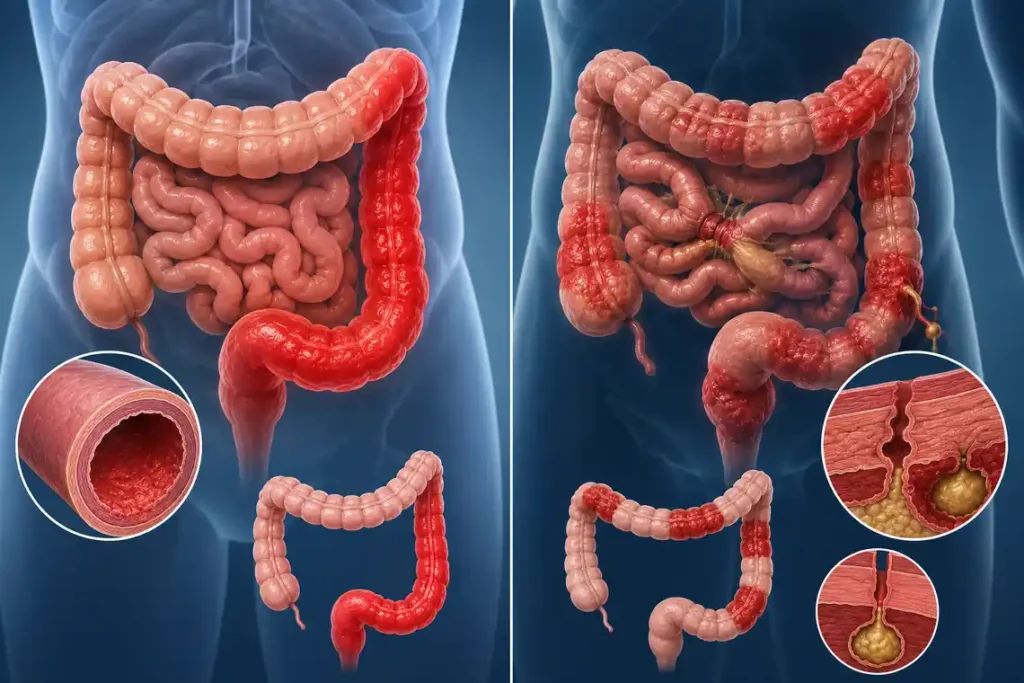
Morbus Crohn is less predictable.
It may be in the small bowel.
It may be in the colon.
It may skip areas.
It may go deeper into the bowel wall.
Ulcerative colitis usually stays in the colon and rectum.
That sounds simple, but it changes a lot.
It changes imaging.
It changes follow-up.
It changes how we think about surgery.
It changes what complications we look for.
Can a patient know the difference from symptoms alone?
Usually not.
Symptoms can mislead.
Blood does not automatically mean ulcerative colitis. Pain does not automatically mean Morbus Crohn. Diarrhea can happen in both.
So I would not make the diagnosis from symptoms alone.
Colonoscopy matters.
Biopsy matters.
MRI matters when small bowel disease or fistulas are suspected.
The answer comes from the whole picture.
Why can the diagnosis change later?
Because sometimes the disease shows only one part of itself at the beginning.
At first, the colon may look inflamed. Later, MRI may show small bowel disease. Or a fistula appears. Or old biopsy results make more sense when new findings are added.
This is frustrating for patients. But it does not always mean the first doctor was careless.
Sometimes the disease simply became clearer with time.
Does treatment follow the same path in both diseases?
Not always. Some medicines overlap. That part is true. But the reason for treatment may be different.
In ulcerative colitis, we often focus on the colon and rectum.
In Morbus Crohn, we may also have to think about small bowel disease, strictures, fistulas, nutrition, perianal disease, or surgery risk.
So the medicine name is not the whole story. The disease pattern is the story.
Can stem cell therapy help both Morbus Crohn and ulcerative colitis?
I would answer carefully. Stem cell therapy is not a general treatment for every patient with bowel inflammation.
The clearest discussion is still in selected complex perianal fistulas in Morbus Crohn. Local mesenchymal stem cells have been studied there as a supportive option.
That is very specific. It does not mean every Crohn’s patient is suitable. It also does not mean ulcerative colitis follows the same path. First we need the correct diagnosis. Then we need to know the exact disease pattern.