Regenerative Medicine

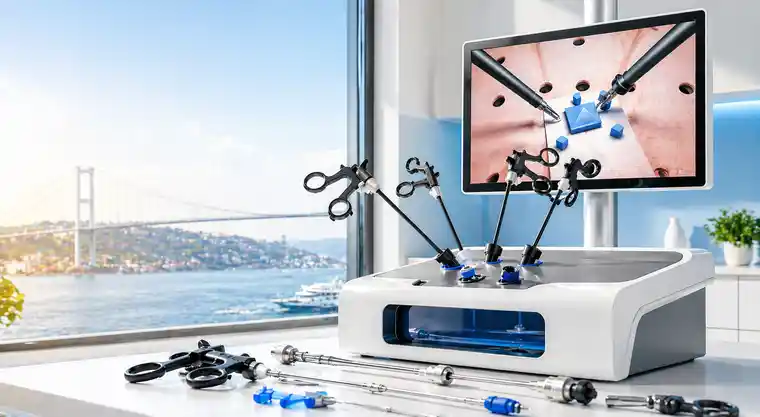
Laparoscopy looks elegant from the outside. Small incisions. A camera. Fine instruments. Less trauma for the patient. Faster recovery in many cases.
But every surgeon who has stood at the operating table knows the truth: laparoscopic surgery is not simply “open surgery through small holes.”
It changes the way the hands, eyes and brain work together.
Depth perception is different. The instruments move differently. The image is indirect. Small hand movements become amplified. Tissue handling requires patience. Camera navigation matters. Even tying, cutting, grasping and dissecting feel unfamiliar at the beginning.
That is exactly why proper basic laparoscopy training matters.
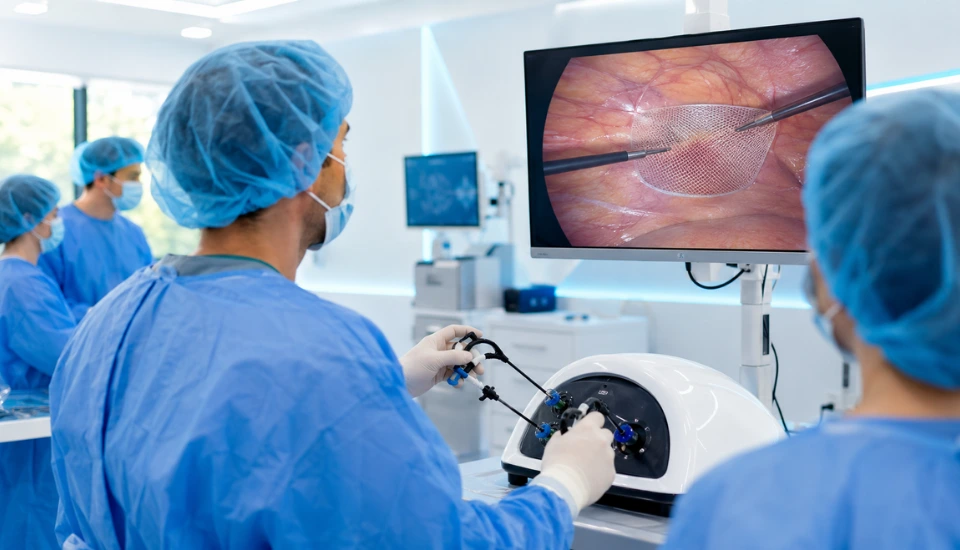
The Basic Laparoscopy Course takes place in Istanbul and is designed for doctors and surgical trainees who want to build a stronger foundation in minimally invasive surgery through structured theory, simulation and live tissue practice. The program brings together academic teaching, dry lab training, wet-lab practice on a porcine model, expert supervision and case-based discussion.
This is not a passive conference.
It is a training environment built around doing, correcting, repeating and understanding.
Laparoscopy has a special learning curve.
In open surgery, the surgeon sees and works directly with the hands. In laparoscopy, the surgeon works through long instruments while watching a screen. The anatomy may be the same, but the way the surgeon interacts with it is completely different.
That is why laparoscopic skills should not be something a doctor simply “picks up” in the operating room.
A structured course gives participants time to understand the principles, practice the movements, receive correction and build confidence before those skills are required in real surgical situations.
International surgical education has moved strongly in this direction. The Fundamentals of Laparoscopic Surgery program, supported by SAGES and the American College of Surgeons, describes basic laparoscopy education as a combination of cognitive knowledge, surgical judgment and technical skills training.
The logic is simple: patients deserve surgeons who have practiced the fundamentals before they perform them.
The Basic Laparoscopy Course is an intensive two-day program built around the core skills needed in minimally invasive surgery.
The structure is intentionally practical. Participants are not only listening to lectures. They work with instruments, practice laparoscopic movements, discuss real cases and learn how to think through complications.
There are many medical courses that sound impressive on paper.
Some offer lectures. Some offer demonstrations. Some offer a few hours of instrument handling and call it hands-on training.
This course is different because it combines three important parts:
Participants learn the basic principles behind laparoscopy: access, ergonomics, visualization, instrument control, tissue handling, safety and complication awareness.
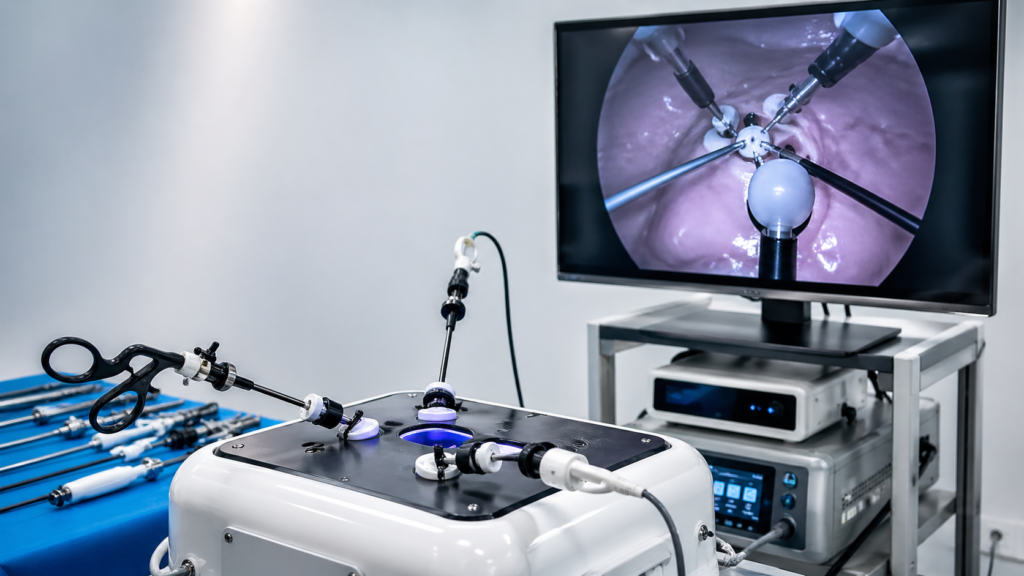
Dry lab training helps participants build hand-eye coordination, camera orientation and basic laparoscopic movements in a controlled setting.
Wet-lab training with a porcine model brings the learning closer to real tissue behavior. Tissue tension, dissection planes and instrument response cannot be fully understood from a lecture alone.
The course also includes one-to-one supervision by expert faculty. A participant may repeat the same movement many times and still not understand what is wrong until an experienced surgeon corrects the angle, posture, camera view or instrument handling in real time.
That is where progress happens.
Not in the certificate.
In the correction.
Simulation is not a replacement for the operating room. But it is one of the safest places to make mistakes, recognize them and improve.
A doctor learning laparoscopic movement for the first time may struggle with limited depth perception, counterintuitive instrument motion or coordination between the camera and the working instruments. These are normal early challenges. The problem is not having them. The problem is discovering them for the first time during a real case.
Dry lab training gives participants a controlled space to build rhythm and precision.
Wet-lab training adds another layer. Tissue moves, stretches, slips and responds to traction. It teaches something a plastic model cannot fully show: how much force is too much.
Together, both formats help participants move from awkward instrument handling toward more controlled laparoscopic work.
The course is designed around the practical foundations of laparoscopic surgery.
Participants can expect training in:
The format is simple: understand, practice, receive feedback, repeat.
That is how surgical confidence grows.
This course is especially suitable for doctors and surgical trainees who want to build or strengthen their foundation in laparoscopic technique.
It may be valuable for:
The course is called “basic,” but that does not mean superficial.
In surgery, the basics are not small. They are the part everything else depends on.
A surgeon who cannot control the camera view will struggle with dissection. A surgeon who cannot handle tissue gently will create unnecessary trauma. A surgeon who does not understand ergonomics will fatigue faster and lose precision.
Basic skills are not beginner skills only.
They are permanent skills.
The course fee is USD 2,500 and includes the academic program, hands-on training access, materials, certificate and organizational support.
Participants receive access to dry lab and wet-lab training, including work with a porcine model. The program also includes expert supervision, surgical instruments, consumables, case-based discussions and complication management.
The package also includes a scrub set, course booklet, participant kit, university-approved certificate, coffee breaks, lunches and on-site coordination.
Participants also receive membership benefits, including discounts on selected future trainings and access to online case discussions.
Minimally invasive surgery is no longer a rare skill. In many fields, it has become part of standard surgical practice.
Patients often expect smaller incisions, faster recovery and modern surgical techniques. Hospitals expect doctors to understand minimally invasive principles. Training programs expect residents to develop laparoscopic ability earlier than before.
But expectations alone do not create skill.
Skill needs structure.
That is why a focused course like this matters. It gives participants protected time to practice, make mistakes safely, receive feedback and understand laparoscopy as a discipline — not just a technique.
For a young surgeon, this may be the first serious step into minimally invasive surgery. For a resident, it may make the operating room feel less intimidating. For a physician returning to laparoscopy after a long break, it may rebuild confidence.
For surgeons who are ready to move beyond basic laparoscopic skills, MedClinics also shares upcoming advanced surgical training opportunities in Istanbul.
The Advanced Hernia Surgery Course 2026 will take place on 4–5 September 2026 and focuses on hands-on laparoscopic hernia surgery training, including hiatal hernia repair, TEP inguinal hernia repair and umbilical hernia repair.
The Advanced Laparoscopic Colorectal Surgery Cadaveric Masterclass 2026 will take place on 12–13 September 2026 and is designed for surgeons seeking focused cadaveric training in advanced colorectal procedures, including CME, TME, laparoscopic colectomy and low anterior resection.
Doctors who are interested in the next level of laparoscopic training can read more about the upcoming hernia surgery course and colorectal surgery masterclass through the related course articles.
Acıbadem University brings the academic weight behind the course.
Founded in 2007 by the Acıbadem Health and Education Foundation, the university is focused strongly on health sciences and medical education, with an emphasis on research, practical learning and modern clinical training.
For a surgical course, this matters.
Laparoscopy should not be taught casually. The setting, faculty, simulation environment and educational standards all influence what a participant actually takes home. Acıbadem University’s role gives the program a serious academic frame: not just a workshop, but a training experience connected to medical education.
MEDUNÈRA supports the course as a medical training platform focused on hands-on workshops, live surgery education and practical clinical learning for healthcare professionals.
Its role here is mainly to help shape the course as a real training experience, not a passive lecture day.
MedClinics provides the international coordination behind the experience.
For many doctors coming from abroad, the course itself is only one part of the decision. They also need clear communication, reliable planning, local guidance and a team that understands how medical travel works in Istanbul.
MedClinics helps make the experience easier before the course, during the stay and around the practical details that can otherwise distract from learning.
This way, participants do not lose energy on the wrong things. The practical details are handled in the background, while doctors can stay with the course itself: the training room, the faculty, the instruments and the questions that come up during practice.
For doctors who want to stay updated on medical education, treatments and healthcare developments in Turkey, MedClinics also shares regular insights through its medical news section.
It is a practical laparoscopy training for doctors who want to stop watching from the side and start understanding what actually happens with the instruments in their own hands.
That may sound simple, but in laparoscopy it is not. The camera changes everything. Your hands are outside the body, your eyes are on a screen, and the instrument tip does not always seem to move the way your brain expects.
So the course starts there: with the basic logic of laparoscopic surgery. Then it moves into practice, correction and repetition.
It is mainly for doctors who are building their laparoscopic foundation.
That may be a surgical resident, a young surgeon, a gynecology or urology doctor, or someone who has already seen laparoscopic cases but wants more structured practice.
It is hands-on.
There is theory, yes, because without theory the hands do not know what they are trying to do. But the course is not built as a lecture-only event. Participants work in the dry lab and wet lab, including practice with a porcine model.
That matters because laparoscopy cannot be learned only by watching someone else operate. At some point, your own hands have to understand the movement.
The total fee of USD 2.500 includes the full training program, dry lab and wet-lab access, expert supervision, surgical instruments, consumables, course materials, certificate, membership benefits, coffee breaks, lunches and on-site support.
Yes. Participants receive a university-approved certificate after the course.
Because tissue behaves differently from plastic models.
It slips, stretches, pulls back and reacts to force. Wet-lab practice helps participants feel this difference under supervision.
Because laparoscopy feels strange at the beginning.
Unlike in open surgery, your eyes are focused solely on the screen. You cannot rely on the sense of touch in your hands, as there are instruments inside the body that must be controlled as if they were an extension of your hands, much like a video game controller.
During the course, you can make mistakes without jeopardising a patient’s safety. This allows you to learn how the procedure should be carried out correctly and how best to use the instruments.
No serious basic course should promise that.
This course gives participants a stronger start, better instrument familiarity and a clearer understanding of what they still need to practice. Independent surgery comes later, with supervised operating room experience and repetition.