Regenerative Medicine

Clinical insights by Dr. Tengiz Tkebuchava, MD, PhD
I’m Dr. Tengiz Tkebuchava.
Many patients do not come in asking whether stem cell injections can regenerate cartilage. They ask something more direct.
Can this help me avoid surgery?
Often, this question comes much later than it should.
By the time patients ask it, they have usually been dealing with the problem for quite a while. The knee has hurt for months. The hip has become stiff. Walking feels different. Sitting too long is uncomfortable. Getting up is slower than before. Many have already tried to manage it on their own first. They rest more, move less, take medication when needed, maybe do physiotherapy, maybe try a standard injection, and hope the joint will calm down again.
Sometimes it does. Sometimes it does not.
And when it does not, the whole situation starts to feel narrower. Surgery no longer sounds like one possible step somewhere in the future. It starts to feel like the direction everything is heading in. That is usually the moment patients begin asking whether there is still something meaningful they can do before reaching that point.
Pain changes the way people think.
A patient may still be walking, still working, still managing daily life, and yet already feel mentally close to surgery. That happens because chronic joint pain is exhausting. It creates the sense that the problem is moving only in one direction.
In many cases, that impression is understandable but still incomplete.
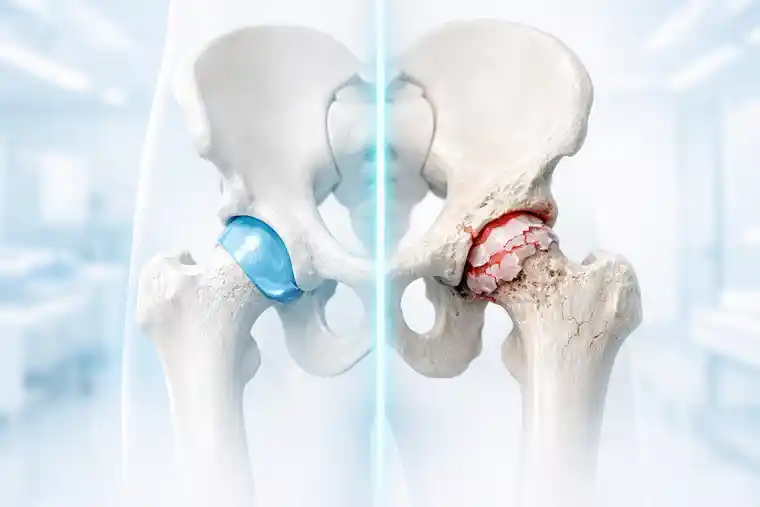
A painful hip or knee does not automatically mean a joint replacement is the next necessary step. There is often a middle phase between basic conservative treatment and surgery. This is the phase many patients are actually living in when they first ask about stem cell injections.
The joint is no longer comfortable, but it may still be biologically worth treating. Symptoms are real, but the situation may not yet be beyond regenerative support. That distinction matters.
This is an important point to state clearly.
Stem cell treatment should never be presented as a magical substitute for every form of orthopedic surgery. There are joints that are too advanced, too unstable, too severely worn, or too structurally damaged for injection-based treatment to do enough. In those cases, surgery may remain the better option.
But that does not mean every patient with hip or knee degeneration has already reached that stage.
Quite a few have not.
What they need is not a promise. What they need first is an honest look at the joint itself.
Sometimes there is still enough there to work with. And when that is the case, injections may ease the pain, improve movement, and help the patient stay away from surgery for longer.
For some patients, delay is already a meaningful success. For others, the improvement may be enough that surgery no longer feels necessary at all, at least not for the time being.
Patients sometimes imagine this in very black-and-white terms. Either the injection “fixes” the joint or it does not. Real medicine is usually less dramatic than that.
The purpose of stem cell injections is to improve the biological environment inside the joint. In a hip or knee that has been dealing with cartilage wear, inflammation, overload, or chronic irritation, that can matter a great deal.
The aim is to support repair processes, influence inflammation, and create better conditions for the joint to function more calmly and more efficiently.
That may not sound spectacular, but clinically it is exactly the point.
When the joint environment becomes less inflamed and more stable, patients often feel the difference in very practical ways. Less pain when walking. Less stiffness after sitting. More confidence on stairs. Less sense that the joint is steadily pushing them toward surgery.
This is why stem cell injections are relevant in the surgery discussion. Not because they replace orthopedic operations in every case, but because they may change the trajectory of a joint before that point is reached.
This is where the discussion becomes more useful.
Patients naturally want a yes or no answer. But the more honest question is not whether stem cell injections can ever help avoid surgery. They can. The better question is which patients are most likely to benefit from that possibility.
That usually depends on several things at once.
The condition of the cartilage matters. The level of inflammation matters. The stage of degeneration matters. The age and activity of the patient matter. Previous treatment matters. Joint alignment and overall function matter too.
A patient with moderate degeneration and persistent symptoms may still have a meaningful regenerative window. A patient with severe collapse of the joint structure may not. That is why stem cell therapy is not decided by the diagnosis name alone. Two patients may both say they have knee arthritis, while the practical treatment possibilities are very different.
One of the most common mistakes is waiting until the joint has become too advanced and then expecting injections to do what only surgery can still do.
By that stage, the treatment is often being judged unfairly.
Regenerative medicine tends to work best when there is still enough joint structure and enough biological responsiveness left to support.
By the time pain is constant and movement is already badly affected, there is often not much left for non-surgical treatment to save.
That is why timing matters.
Many patients start looking at regenerative options only when they already feel very close to surgery. But that is often quite late. In most cases, the better moment to ask is earlier, while the joint is still damaged, but not yet too far gone to respond.
That does not mean very early treatment is always necessary. It simply means there is a window where injections may still make a substantial difference, and it is better not to miss it.
Patients know this intuitively, even when they try to be pragmatic about it.
Surgery is not only about solving a joint problem. It also means recovery time, interruption of normal life, rehabilitation, travel planning, work planning, physical limitations, and the emotional weight of undergoing an invasive procedure.
That is one reason the question of avoiding surgery matters so much. It is not fear alone. It is proportion. Many patients want to know whether there is a serious treatment option that matches the stage of their problem without immediately escalating to an operation.
That is a reasonable way to think.
If a non-surgical regenerative procedure can reduce symptoms enough, restore function enough, and keep the patient comfortably on their own joint for longer, that has real value. Even if surgery is needed one day, postponing it under the right conditions may still be the better path.
Not every patient needs the same result in order to step away from surgery.
For some, avoiding surgery means being able to walk without daily pain again. For others, it means climbing stairs more comfortably, traveling more easily, or getting through exercise without the joint reacting badly afterward. Some want to return to sport. Others simply want normal daily life back.
That is why outcome should not be measured only in imaging language.
If stem cell injections help the joint become calmer, less painful, and more functional, and if that change is enough to make surgery unnecessary in the patient’s real life, then the treatment has achieved something important.
This is also why modest improvement should not be underestimated. A joint does not have to become perfect in order for surgery to stop feeling necessary.
In general, the patients most likely to explore this path are those who are no longer doing well with basic measures, but who are not yet at the point where surgery is unquestionably the only reasonable option.
That group is larger than many people think.
It often includes patients with:
What matters most is not whether the patient wants to avoid surgery. Most do. What matters is whether the joint still gives us a medically realistic reason to try.
This is just as important to say.
There are situations where the desire to avoid surgery is understandable, but the joint has already moved beyond what regenerative injection treatment can realistically offer. Some joints are simply too far gone.
If the structure is badly damaged, the joint is very unstable, or the whole condition is already too advanced, injections are unlikely to do enough.
In that situation, it would be wrong to present stem cell treatment as if it could replace surgery.
Not every patient needs the answer they want to hear. They need an honest answer about what still makes sense and what does not.
That is one of the reasons careful patient selection matters so much in this field.
The practical side matters almost as much as the biological side.
Stem cell treatment for hip and knee joints is non-surgical. It is performed by injection, usually under ultrasound guidance, and in many cases does not require hospitalization. That changes how patients experience the whole decision.
They are not preparing for a large operation. They are not facing the same recovery burden. They are not stepping into a long postoperative process.
For patients who are still in a reasonable regenerative window, that difference can be decisive. It allows them to try a serious treatment without crossing immediately into invasive care.
That is one of the main reasons stem cell injections are so often discussed in relation to avoiding surgery. The comparison is not theoretical. It is built directly into the patient’s decision.
This distinction matters more than it may seem.
Some patients worry that if they choose regenerative treatment, they are somehow refusing proper orthopedic care. That is not the right way to see it. Choosing stem cell injections when the joint is still a good candidate is not denial. It is timing.
It is an attempt to preserve function with the least invasive appropriate method first.
If the treatment works well, surgery may be postponed for a long time or may no longer feel necessary. If the condition progresses later despite treatment, surgery can still remain available. In that sense, regenerative treatment is often less about rejecting surgery and more about asking whether it is truly needed now.
That is a very different question.

I usually answer carefully.
Yes, in some patients stem cell injections may help avoid hip or knee surgery. But no serious physician should say that to everyone in the same way.
The better conversation is always about the actual joint in front of us. How advanced is the degeneration? How much function remains? How much inflammation is driving the symptoms? Is the patient still in a stage where regenerative treatment can meaningfully change daily life?
When the answer is yes, the possibility of avoiding surgery becomes real, not as a slogan, but as a medical strategy.
That is the point.
Over the years, I have seen many patients arrive feeling that surgery is already closing in on them, even though their joint still has a meaningful chance to respond to a non-surgical treatment.
That middle zone is important.
It is where stem cell injections can be most valuable. Not as a miracle and not as a replacement for every orthopedic procedure, but as a way to preserve function, reduce pain, and keep invasive treatment from becoming the next automatic step.
That is how I think about regenerative medicine in hip and knee care. Not as a promise that surgery will never be needed, but as a serious attempt to help the patient avoid it when the biology of the joint still allows that possibility.

Sometimes they can.
I would not say that to every patient in the same way, because the joint has to be looked at honestly first. But there are patients in whom the pain settles down, movement improves, and the pressure toward surgery becomes much less immediate after treatment. In that kind of situation, injections can create real time and sometimes much more than that.
Other joints are already too far advanced. That is why the answer depends less on the idea of stem cells in general and more on the actual condition of the hip or knee.
Usually the joint gives some signs.
If pain is there most of the time, movement is becoming much more limited, and daily life is already shaped around the joint, the situation may already be moving quite far. That does not automatically mean it is too late. But it does mean the space for non-surgical treatment may be getting smaller.
This is one reason patients are often better off asking earlier rather than waiting until everything starts to feel like it is heading in one direction only.
No, not at all.
That is an important point because many patients imagine the result in extremes. Either the joint is fully fixed, or the treatment has failed. Real life is usually not like that. Sometimes the joint does not need to become perfect. It just needs to become manageable again.
If pain is reduced, walking is easier, and everyday life stops revolving around the joint, that may already be enough to make surgery unnecessary for now.
Often, it is the patient who is no longer doing well, but is not yet at the end of the road.
The joint hurts more often now. Walking is not as easy. Stairs are annoying. The hip or knee keeps interfering with normal life. But the joint is still being used, and there is still something there to work with.
That is usually the point where it makes sense to ask whether injections may still help before moving on to surgery.
Yes, in principle.
Patients sometimes worry that trying injections first means they are somehow making the wrong decision if surgery is needed later. That is usually not the right way to look at it. For many people, the real question is simply whether the joint can still be helped without going straight to an operation right now.
And if later on the joint still progresses, surgery does not suddenly disappear as an option. That is why many patients see regenerative treatment as a serious step before surgery, not as a forever decision against it.
Sometimes yes.
But this is exactly the point where I prefer to be careful.
Not every hip or knee that hurts is already a surgical joint. At the same time, not every damaged joint can be brought back under control with injections. The real question is not whether stem cell treatment sounds promising in general. The real question is whether this particular joint still has enough function and enough biological reserve to respond in a meaningful way.
When that is still the case, injections may reduce pain, improve movement, and make daily life easier again. For some patients, that is enough to postpone surgery. For others, it may take surgery off the table altogether, at least for now.
But there are also joints that are simply too advanced. In those cases, saying “we can avoid surgery” would not be serious medicine.
So my answer is not a blanket yes and not a blanket no. In the right patient, stem cell injections may create a real chance to stay with the native joint longer and avoid moving too quickly toward an operation.