
Regenerative Medicine

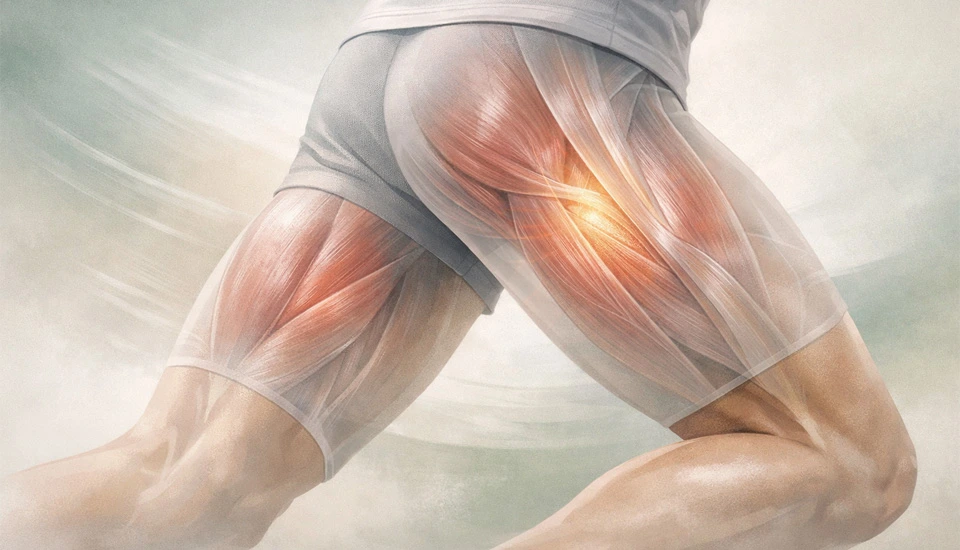
Clinical Insights by Op. Dr. Hilmi Karadeniz
Orthopedic Surgeon & Sports Medicine Physician
Hamstring injuries can be deceptive.
The pain eases. Walking feels normal again. Jogging feels manageable. Then sprinting returns, at least enough to make the athlete think the worst is over. Training resumes. Sometimes matches do too. For a short while, everything seems to hold. Then the same area tightens again, or gives way again, or simply refuses to feel dependable.
That is what makes these injuries so frustrating. Not only because they are common, but because they have a habit of lingering in the background even after the obvious symptoms have settled. In sport, hamstring strains remain among the injuries physicians see again and again. Just as troubling is how often they return.
So the athlete asks the obvious question: why this one, again?
“Hamstring strain” sounds neat on paper. In real life, it rarely is.
The hamstrings cross both the hip and the knee, which means they are involved in more than one job at the same time. They help drive the leg back, control it as it swings forward, absorb force, and deal with high-speed loading when the athlete is accelerating or trying to slow down. In sprint-based sports, that demand becomes extreme, especially in the phase just before the foot hits the ground, when the muscle is lengthening while already under tension. That is one reason these injuries are seen so often in football, athletics, rugby, and other sports built on speed.
But even then, one hamstring injury is not necessarily like the next.
Some are mostly muscular. Some involve the tendon more than expected. Some settle relatively quickly and behave well once load is rebuilt. Others are slower, more irritable, harder to trust. And when tendon-related involvement is part of the picture, the timeline often becomes less straightforward.
That is why it is risky to judge a hamstring only by pain. Two athletes may describe the injury in similar words while dealing with very different problems underneath.

A recurrent hamstring injury is rarely just bad luck.
Very often the athlete comes back at a point where the leg is improved, but not truly restored. Pain may be better. Strength may look acceptable. Basic training may feel fine. Yet something important is still missing.
Sometimes that missing piece is tissue tolerance. Sometimes it is timing. Sometimes it is the way force moves through the pelvis and trunk when speed increases. Sometimes it is the athlete’s willingness to fully trust the leg again. And sometimes the problem is more subtle than pure weakness. The hamstring may hold up in controlled work but behave differently under fatigue, or when sprinting mechanics become less tidy late in a session.
That is part of the reason recurrence is so common. The first injury changes the way the system behaves, even if only slightly. The athlete may not notice it at first. The body may compensate well enough to get through training. But competition tends to expose what training can hide.
Previous hamstring injury remains one of the clearest warning signs for another one. Once an athlete has had one, the threshold for the next is often lower—especially if the return happened a little too early, or if the process looked complete from the outside before it really was.
Athletes do not usually describe recurrent hamstring problems in dramatic terms.
They say things like:
“It opens up, but not completely.”
“It’s okay until I really sprint.”
“It doesn’t hurt much. I just don’t trust it.”
“It’s there, but only when I push.”
Those comments matter.
They usually point to the space between ordinary function and true sporting readiness. That space is where a lot of recurrent hamstring trouble lives. The athlete can walk, jog, lift, even train. But once the movement becomes fast, repeated, reactive, or tired, the weakness in the chain shows itself again.
That is why everyday comfort tells us very little on its own. A leg that feels fine in the gym can still be wrong for high-speed running. A hamstring that tolerates warm-up can still fail once the session becomes chaotic, competitive, or fatigued.
The body is good at helping athletes get by. Sport is good at showing where “getting by” stops.

The first phase of rehabilitation usually gets the most attention. Diagnosis, early pain control, restoring basic movement, reintroducing strength. All of that matters.
But with hamstrings, the more decisive phase is often the one that comes later, when the athlete is nearly back and everyone is tempted to think the difficult part is over.
That is where things become murkier.
Most return-to-play decisions still lean on a familiar combination: symptoms, flexibility, strength measures, running progression, general function. None of that is useless. The problem is that none of it gives certainty either.
That matters because a hamstring does not have to be obviously weak to be vulnerable. It may cope with straight-line running and still react badly to repeat sprinting. It may feel settled in controlled drills and then tighten during a high-speed kick, a chase, or the final part of a match when fatigue begins to change mechanics.
So yes, this is exactly why being pain-free is not enough.
Pain tells you something. It does not tell you everything.
A player can be pain-free and still not be ready for the exact things the sport will demand five minutes after kickoff.
Hamstring injuries rarely belong only to the tissue itself.
They sit inside a larger context: match congestion, abrupt spikes in running volume, poor recovery, repeated maximal efforts, underexposure to sprinting, or the opposite problem—too much too soon after time away. All of that matters.
That is why I do not see hamstring recurrence only as a rehabilitation issue. It is often a loading issue too.
If an athlete is pushed back into full intensity too early, the tissue may still be healing while already being asked to tolerate competitive force. If sprint work has been reintroduced too cautiously, the athlete may return without having rebuilt capacity for the exact stress that matters most. If overall load climbs faster than the leg can adapt, recurrence becomes easier. If sport-specific exposure stays too low, the athlete may look good in clinical testing and then struggle the moment the game becomes fast and unpredictable.
This is where medicine, rehabilitation, and coaching need to meet each other honestly.
The real question is not simply, Has the hamstring improved?
It is, Has the athlete been prepared for sport again?
Those are not identical questions.
Athletes often describe recurrence as if the original injury has simply repeated itself.
Sometimes that is true. Sometimes it is not.
A second episode may involve the same site, but it may also reflect something left unresolved in the surrounding system. A change in running mechanics. Protective behavior that became habitual. Asymmetry at speed. Tendon-related irritation that behaves differently from the original muscular injury. Scar behavior. Pelvic control. Trunk timing.
So when the hamstring “goes again,” the useful response is not to shrug and call it bad luck.
Usually it is a clue.
Something in the earlier recovery did not settle as completely as everyone hoped. That could be tissue healing, loading progression, movement behavior, or how readiness was judged near the end. Whatever the reason, recurrent hamstring injuries deserve a wider look than they often get.
That broader view is exactly why these cases should not be reduced to a stretching routine or one favored strengthening drill. They ask for a fuller understanding of how the athlete moves, loads, recovers, and returns.
The Nordic hamstring exercise deserves its place in this discussion. It has value, and there is a reason it appears so often in prevention conversations.
But recurrent hamstring injury cannot be reduced to one exercise, however useful that exercise may be.
Prevention usually works better when it is treated as a combination of things that reinforce one another: sensible sprint exposure, eccentric strength, control around the pelvis and trunk, fatigue management, gradual return to high-speed running after injury, and special attention to athletes who already carry a history of hamstring trouble.
That is one reason these injuries remain so persistent in real sport. They are never just about the muscle. They sit at the point where tissue healing, running mechanics, performance demands, recovery habits, and schedule pressure all meet.
The body does not divide those things into neat categories, even if sports systems sometimes try to.

When a hamstring keeps causing trouble, the temptation is sometimes to assume the answer must lie in something more advanced. Usually it does not.
Most of the time, the important things are still the ordinary things: how the athlete rebuilt load, whether strength truly came back, how sprinting was reintroduced, whether movement settled properly, and whether the decision to return was honest rather than optimistic.
That is still the foundation.
At the same time, sports medicine has become more interested in the biological side of recovery itself. Not in a dramatic way, but in a practical one. Why does one tissue calm down and rebuild smoothly while another stays reactive? How do muscle and tendon repair unfold over time? What shapes the environment in which healing happens?
That is where regenerative medicine sometimes enters the conversation. Stem cells and exosomes are mentioned because researchers are trying to understand tissue signaling, repair biology, and the conditions that surround healing. They belong to a wider scientific discussion about how recovery happens at the cellular level and why some tissues regain tolerance more smoothly than others.
Still, that interest should be kept in proportion. Stem cells, exosomes, and regenerative medicine do not replace rehabilitation, and they are certainly not a shortcut past the slower work of rebuilding an athlete properly.
With hamstring injuries, the central task remains the same: diagnose clearly, progress carefully, and make return-to-sport decisions without pretending that eagerness and readiness are the same thing.
What makes hamstring injuries so stubborn is that sport tests the exact things that do not come back neatly or all at once. Speed. Rhythm. Repeatability. Confidence. Tolerance under fatigue.
That is where recurrence usually hides.
An athlete can look close. Sometimes very close. The leg may feel mostly normal. Training may go reasonably well. But competition has a way of finding whatever was left unfinished.
So when a hamstring injury comes back, the more useful question is not only, Why did it happen again?
It is, What was still missing when the athlete returned?
That question is usually less comfortable.
It is also usually more useful.
Because symptoms often settle before the whole problem does. The athlete may feel much better, but sprint capacity, tissue tolerance, timing, and control can take longer to return. A previous hamstring injury also raises the chance of another one.
They can be. Very often the second injury is more disruptive simply because the athlete thought the issue was already over. It may lead to more lost time, more caution, and a harder road back.
No. Pain-free movement is helpful, but it is not a complete test of readiness. Many athletes feel fine in basic running or gym work and still struggle when speed, fatigue, or repeated efforts enter the picture.
Sometimes, yes. When tendon structures are involved, recovery can become less predictable and the return to speed may need to be handled more carefully.
No. They may be part of a broader scientific discussion about tissue repair and recovery biology, but they do not replace good diagnosis, careful progression, sprint exposure, and sensible return-to-sport judgment.
No. Sport does not allow that kind of certainty. But the risk can often be reduced when athletes build strength properly, keep appropriate sprint exposure in their training, manage load sensibly, and pay close attention to previous injury history.