Clinical Insights from Prof. Dr. Serdar Kabataş, MD, PhD (C)
Perianal Crohn’s Disease Is Not Only a Skin Problem
Patients sometimes describe it very quietly.
They say there is drainage.
Or pain when sitting.
Or a swelling near the anus that comes and goes.
Some say:
“It closes for a while, then opens again.”
Others say:
“I thought it was only an abscess.”
But in Crohn’s disease, a problem around the anus may be more than a local skin infection. It may be part of the disease itself.
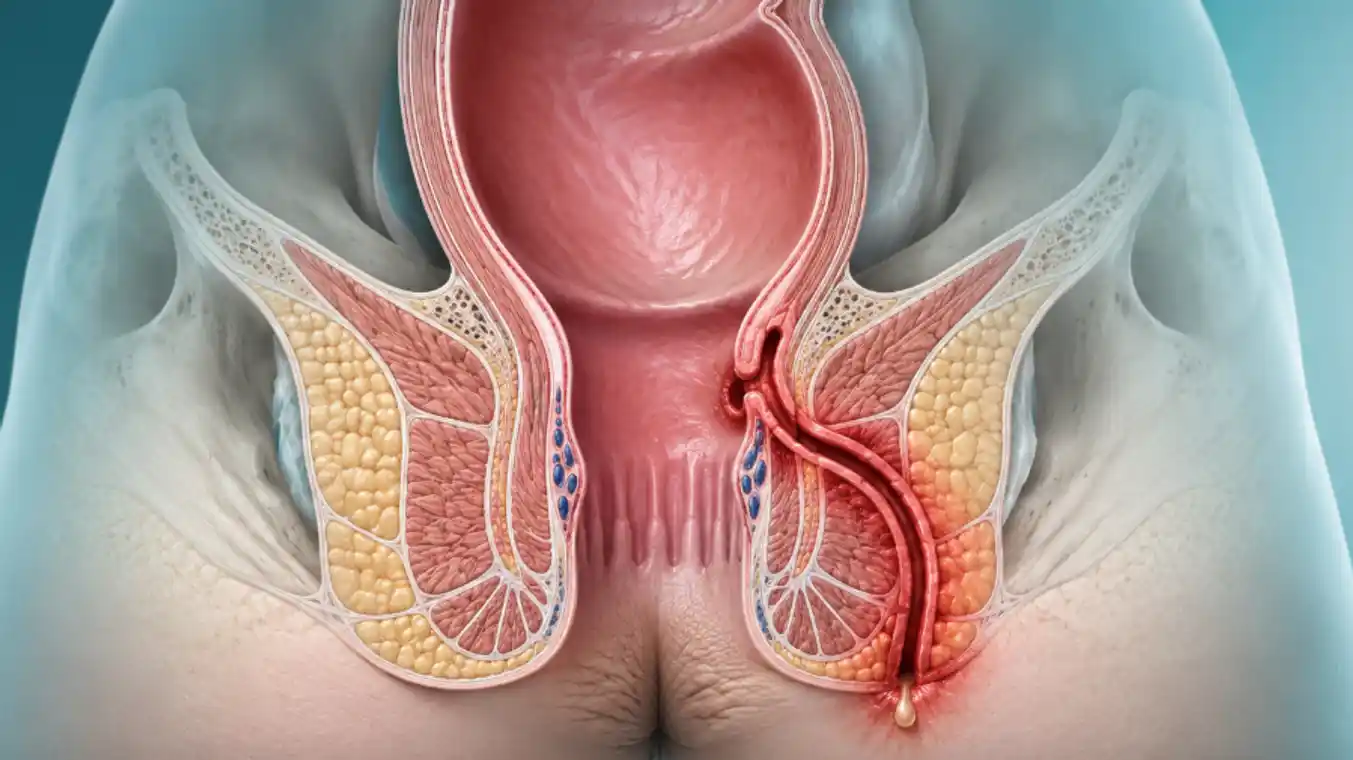
Perianal Crohn’s disease can involve the skin, the anal canal, the rectum, deeper tissues, and sometimes complex fistula tracts. A fistula is an abnormal tunnel. It may connect the rectum or anal canal to the skin. Sometimes it has one opening. Sometimes more. Sometimes it branches. Sometimes it hides deeper than the patient expects.
This is why perianal Crohn’s disease needs careful attention.
It is not only about stopping drainage for a few days.
It is about understanding the anatomy, the inflammation, and the disease activity behind it.
Table of Contents
What a Perianal Fistula Means in Crohn’s Disease
A perianal fistula is an abnormal passage near the anus or rectum.
In simple words, it is a tunnel that should not be there.
The inside opening may begin in the anal canal or rectum. The outside opening may appear on the skin near the anus. Fluid, pus, or blood may drain from it. Sometimes the drainage decreases. Sometimes it returns suddenly. Sometimes the area becomes painful and swollen because an abscess forms.
Patients often ask:
“Why does it keep coming back?”
The answer is not always simple.
In Crohn’s disease, inflammation can affect the deeper layers of the bowel wall. This makes fistula formation more likely than in many other conditions. The tissue may not heal normally. The immune system may remain active. Infection may collect. The rectum may be inflamed. The fistula tract may stay open even when the skin looks better from the outside.
That is one of the reasons perianal fistula treatment can be difficult.
The outside opening is only what we see.
The real problem may be deeper.
Why Fistulas Can Close and Open Again
Many patients with Crohn’s fistulas experience the same frustrating pattern.
The drainage becomes less.
The skin looks calmer.
The patient feels hopeful.
Then, after some weeks or months, the fistula opens again.
This does not always mean that the previous treatment was wrong. It may mean the fistula tract was still active under the skin. It may mean inflammation in the rectum was not controlled. It may mean there was a small abscess. It may mean the biologic therapy was not strong enough, not at the right level, or no longer working as expected.
Sometimes the skin heals before the inside heals.
That can be a problem.
If the outer opening closes while infection remains inside, pressure may build up. Then pain, swelling, fever, and abscess formation can follow.
This is why doctors are careful with fistulas. Closing the skin is not enough. We need to know whether the tract is quiet, whether infection is controlled, and whether Crohn’s inflammation is active.
A fistula that looks small from outside can still be complex inside.
Symptoms Patients Should Take Seriously
Perianal Crohn’s disease can feel embarrassing for patients. Many delay care because they do not want to talk about drainage, pain, or swelling near the anus.
But these symptoms are medical symptoms.
There is no shame in them.
Patients should speak with a doctor if they notice:
- drainage near the anus
- pus or blood from a small opening
- pain when sitting
- swelling around the anus
- fever or chills
- repeated abscesses
- pain during bowel movements
- irritation or skin wounds
- a feeling of pressure near the rectum
Some symptoms need faster attention.
Fever, increasing pain, a painful lump, chills, weakness, or rapidly worsening swelling may suggest an abscess. An abscess should not wait. It may need drainage and proper infection control.
In perianal Crohn’s disease, waiting too long can make a difficult problem more difficult.
Why MRI Matters in Perianal Crohn’s Disease
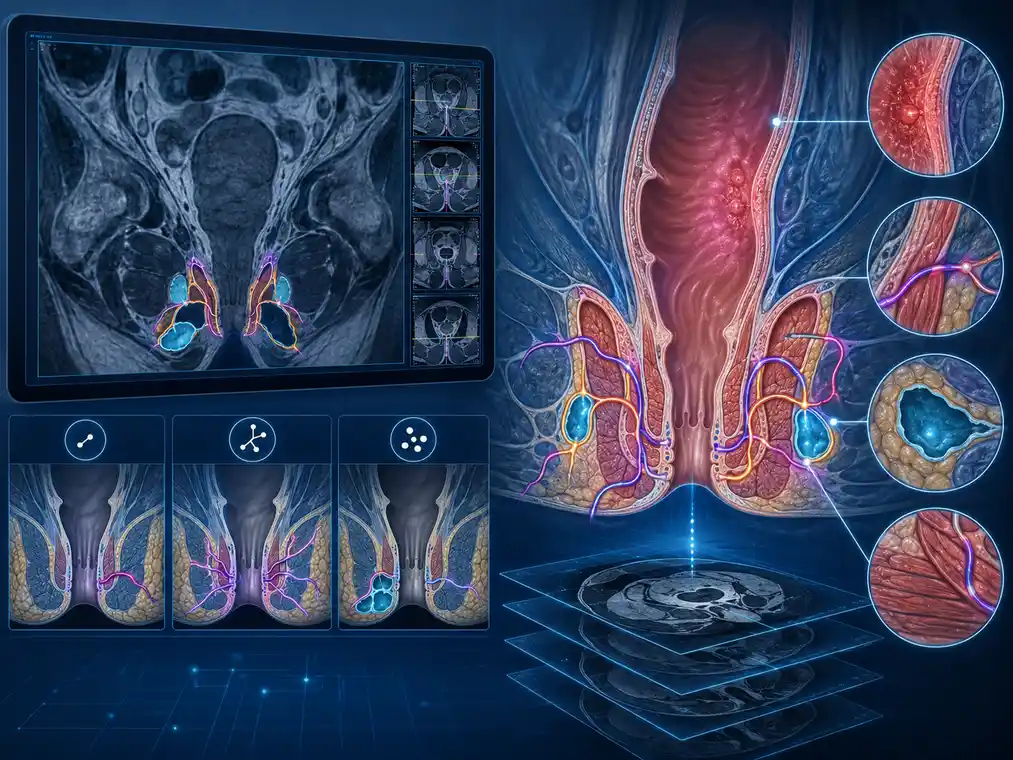
The doctor cannot understand every fistula by looking from the outside.
This is why pelvic MRI is often important.
MRI can show where the fistula goes. It can show whether there is one tract or several. It can show abscess formation, branching, involvement of sphincter muscles, and whether the rectum is inflamed.
This changes the treatment plan.
A simple fistula and a complex fistula are not treated the same way. A fistula with abscess is different from a fistula without abscess. A fistula with active rectal inflammation is different from one where the rectum is quiet.
Patients sometimes ask:
“Why do I need MRI if the opening is visible?”
Because the visible opening is not the whole disease.
With Crohn’s fistulas, the map matters.
Without a map, treatment becomes guessing.
The Role of Gastroenterology and Colorectal Surgery
Perianal Crohn’s disease often needs more than one specialist.
Gastroenterology is needed because Crohn’s disease activity must be controlled. The bowel and rectum must be assessed. Medication may need adjustment. Biologic therapy may need to be started, optimized, switched, or combined with other measures.
Colorectal surgery is needed because fistula anatomy matters. Abscesses may need drainage. A seton may be placed. The surgeon may need to keep the tract open enough to drain safely while inflammation is treated.
This cooperation is important.
If we treat only the immune disease and ignore the abscess, the patient may worsen.
If we treat only the abscess and ignore Crohn’s inflammation, the fistula may return.
Both sides matter.
Perianal fistula treatment is not only a medication decision. It is also an anatomical decision.
What a Seton Does and Why It May Be Needed
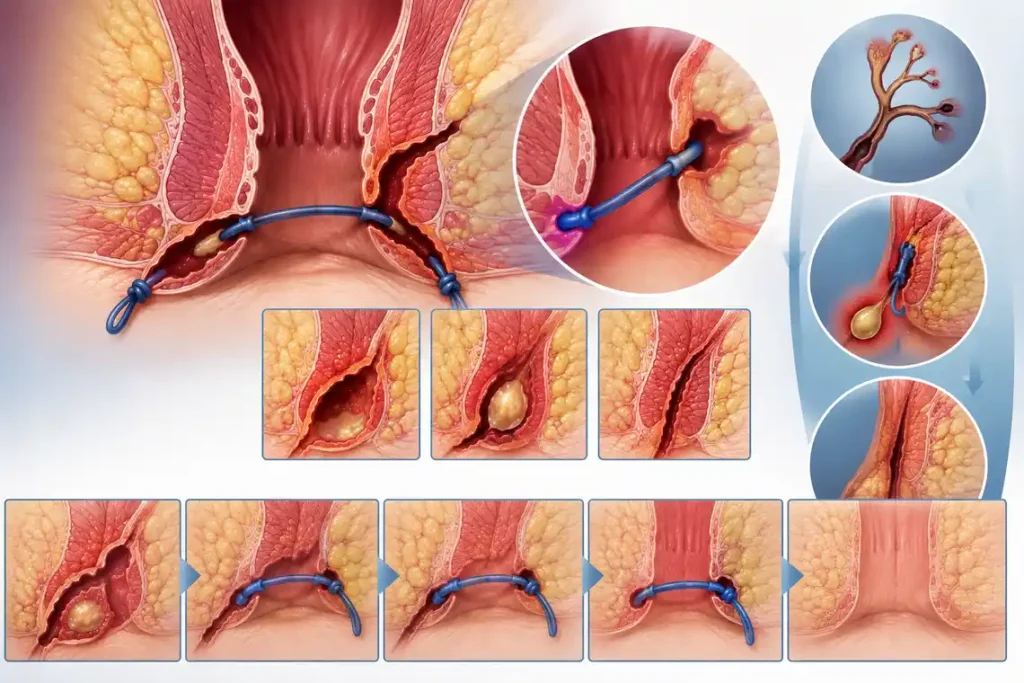
A seton is a thin surgical thread or loop placed through a fistula tract.
Patients sometimes become worried when they hear this. They think it means the fistula is being left open forever.
That is not the idea.
A seton may help the fistula drain safely. It can reduce the risk of pus collecting inside and forming another abscess. It may also give time for medical treatment to control inflammation.
In Crohn’s disease, forcing a fistula to close too early can sometimes create problems. If infection remains trapped, the patient may develop pain and abscess again.
So, in selected patients, a seton is not a failure.
It is part of a staged plan.
First control infection.
Then control inflammation.
Then consider whether closure is possible.
The order matters.
Why Biologic Therapy May Help but Not Always Solve the Problem
Biologic medicines can be very important in perianal Crohn’s disease.
Anti-TNF therapy, for example, has been used in fistulizing Crohn’s disease for many years. Other biologic options may also be considered depending on the patient’s history, disease pattern, and previous response.
But biologic therapy is not magic.
It may reduce inflammation.
It may reduce drainage.
It may help some fistulas heal.
But it may not close every fistula.
If there is an abscess, medication alone is usually not enough. If the fistula tract is complex, surgical management may still be needed. If drug levels are low, the biologic may not work well enough. If antibodies develop, response may be lost. If the rectum remains inflamed, fistula healing becomes harder.
This is why perianal Crohn’s disease should not be judged only by symptoms.
Sometimes the patient feels better, but MRI still shows activity.
Sometimes drainage decreases, but the tract remains.
Treatment decisions need the whole picture.
Why Some Fistulas Become Chronic
A fistula can become chronic when the tract stays open for a long time.
In Crohn’s disease, several factors can contribute to this:
- ongoing rectal inflammation
- repeated abscess formation
- complex branching tracts
- poor tissue healing
- smoking
- malnutrition
- anemia
- uncontrolled bowel inflammation
- medication failure
- previous surgery
- delayed diagnosis
The body cannot heal well if inflammation continues.
Healing also needs nutrition, blood supply, infection control, and time. If the patient is weak, losing weight, anemic, or inflamed, the tissue may not respond normally.
This is one reason a fistula should not be treated as a small isolated wound.
It belongs to the larger Crohn’s disease picture.
When Stem Cell Therapy Enters the Discussion
Stem cell therapy is often discussed in Crohn’s disease because of perianal fistulas.
This is the area where the conversation is most serious.
In selected patients with complex perianal fistulas, mesenchymal stem cells have been studied as a local supportive treatment. The idea is not that stem cells become new bowel tissue. The more realistic idea is that they may influence inflammation, immune signaling, and the local wound environment.
This may help create better conditions for healing in selected cases.
But this must be said carefully.
Stem cell therapy is not a cure for Crohn’s disease. It is not a replacement for drainage, seton placement, biologic therapy, infection control, or proper imaging. It should not be offered before the fistula anatomy is understood.
If there is an abscess, it must be treated first.
If the rectum is inflamed, that matters.
If Crohn’s disease is active in the bowel, that also matters.
A stem cell discussion without MRI and proper Crohn’s assessment is not enough.
What Regenerative Medicine Cannot Promise
Patients with long-term fistulas are tired.
They are tired of drainage.
Tired of pads.
Tired of antibiotics.
Tired of surgery appointments.
Tired of hope that does not last.
This is exactly why we must avoid strong promises.
Regenerative medicine cannot promise that every fistula will close. It cannot promise that a fistula will never return. It cannot promise that biologic medicines will no longer be needed. It cannot promise that surgery will be avoided. It cannot promise that Crohn’s disease will disappear.
In selected cases, regenerative medicine may be part of a broader treatment discussion.
But the patient must know what is realistic.
A careful treatment plan is better than a beautiful promise.
When Surgery Becomes Necessary
Surgery in perianal Crohn’s disease does not always mean a large operation.
Sometimes surgery means drainage of an abscess. Sometimes it means placing a seton. Sometimes it means examining the fistula under anesthesia. Sometimes it means treating complications before medication can work safely.
In more difficult cases, additional surgical strategies may be discussed. But the decision depends on fistula anatomy, sphincter involvement, rectal inflammation, previous treatments, and the patient’s general condition.
Patients sometimes fear surgery because they think it means everything has failed.
That is not always true.
In perianal Crohn’s disease, surgery may be what makes medical treatment safer. It may control infection. It may prevent abscess recurrence. It may help define the tract. It may protect the patient from worsening sepsis.
The question is not:
“Medication or surgery?”
Often the better question is:
“What combination is safest for this fistula?”
Safety Signs Patients Should Not Ignore
Some symptoms should not be watched quietly at home.
A painful swelling near the anus, fever, chills, increasing pain, weakness, foul-smelling drainage, or difficulty passing stool should be checked quickly.
Severe abdominal pain, vomiting, dehydration, heavy bleeding, confusion, or rapid worsening also need urgent medical care.
A Crohn’s patient may become used to discomfort.
But perianal abscess can progress.
Fever and a painful lump near the anus should not wait for a routine appointment. They may need urgent drainage and antibiotics.
This is not written to frighten patients.
It is written because timing matters.
How I Usually Explain Perianal Crohn’s Disease in the Clinic
When a patient comes with a Crohn’s fistula, I first try to reduce shame.
This is a disease problem.
Not a personal problem.
Then I explain that we need to know three things.
First, what is the anatomy?
Where does the fistula go? Is there one tract or more? Is there abscess?
Second, what is the inflammation doing?
Is the rectum inflamed? Is bowel Crohn’s active? Are medications working?
Third, what is the safest sequence?
Drainage first? Seton first? Biologic optimization? Surgery? Stem cell-based local treatment in a selected case?
The answer is not the same for every patient.
A small fistula with no abscess is one situation.
A complex fistula with rectal inflammation is another.
A recurrent abscess is another.
This is why perianal Crohn’s disease needs patience and planning.
Not shortcuts.
Final Thoughts on Perianal Crohn’s Disease
Perianal Crohn’s disease can be one of the most difficult parts of Morbus Crohn.
Not only medically.
Emotionally too.
Patients may feel embarrassed, tired, or hopeless after repeated drainage, abscesses, or fistula recurrence. But difficult does not mean impossible to approach.
The first step is proper assessment.
We need to understand the fistula anatomy, the presence of abscess, rectal inflammation, bowel disease activity, previous treatment response, and the patient’s general condition.
Only then can treatment become logical.
Sometimes the answer is medication optimization. Sometimes drainage. Sometimes seton placement. Sometimes biologic change. Sometimes surgery. Sometimes regenerative medicine may be discussed as a supportive option in selected cases.
The goal is not only to close an opening in the skin.
The goal is to treat the disease process behind it.
Frequently Asked Questions About Perianal Crohn’s Disease
Can a Crohn’s fistula heal on its own?
Sometimes drainage may decrease for a while, but a true Crohn’s fistula should not be ignored.
It may still be active under the skin. If infection becomes trapped, an abscess may form. A fistula needs proper evaluation, especially if it returns, drains repeatedly, or causes pain.
Why does my fistula keep coming back?
There may be several reasons.
The tract may still be open inside. There may be active rectal inflammation, an abscess, low drug levels, medication failure, or complex branching anatomy. This is why pelvic MRI and proper Crohn’s assessment are often important.
Is biologic therapy enough for perianal Crohn’s disease?
Sometimes it helps a lot.
But biologic therapy may not be enough alone, especially if there is an abscess or a complex fistula tract. Many patients need combined care from gastroenterology and colorectal surgery.
Do I always need surgery for a perianal fistula?
Not always.
But some procedures may be needed, especially if there is abscess, recurrent infection, or complex anatomy. Surgery may mean drainage or seton placement, not necessarily a large operation.
Can stem cell therapy help Crohn’s fistulas?
In selected complex perianal fistulas, mesenchymal stem cells have been studied as a local supportive treatment.
But it is not a cure for Crohn’s disease. It should only be discussed after proper imaging, infection control, and assessment of Crohn’s activity.
When a Careful Fistula Review Makes Sense
Perianal Crohn’s disease can look small from the outside, but the real problem may be deeper. The fistula tract, abscess risk, rectal inflammation, previous treatments, and current symptoms all matter.
If drainage, swelling, pain, or repeated opening keeps coming back, the next step should not be a promise. It should be a careful review of the reports, imaging, and Crohn’s disease pattern.