Regenerative Medicine


Clinical insights from Prof. Dr. Serdar Kabataş, MD, PhD (C)
Getting older is an abstract subject until something changes. Stairs become harder. Recovery takes longer. An activity that used to be enjoyable starts to feel like too much effort.
These changes are often what bring a person to a consultation. They may ask about longevity or a new treatment, but their concern is usually more immediate: “How can I keep doing the things I do now?”
As a neurosurgeon, I approach healthy aging through that question. Movement, sensation, memory and judgement all contribute to independence. Losing even a small part of one ability can change someone’s routine considerably.
I am interested in the research on stem cells, exosomes and immune-based approaches. To discuss their possible role sensibly, we need to understand the processes they are intended to influence.
One of those processes is immune aging. The immune system helps protect us from infection, recognises certain abnormal cells and participates in the response to tissue damage. Its behaviour changes over a lifetime, with consequences that extend beyond how often we catch a cold.
Age alone tells me little about what a person needs.
Two patients in their seventies may have very different levels of strength and mobility. One may be working and travelling. Another may have lost confidence after a fall and stopped going out.
Their priorities will be different too.
We use lifespan to describe how long someone lives. Healthspan refers to the years lived with good health and useful function. Both belong in a discussion about longevity.
For the person sitting in front of me, useful function might mean being able to dress without assistance or walk to the local shop. For someone else, it means continuing a physically demanding hobby.
A diagnosis does not automatically prevent healthy aging. Many people remain independent while living with well-managed diabetes, high blood pressure or a neurological condition. Their care should account for what they want to keep doing.
I would also be reluctant to explain a new problem simply by saying, “You are getting older.” A change in balance, persistent fatigue or increasing forgetfulness deserves attention. There may be a cause we can treat.
Our immune system carries a history. It has responded to infections and vaccinations, dealt with injuries and encountered changes in our own cells.
Over time, the tissues that produce and maintain immune cells also change.
The term immunosenescence describes age-related changes in immune function. It does not mean that immunity stops working at a particular birthday. Some responses become less effective; others become harder to regulate.
There is considerable variation between people. Existing illness, medication, nutrition and previous infections all influence the picture.
This is why the idea of simply “boosting” immunity can be misleading. We need an appropriate response to a threat, followed by a return to a more settled state. Persistent immune activity can cause problems of its own.
T cells perform several jobs. Some help coordinate an immune response. Others destroy infected or abnormal cells.
After an infection or vaccination, certain T cells remain as memory cells. They help the body recognise something it has encountered before.
For an unfamiliar threat, we also depend on naive T cells—cells that have not yet met their specific target. Their supply generally declines with age. The thymus, where T cells mature, becomes less active over time.
The balance gradually shifts towards cells shaped by earlier encounters. The immune system retains experience, while its ability to respond to something new may become less flexible.
These changes help explain why certain infections can be more difficult in later life. They are also one reason appropriate vaccination remains relevant.
Natural killer cells, or NK cells, are part of the innate immune system. They can recognise certain signs of stress or abnormality on other cells and respond without first developing the same specific immune memory as T cells.
Researchers study them in cancer and in the biology of aging. Among their activities is the recognition of some senescent cells.
Counting NK cells in a blood sample gives us only part of the information. Their ability to recognise a target, become activated and carry out their response matters as well.
Age can affect these functions. Having more cells does not necessarily mean that surveillance is more effective.
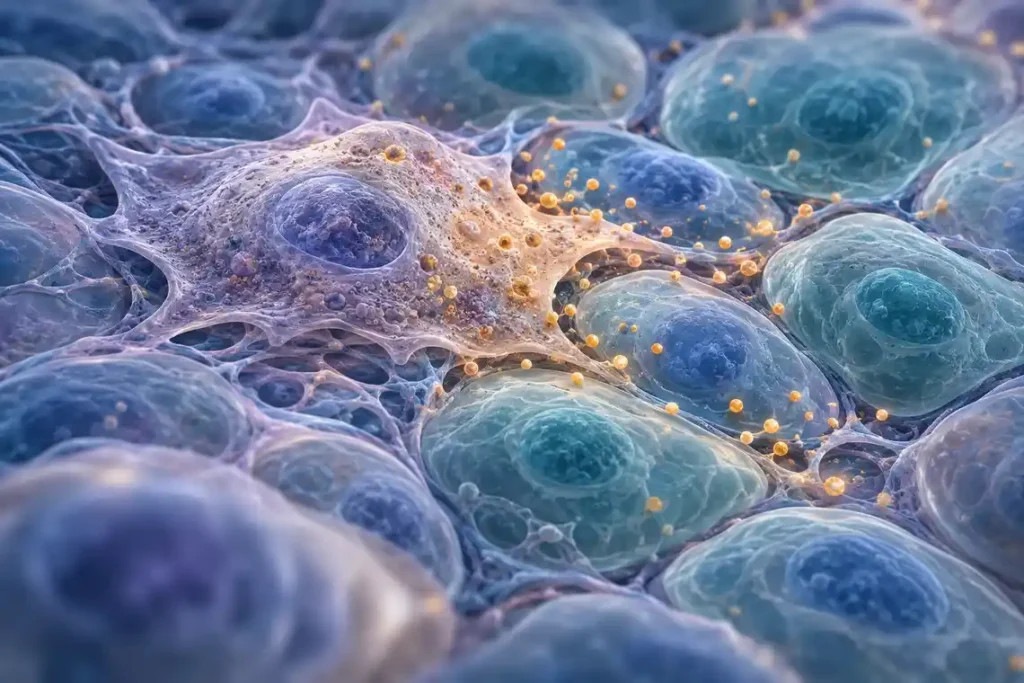
“Zombie cells” is a memorable expression. The scientific term is senescent cells.
A senescent cell has stopped dividing but remains alive. It can still release substances that affect nearby cells.
Senescence may develop after repeated cell division, DNA damage or other stress. It has useful roles. Stopping a damaged cell from multiplying can help limit cancer development, and temporary senescence contributes to wound healing.
The concern is what happens when particular senescent cells persist.
Some release inflammatory signals and other substances that change the surrounding tissue environment. This collection of secretions is known as the senescence-associated secretory phenotype, or SASP.
There is no single behaviour shared by every senescent cell. Their effects depend on the tissue, their biological activity and how long they remain.
Immune cells help remove cells that are no longer needed. If that clearance becomes less efficient, senescent cells may accumulate.
Research is therefore concerned with identifying which cells are contributing to harm and whether they can be targeted selectively. Their useful functions are a reason to be precise about what we try to remove.
After an infection or injury, inflammation helps organise the response. Once the immediate problem has passed, that response should subside.
In later life, low-level inflammatory activity can remain. Researchers call this inflammaging.
Senescent cells may contribute, alongside changes in metabolism, tissue health and immune regulation. Chronic conditions can add further sources of inflammation.
A person can therefore have a less effective response to a new infection while also having more background inflammatory activity. These involve different aspects of the immune system.
Researchers are examining how these changes relate to cardiovascular disease, metabolic disorders and neurological conditions. The contribution varies between diseases and individuals.
In a consultation, however, “inflammaging” would not be enough to explain fatigue or difficulty concentrating. I would still need to consider sleep, medication, medical history and when the symptoms began. An inflammatory marker may add information, but it cannot replace that assessment.
Before discussing an intervention, I would want to understand why someone’s daily life has changed.
Perhaps knee pain has made them stop walking. Perhaps they eat less because preparing meals has become difficult. Perhaps they became unsteady after a medication change.
These details influence what we do next. A healthy aging plan should be based on the person’s circumstances, including problems that can be addressed now.
One question I would ask is whether getting out of a chair has become harder. It is an ordinary task, but it can reveal a loss of strength that the person has barely noticed.
Walking is useful, although it does not give every muscle the work it needs. Some form of resistance exercise usually belongs in the discussion as well.
I would want to know about pain, weakness, previous surgery and any difficulty with balance before recommending a programme. A person with a neurological condition may need a physiotherapist to help choose suitable exercises.
For someone who has been inactive, the first step may be quite small. The starting point should allow them to return the following day or week without feeling that the programme is beyond them.
Fear of falling needs attention too. Once someone stops going out because they feel unsafe, it becomes easier to lose further strength. Assessing the reason for that fear can help us decide whether balance work, rehabilitation or another intervention is needed.
Before recommending a supplement, I would ask what the person actually eats during an ordinary day.
Is breakfast being skipped? Has dinner become tea and a piece of bread? Does chewing hurt? These questions can be more useful than asking whether the diet is “healthy.”
A loose denture, poor appetite or difficulty standing in the kitchen may gradually reduce food intake. Sometimes the family notices that clothes have become looser before anyone mentions weight loss.
Unintentional weight loss should be assessed. It should not automatically be welcomed because the person used to be overweight.
Protein intake deserves attention when strength is declining. A varied diet also needs to provide enough energy and include foods such as vegetables, fruit, legumes and whole grains.
Advice should account for medical conditions. Someone with kidney disease, for example, may need a different nutritional plan. I would rather clarify those needs than give every patient the same list of foods or supplements.
If a patient says they are tired all day, I ask about the night.
How often do they wake? Does anyone hear them snoring? Have breathing pauses been noticed? Are they taking something to help them sleep?
The answers may point towards a sleep disorder, a medication effect or a routine that needs adjusting. Persistent insomnia and marked daytime sleepiness deserve more than the explanation that older people sleep badly.
Sleep problems can also complicate the assessment of memory complaints. Someone who is exhausted may struggle to concentrate or remember information. That does not tell us the cause on its own, but it makes sleep part of the investigation.
When a patient asks about a newer treatment, I would still want to know whether their blood pressure and diabetes are being managed and whether they smoke.
I would also review their medicines. Dizziness or daytime drowsiness may appear after a new prescription, a dose change or a combination of treatments. Patients should discuss possible changes with their clinician rather than stopping medication themselves.
Vaccination needs can change with age and medical history, so these belong in routine care as well.
Hearing and vision are easy to leave out of a longevity discussion. Yet a person who cannot follow a conversation may begin avoiding company. Someone who cannot see a kerb clearly may stop walking outdoors.
These are practical barriers to independence. They deserve investigation alongside the more specialised questions about aging.
Patients hear about anti-aging treatments from many sources, often without much explanation of what is being treated.
Senolytics, MSCs, exosomes and NAD⁺ are different approaches. Their evidence cannot be combined into one general claim about rejuvenation.
I would begin by agreeing on the purpose. If someone hopes to recover strength after illness, that gives us a different question from whether a treatment can extend lifespan. We also need a way to judge the result.
Senolytics are compounds being studied for their ability to eliminate certain senescent cells.
Another research direction involves helping immune cells recognise selected targets more effectively. Both approaches arise from the possibility that removing a harmful cell population could improve its surrounding environment.
Human studies are testing parts of this idea. The findings remain specific to the condition, treatment and outcome examined. They have not established a general therapy that slows aging in everyone.
Mesenchymal stromal cells, commonly called MSCs, are being investigated for their influence on immune responses and tissue signalling. This includes research involving frailty and declining physical function.
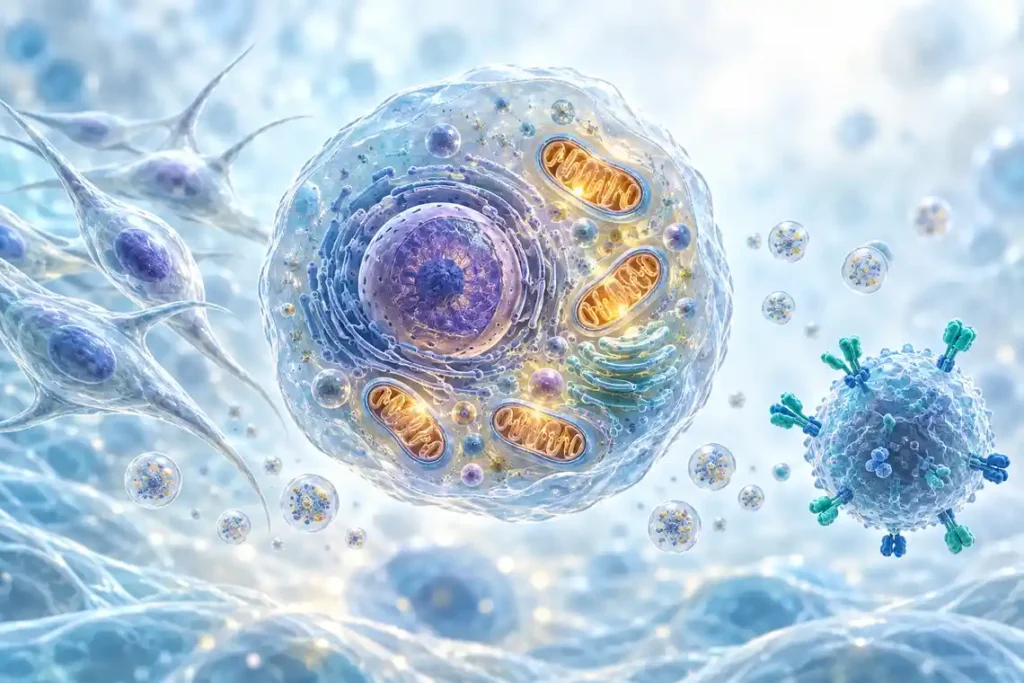
MSC-derived exosomes are also being studied. They carry biological material that can influence other cells, which makes them of interest in regenerative medicine.
We have discussed MSCs and exosomes in our other articles. Here, their relevance is whether a defined preparation can help with a particular problem associated with aging.
The source and preparation matter. A finding involving one product does not establish the effect of every treatment described as an exosome therapy.
NAD⁺ participates in energy metabolism and other essential cellular processes. That has led to interest in supplements and treatments intended to influence its availability.
Some preparations can increase measured NAD⁺ levels. Whether this leads to lasting improvements in strength, recovery or other aspects of health requires a separate assessment.
The preparation and route also matter. Results from an oral precursor study cannot automatically be applied to an infusion.
If fatigue is the main concern, I would first investigate the fatigue. A discussion about NAD⁺ can follow without overlooking another explanation for the symptom.
The interest in CAR-NK exosomes comes partly from the role of NK cells in recognising abnormal cells.
CAR-NK cells are NK cells genetically modified to express a chimeric antigen receptor, or CAR. The receptor is designed to recognise a chosen target.
Exosomes obtained from these engineered cells are being investigated for biological properties they may carry from their parent cells. Our separate CAR-NK exosomes article covers their production and broader research applications.
For healthy aging, an important question is whether a product could act on a defined population of harmful cells or influence a particular tissue environment.
The connection to senescent cells is worth investigating because NK cells participate in their surveillance. Selecting a target requires care, however. Senescent cells differ, and a marker associated with them may also be present on other cells.
We also need to distinguish between an engineered immune cell and the exosomes collected from it. They are different biological products. Findings involving whole CAR cells provide a starting point; the exosomes need their own characterisation and testing.
I find this direction interesting because it could offer a more selective way to address a cellular problem. Demonstrating that selectivity and a useful effect in people is essential to developing the approach.
If someone asks me which longevity treatment they should choose, I would first ask what has prompted the question.
They may have noticed a change in their memory. They may be struggling to regain strength after an illness. Or they may feel well and want advice about maintaining that health.
Each situation calls for a different discussion.
New neurological symptoms need assessment. A concern about future health may call for reviewing risk factors and daily habits. An interest in an emerging therapy requires a clear explanation of what is known about that specific approach.
Research into immune regulation, senescent cells and cellular communication may provide additional options. I welcome the effort to understand these processes more precisely.
For me, their value will ultimately be judged through the patient’s life. Can they walk more comfortably? Can they return to something they have stopped doing? Do they need less help at home?
Those questions give healthy aging a purpose beyond a laboratory result.

There may be several reasons, including reduced muscle reserves, existing conditions, nutrition, medications and changes in immune function. The illness or injury matters too. A substantial change in recovery is worth discussing with your doctor.
There are useful steps at sixty and beyond. Physical activity, adequate nutrition, good sleep, appropriate vaccination and management of existing disease all support health. Frequent infections or persistent fatigue may need investigation.
There is no routine test that reliably counts senescent cells throughout the body and tells you which treatment to choose. Researchers examine these cells using different methods in particular tissues.
Yes. Studies are examining effects relevant to aging and specific problems such as frailty. That does not yet establish that these treatments extend lifespan in healthy people. The purpose and the particular product need to be considered.