Clinical Insights from Prof. Dr. Serdar Kabataş, MD, PhD (C)
COPD Chronic Inflammation: Why It Matters Before Regenerative Medicine
Patients usually describe COPD through breathing.
“I get tired faster.”
“I cannot walk like before.”
“I cough every morning.”
“I recover slowly after infections.”
“I feel my lungs are never really calm.”
That last sentence is important.
Because in many COPD patients, the lungs are not calm.
Even when there is no fever.
Even when there is no obvious infection.
Even when the patient says, “I stopped smoking years ago.”
Even when the inhalers are being used correctly.
Something may still be active in the background.
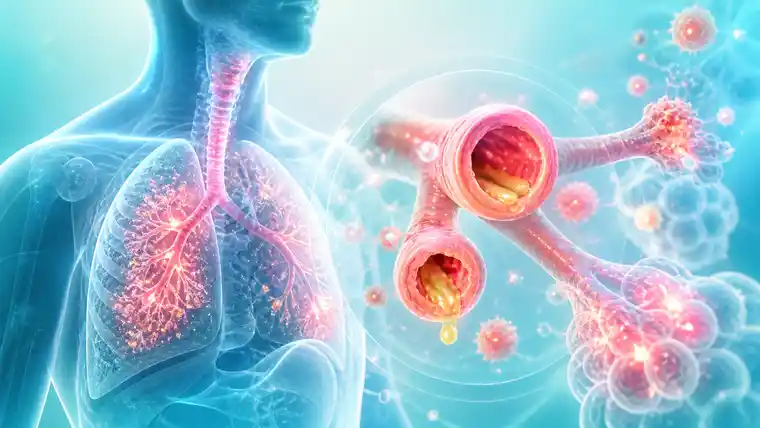
This is one of the difficult parts of COPD. The disease is not only about air moving through narrow tubes. It is also about the condition of the lung environment itself.
And in many patients, that environment remains irritated.
This is where chronic inflammation becomes important.
Not dramatic inflammation.
Not always painful inflammation.
Not the kind patients can point to with one finger.
Something slower. Quieter. More persistent.
But very real.
Table of Contents
Why COPD Is Not Only a Breathing Problem
COPD is usually explained with airflow.
How much air can the patient blow out?
How fast?
How much does it improve after medication?
How much air gets trapped inside the lungs?
These measurements matter. We need them. Spirometry is important but not everything.
Two patients may have similar lung function results, but very different daily lives. One may walk slowly but steadily. Another may have repeated flare-ups, chronic mucus, poor sleep and fear of the next infection.
The difference is not always visible in one test.
COPD affects the airways, the small air sacs, the immune response, the mucus glands, the blood vessels, the breathing muscles and sometimes the whole body. A disease that begins in the lungs can slowly change how a person moves, sleeps, eats, speaks and plans the day.
That is why I do not like reducing COPD to one number.
FEV1 matters.
Oxygen matters.
CT findings matter.
But the patient in front of us matters more.
And when a COPD patient says, “My lungs feel irritated all the time,” I listen carefully.
Because very often, that is exactly what is happening biologically.
What Chronic Inflammation in COPD Really Means
Inflammation is not always bad.
The body needs inflammation. It is part of protection and repair. When there is infection or injury, immune cells arrive. Signals are released. The body tries to defend itself.
That is normal.
The problem begins when this response does not switch off properly.
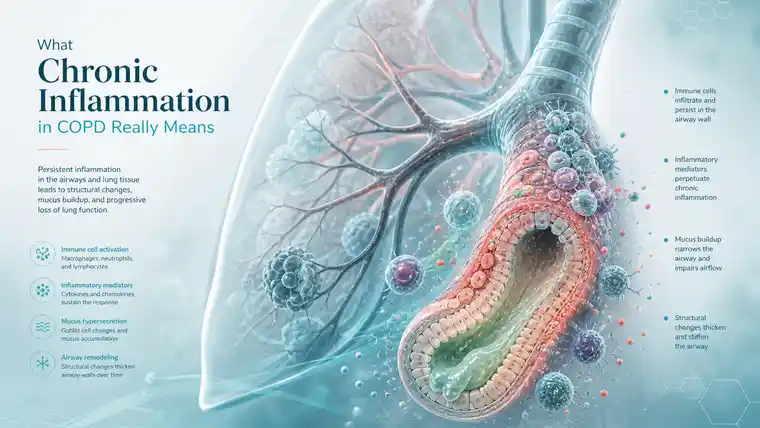
In COPD, the lungs may remain in a state of low-grade irritation for years. Immune cells stay active. Chemical signals continue. The airway lining remains sensitive. Mucus production may increase. Small airways become more reactive and narrowed.
At first, inflammation is a response to injury.
Later, it becomes part of the disease.
This is why COPD can continue to progress even after the first trigger has been removed. A patient may stop smoking. They may avoid dust. They may take their inhalers. And still, the lungs may not fully return to a quiet state.
This can be frustrating for patients.
They say, “But I did what I was told.”
Sometimes they did.
But COPD has memory.
The lung tissue remembers years of irritation. The immune system may remain trained in the wrong direction. The small airways may have already changed shape. The alveoli may have lost elasticity. The repair process may no longer be clean.
So the question becomes different.
Not only:
“What caused the damage?”
But also:
“What is still keeping the lungs irritated now?”
Why the Lungs Keep Getting Irritated
There is rarely one single reason.
In some patients, smoking started the process. In others, pollution, workplace dust, chemical exposure, repeated infections, untreated asthma, or long-term airway sensitivity may have contributed.
But once COPD is established, irritation can continue from several directions.
The airway lining may become fragile.
Mucus may stay thick.
The small airways may trap air.
Breathing muscles may work harder.
Oxygen exchange may become less efficient.
The immune system may remain over-alert.
Each infection may leave the patient weaker than before.
This is not the same as a fresh injury.
It is more like a wound that never fully settles.
Some days are better. Some days are worse. But the background vulnerability remains.
This is why COPD patients often fear winter. Or crowded places. Or a simple cold. Because they know that for them, an infection may not be “just a cold.”
It may become a flare-up.
And after a flare-up, many patients do not return exactly to where they were before.
That is one reason inflammation matters so much.
Inflammation, Mucus and the Small Airways
Patients often underestimate mucus.
They think mucus is just an annoying symptom.
But in COPD, mucus can tell us a lot.
When the airway lining is chronically irritated, mucus glands may become more active. The mucus may become thicker. The small cilia that normally help clear the airways may not work as well. Bacteria and particles may stay longer than they should.
Then the cycle continues.
Irritation creates mucus.
Mucus blocks small airways.
Blocked airways trap air.
Trapped air makes breathing harder.
Harder breathing creates fatigue.
Infections become easier.
Inflammation increases again.
Patients feel this as heaviness.
And when mucus, airway narrowing and inflammation continue together, the lungs become less stable.
When Inflammation Becomes Structural Change
This is one of the most important parts to understand.
Inflammation is active.
Structural damage is what remains after repeated injury.
In COPD, chronic inflammation can contribute to changes in the airway wall. The small airways may thicken. Their openings may become narrower. The surrounding tissue may lose elasticity. In emphysema, the air sacs can become damaged and lose surface area needed for oxygen exchange.
At that point, the problem is no longer only “inflammation.”
It is inflammation plus structure.
This is why COPD is difficult to reverse.
If the airway is only temporarily tight, medicine can often open it.
If the airway wall has changed, the response is more limited.
If alveoli are destroyed, the body does not simply rebuild them.
This is the difference patients need to hear honestly.
Reducing inflammation may help the remaining lung environment.
It may reduce irritation.
It may support stability.
It may reduce the tendency toward flare-ups in some patients.
But it does not erase established structural damage.
That is why every serious COPD treatment discussion must stay realistic.
Why COPD Flare-Ups Make Inflammation Worse
A COPD flare-up is not just a bad breathing day.
It is often a biological event.
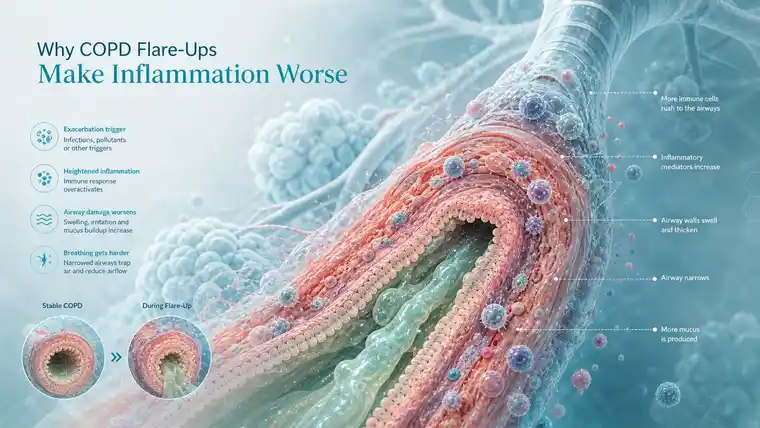
During a flare-up, inflammation increases. Airways narrow more. Mucus may rise. Oxygen exchange can become harder. The breathing muscles work more. The patient may need antibiotics, steroids, oxygen adjustment, emergency care or hospitalization.
But the important part is what happens after.
Some patients recover fully.
Some recover slowly.
Some never return completely to their previous baseline.
This is why preventing flare-ups is one of the most important goals in COPD care.
Each flare-up can push the lungs into another cycle of inflammation and stress. The patient may become more cautious. They move less. Muscles weaken. Breathlessness becomes worse with smaller effort. Confidence decreases.
The lungs suffer.
But so does the person.
A patient who had one bad exacerbation may start living around the fear of the next one.
They avoid going out.
They avoid guests.
They avoid cold weather.
They avoid travel.
They avoid life.
So when we talk about inflammation, we are not talking about a laboratory word.
We are talking about daily freedom.
Why COPD May Continue After Smoking Stops
Many patients ask this with frustration.
“I stopped smoking. Why is the COPD still there?”
It is a fair question.
Stopping smoking is one of the most important decisions a COPD patient can make. It reduces ongoing exposure. It protects what remains. It lowers future risk.
But it does not automatically remove damage that has already occurred.
The small airways may already be changed. The alveoli may already be damaged. The immune system may remain active. The lungs may continue to respond strongly to infections, pollution, dust or even ordinary irritants.
This does not mean stopping smoking was useless.
The opposite is true.
It means stopping further injury is necessary, but sometimes not enough to fully calm the disease.
Patients should understand this clearly.
Stopping smoking protects the future.
But COPD still needs follow-up.
It still needs treatment.
It still needs flare-up prevention.
It still needs attention to inflammation and lung environment.
The patient has done something important.
Now the disease still needs to be managed.
How Standard COPD Care Targets Inflammation and Irritation
Before any advanced treatment is discussed, the foundation must be right.
COPD care is not one medicine.
It is a plan.
Bronchodilators help keep the airways open. Inhaled anti-inflammatory treatments may be useful in selected patients, especially those with certain inflammatory patterns or frequent exacerbations. Pulmonary rehabilitation helps the body use oxygen and muscle strength better. Vaccinations reduce infection risk. Oxygen helps when blood oxygen is low. Smoking cessation, nutrition, activity planning and regular follow-up all matter.
Patients sometimes underestimate these things because they sound ordinary.
But ordinary does not mean weak.
A correctly used inhaler can matter.
A rehabilitation program can matter.
Avoiding infections can matter.
Learning when to seek help can matter.
Treating reflux, sleep apnea or heart disease can matter.
COPD becomes worse when the whole system is ignored.
That is why I always look at the foundation first.
If the inhaler technique is wrong, we correct it.
If oxygen is low, we measure it properly.
If infections are frequent, we ask why.
If the patient is inactive, we rebuild capacity carefully.
If there is untreated heart disease, we cannot pretend it is only the lung.
Chronic inflammation does not exist in isolation.
It lives inside the whole patient.
Where Regenerative Medicine for COPD Enters the Conversation
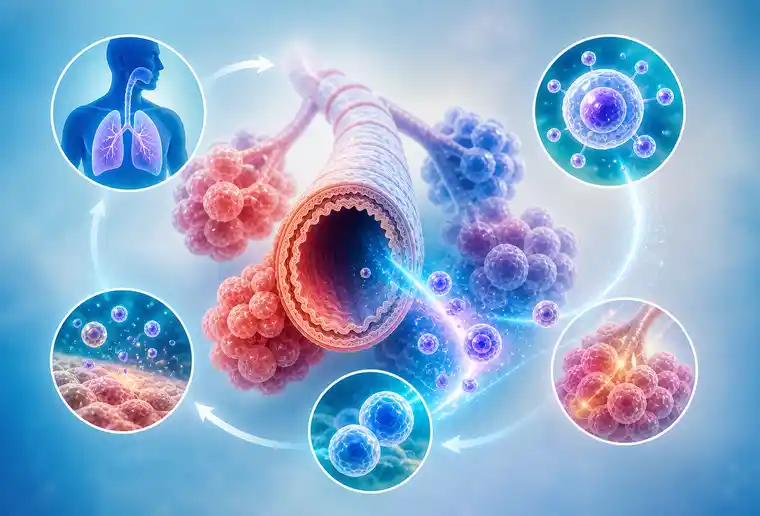
Regenerative medicine enters this discussion because COPD is not only mechanical narrowing.
It is also inflammation, immune signaling, tissue stress and poor repair.
Stem cells and exosomes are being studied because they may influence the inflammatory environment. Not because they create new lungs. Not because they erase emphysema. Not because they replace inhalers, oxygen or rehabilitation.
Their possible role is more careful.
The aim is to support a calmer biological environment.
In selected COPD patients, this may mean trying to reduce excessive inflammatory signaling, influence immune balance, support microcirculation and help the remaining tissue environment behave less aggressively.
This is not a promise.
It is a treatment discussion.
And the discussion must be honest.
Some patients may feel better endurance.
Some may report fewer bad periods.
Some may recover better after exertion.
Some may sleep better.
Some may not notice much change.
COPD is not one disease in one shape. It has different faces. Chronic bronchitis-dominant COPD is not the same as severe emphysema. A patient with frequent infections is not the same as a patient with mainly exertional breathlessness. A patient with low oxygen is not the same as a patient with preserved oxygen but poor endurance.
So regenerative medicine, if considered, must be matched to the patient.
Not sold as a general answer.
What Exosomes May Add
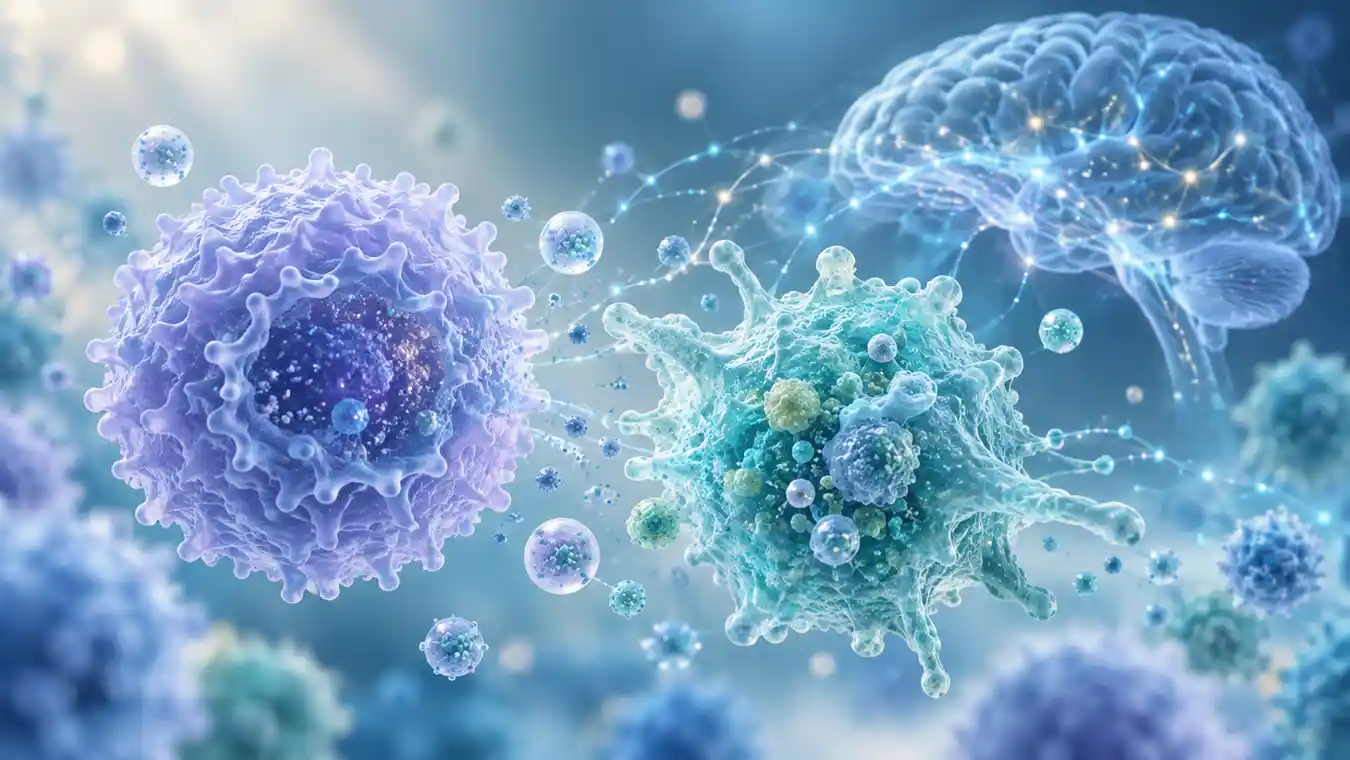
Exosomes are often discussed because they are part of how cells communicate.
They are not living cells.
They do not divide.
They do not become lung tissue.
They carry signals.
In chronic inflammatory disease, signaling matters. Cells are constantly sending and receiving messages. Some messages increase inflammation. Some regulate it. Some call more immune cells. Some help repair. Some continue irritation.
The interest in exosomes is based on this idea of communication.
Can the lung environment be influenced through biological signals?
Can immune behavior become less aggressive?
Can the tissue environment become less irritated?
These are reasonable scientific questions.
But again, we must not jump from biology to exaggeration.
Exosomes are not magic.
They are not a cure for COPD.
They do not rebuild destroyed alveoli.
They do not replace respiratory care.
If they are used, they should be part of a careful medical plan, not a shortcut around diagnosis and follow-up.
Why Patient Selection Matters
Not every COPD patient is the same candidate for regenerative medicine.
This is very important.
A patient with an active infection is not the same as a stable patient.
A patient with uncontrolled heart disease is not the same as a stable cardiac patient.
A patient with very advanced oxygen dependency is not the same as someone with moderate COPD and repeated inflammatory flare-ups.
A patient expecting a cure is not ready for this conversation.
Before any regenerative therapy is considered, we need to understand:
the lung function,
the imaging,
the oxygen level,
the flare-up history,
the infection risk,
the current medications,
the heart condition,
the general strength of the patient,
and what outcome is realistic.
Sometimes the best answer is: not now.
Sometimes the best answer is: first stabilize standard care.
Sometimes the best answer is: yes, we can discuss it, but carefully.
Because in COPD, false hope is easy to sell.
But real medicine requires boundaries.
What Chronic Inflammation Cannot Explain
Inflammation is important, but it does not explain everything.
A COPD patient may be breathless because of airway narrowing, emphysema, low oxygen, weak muscles, heart disease, anemia, anxiety, poor sleep, obesity, malnutrition, deconditioning or several of these together.
So when a patient says, “My inflammation is the problem,” I understand the thought.
But I do not stop there.
We need to ask:
Is there air trapping?
Is there emphysema?
Is there mucus?
Is oxygen dropping during walking?
Is the heart contributing?
Is the patient too inactive because of fear?
Is there sleep-related breathing difficulty?
Is medication being used correctly?
Inflammation may be part of the answer.
But the whole patient gives the real answer.
This is why COPD care should never be reduced to one fashionable word.
Not inflammation.
Not stem cells.
Not exosomes.
Not oxygen.
Not inhalers.
All of these may matter.
But the patient’s actual pattern matters most.
When the Lungs Need Urgent Help
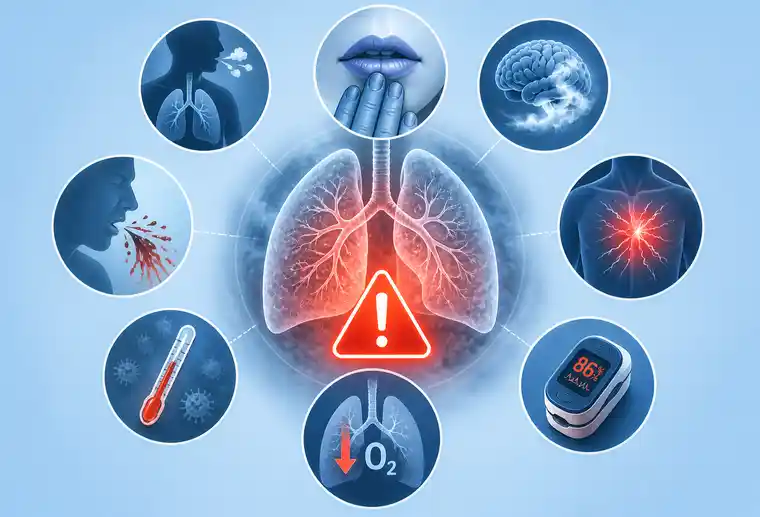
Chronic inflammation is a long-term problem.
But some symptoms are urgent.
A COPD patient should seek medical care quickly if there is severe breathlessness at rest, blue lips or fingertips, confusion, chest pain, coughing blood, high fever, oxygen levels dropping below the advised range, or worsening despite rescue medication.
These signs may mean a serious exacerbation, infection, heart problem, pulmonary embolism or another emergency.
In that situation, regenerative medicine is not the priority.
The priority is safety.
First stabilize the patient.
Then discuss long-term options.
That order should never change.
How I Usually Explain This to Patients
I often use simple language.
I say:
“Your lungs are not only narrow. They are irritated.”
This helps patients understand why treatment is not only about opening airways.
Opening airways matters.
But calming the environment also matters.
Preventing infections matters.
Avoiding flare-ups matters.
Maintaining strength matters.
Measuring oxygen matters.
Understanding the pattern matters.
Then I explain the limits.
If tissue has been destroyed, we cannot pretend it is new again.
If emphysema is advanced, we cannot promise reversal.
If the patient is unstable, we do not jump to supportive therapies.
But if the patient is stable, carefully evaluated and still struggling with chronic inflammation, flare-ups or reduced endurance, then regenerative medicine may become a reasonable discussion.
Not a promise.
A discussion.
That distinction is important.
Final Thought: Calming the Lung Environment
COPD takes away space.
At first, physical space.
The distance a patient can walk.
The stairs they can climb.
The places they can visit.
Then emotional space.
Confidence.
Sleep.
Plans.
Freedom.
Chronic inflammation is one reason the disease can keep pressing on the patient even when no dramatic event is happening.
The lungs remain irritated.
The immune system remains active.
The airways remain vulnerable.
This is why calming the lung environment matters.
Standard COPD care remains the foundation. Inhalers, rehabilitation, oxygen when needed, vaccination, infection control, smoking cessation and regular follow-up are not optional details. They are the base.
Regenerative medicine may have a supportive role in selected patients because it asks a specific question:
Can the inflammatory environment be made less destructive?
Sometimes, the answer may be partially yes.
Not as a cure.
Not as new lungs.
Not as a replacement for respiratory care.
But as one careful attempt to support stability in a disease that often keeps moving in the background.
That is where this conversation belongs.
Careful.
Realistic.
And always honest.
Frequently Asked Questions
I stopped smoking. Why are my lungs still inflamed?
This is one of the most frustrating things for patients.
Stopping smoking is very important. It protects what is left. But it does not erase everything that happened before. The small airways may already be changed. The lung tissue may already be less elastic. The immune system may still react too strongly.
So yes, stopping smoking helps. But COPD may still need treatment, follow-up and flare-up prevention.
Is inflammation the whole problem in COPD?
No.
Inflammation is important, but COPD is not only inflammation. There may also be air trapping, mucus, emphysema, weak breathing muscles, low oxygen, heart problems, poor sleep or loss of physical strength.
That is why I do not like reducing COPD to one word.
Inflammation may be part of the picture.
But the whole patient gives the real answer.
Can inflamed lungs calm down again?
Sometimes, partly.
The goal is not to make COPD disappear. That would not be honest. But in some patients, airway irritation can become less active. Flare-ups may become less frequent. Breathing may feel more stable. Recovery after effort may improve.
Small changes matter in COPD.
But they are not guaranteed, and they do not mean damaged lung tissue has been rebuilt.
Why do flare-ups make COPD worse?
Because a flare-up is not just “a bad day.”
During a flare-up, inflammation increases, mucus often increases, the airways narrow more, and the body works harder to breathe. Some patients recover fully. Others feel that they never quite return to their old level.
That is why we take flare-ups seriously.
Preventing them is one of the most important parts of COPD care.
Can stem cells or exosomes help with COPD inflammation?
That is the reason they are being studied.
Stem cells and exosomes may influence immune signaling and the inflammatory environment around the lung. But this should be understood carefully.
They do not cure COPD.
They do not grow new lungs.
They do not replace inhalers, oxygen, rehabilitation or regular respiratory care.
If they are considered, it should be after proper evaluation and with realistic expectations.
When a Lung Check Makes Sense
COPD can feel different from one patient to another. Some people mainly struggle with mucus. Others with flare-ups, low oxygen, or getting tired too fast.
So it makes sense to look at the whole picture before deciding what may help. Check the lung function. Check oxygen. Talk about infections, inhalers, daily limits, and what has already been tried. Then it is easier to see which COPD treatment options are worth discussing.