Written by Dr. Mehmet Kalcay (DentSpa)
How Jaw Bone Regeneration Helps Prepare for Dental Implants
Let’s say you just lost a couple teeth and you’re hoping to get dental implants.
You head to your dentist, only to hear some disappointing news “You don’t have enough jawbone to support them”
So, what do you do? Bone grafts are an option, but as we all know, they cost extra and honestly, the long recovery time just makes it tougher.
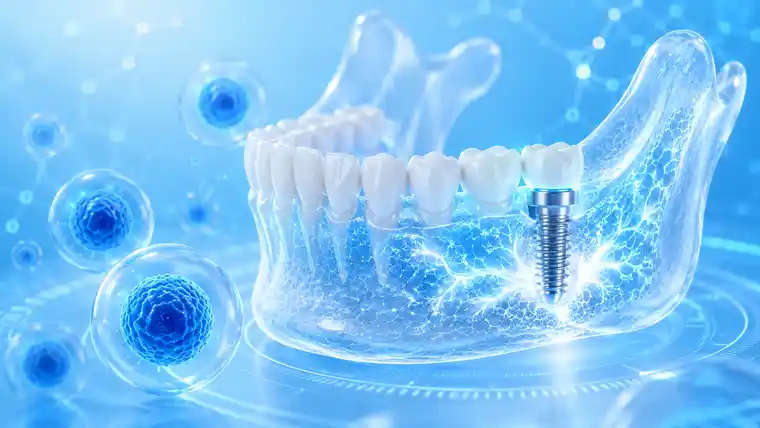
But there is a new approach that’s catching attention: stem cell regenerative treatments. Instead of relying only on grafts, this method makes use of the cells in your body to enhance the regeneration of lost jawbone.
Before we get into stem cells, it makes sense to talk about the bone itself. A lot of people do not know they have lost jawbone until they ask about implants and the dentist checks the scan.
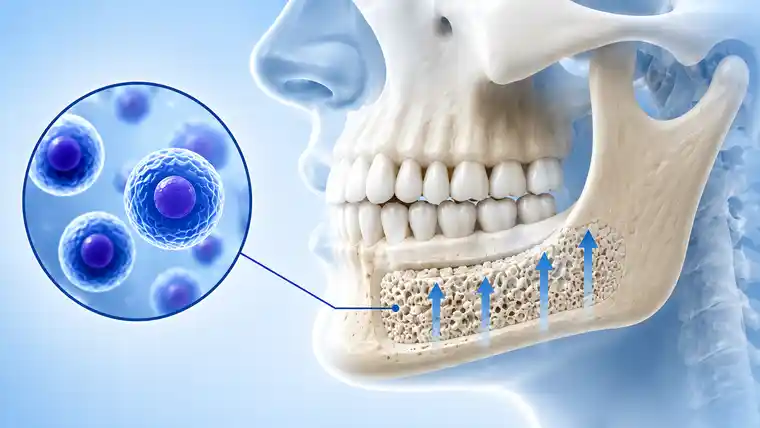
Table of Contents
Common Causes of Bone Loss in the Jaw
Jawbone loss can start in a few different ways. For some people, it begins after a tooth is pulled and the gap is left alone. For others, the problem comes from gum disease that has been active for a long time. Age, smoking, diabetes, and slower healing can also make the situation worse.
Tooth loss or extraction
Bone around a tooth is not just sitting there for no reason. It reacts to daily use.
When we bite and chew, force moves through the tooth root into the jaw. The bone receives that pressure and keeps its shape because of it.
Once the tooth is gone, the area is used much less. The body may then slowly reduce the bone in that spot. It is not something most people can feel happening, but it can show clearly on an X-ray or scan later.
This is why a missing tooth should not always be left for years. The longer the space stays empty, the more the ridge can flatten or narrow. If that happens, there may not be enough bone for an implant without rebuilding the area first.
Gum disease
Gum disease is another reason the jawbone can shrink.
It often starts with plaque sitting around the teeth and under the gumline. If it stays there, it can turn into tartar. Once tartar forms, brushing at home usually cannot remove it properly.
The gums may then become sore, swollen, or bleed when brushing. Some people also notice bad breath or gums pulling back from the teeth.
If the infection keeps going, it does not stay only in the gums. It can move deeper and affect the bone holding the teeth in place. Over time, that bone can wear away. In advanced cases, teeth may start to move, feel loose, or fall out.
Bone resorption
Our body is naturally programmed to break down/dissolve old or damaged bone tissues so that it can be replaced with a new one.
However, when the process becomes “overactive” or the rate at which the body regenerates bones does not keep up with bone breakdown, then there is a problem. Your jawbone as well as your alveolar ridge will gradually lose volume and density.
Age and systemic factors
Ageing is a natural and positive part of life, no doubt about that. But as one grows older, the skeletal system of our body, including the jawbone also undergo gradual changes. That is, it becomes less dense and slower to heal.
Age aside, certain health conditions can also contribute to bone loss in the jaw. Examples include chronic diabetes, osteoporosis, rheumatoid arthritis, lupus and other disorders.
Traditional Jaw Bone Regeneration Methods
Traditional restorative procedures have been around for many years and even till now, they are still as effective as ever. In this section, we will look at these methods and how they work.
Bone grafting
Bone grafting procedure has been used for many years and their role in rebuilding lost jawbone can not be overstated.
This procedure is used when the bone that is meant to hold the implant in place has deteriorated or become weak.
How does bone grafting work?
During a bone graft, the missing area of bone is filled with graft material. This material does not simply “turn into bone” overnight. It mainly works as a scaffold. The body then has to grow into this area slowly, with new blood vessels and bone-forming cells.
With time, part of the graft is replaced or integrated by the patient’s own bone. This is why healing after a bone graft takes several months and why the quality of healing can differ from patient to patient.
Bone graft material can come from:
- The patients body (Autograft)
- A tissue bank (Allograft)
- Animal (Xenograft)
- Synthetic materials (Alloplast)
Sinus lift
This procedure is routinely performed alongside bone grafting to achieve one glorious purpose: restore bone in the upper jaw
The procedure involves the use of specialized tools to gently lift the sinus membrane upward to create space where bone graft material can be placed beneath it.
Over the next few years, the blood vessels and bone cells will begin to grow into this packed grafting material. And before you know it, a new healthy bone is developed.
Ridge augmentation
Ridge augmentation is essentially a specialized type of bone grafting performed to fix jawbone ridge that has shrunk after tooth loss.
The procedure begins with the creation of a small incision in the gum tissue to expose the affected area of the jawbone.
Bone graft material is then stuffed into the deficient space before a barrier membrane is placed over the graft. Lastly, the gum tissue is repositioned and carefully sutured closed to allow the area to heal properly.
How Stem Cells May Support Jaw Bone Regeneration
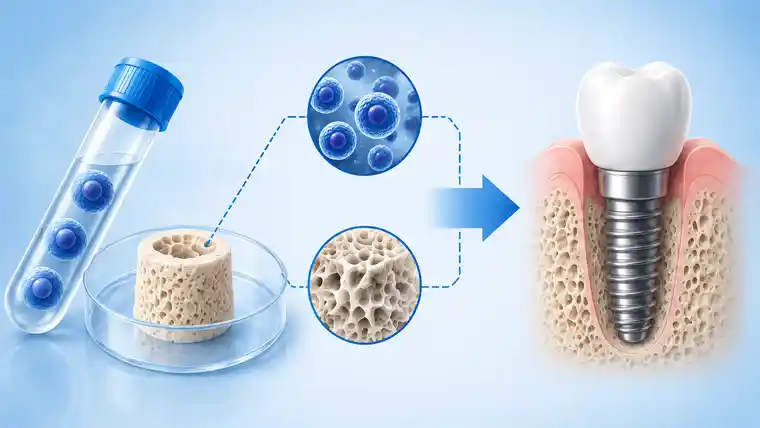
Stem cell treatment is currently being touted as the future in regenerative dentistry and based on various positive clinical reports, it is not hard to see why.
The procedure involves the use of mesenchymal stem cells (MSCs), which are usually extracted from
- The bone marrow
- Dental tissues (pulp from extracted teeth)
- Adipose tissue
Under the right biological conditions, these calls can morph into osteoblasts (the cell responding for bone formation) to promote the regeneration of lost or weakened jawbone tissue.
That is not all. These cells can also be used to accelerate the formation of new red blood cells and overall tissue healing. Both are important, because a grafted area needs a good blood supply and active healing before it can become strong enough for an implant.
In some cases, MSCs are used together with graft material. This may be helpful when the defect is large or when normal healing is expected to be slower.
When Stem Cells May Be Used for Jaw Bone Regeneration
Stem cell therapy is not for every one or every situation. More often than not, it is only used when the condition is severe. Examples of such cases include
Excessive bone loss
If you have lost a significant amount of bone, standard bone grafting alone may not produce the desired result.
In larger bone defects, a normal graft may not always give the result we want. This is especially true when the jawbone has been missing for a long time, or when the patient’s healing capacity is reduced.
For this reason, regenerative methods using mesenchymal stem cells, or MSCs, are now being discussed more often in oral surgery. MSCs are not meant to replace the graft itself. In practice, they are used to support the area around the graft, so the body has a better chance to form new bone.
Early results are promising, but this treatment is still limited to selected cases and specialized clinics. For most patients, the main treatment remains grafting, with stem cells used only as an additional support.
Failed previous grafts
When a graft does not heal properly, the cause has to be checked first. It may be related to infection, poor blood supply, smoking, diabetes, movement of the graft, or simply the size of the bone defect. Repeating the graft without correcting these factors may lead to the same problem again.
In selected complex cases, MSC-based regenerative treatment may be considered as part of a second treatment plan. The aim is to support bone healing in an area where standard grafting alone may not be predictable enough.
Compromised healing capacity
Early clinical research has also suggested that this cell-based treatment may be useful for patients with conditions that normally slow down healing time.
This includes smokers, diabetes patients, aged people and those that suffer from osteoporosis.
Limitations of Stem Cell Bone Regeneration
Although the concept sounds straightforward, stem cell treatment in dentistry is still not routine. There are practical and regulatory limits that patients need to understand before considering it.
- Cell therapy is usually not used on its own. It is normally combined with bone graft to regenerate new jawbone.
- A lot of countries are still yet to approve the therapy for use in the dental industry. For countries that have, the service is only available in specialized clinics and they are heavily regulated.
- Results are not the same in every patient. They depend on the patient’s general health, the size of the defect, the graft material used, and the experience of the treating clinic.
Frequently Asked Questions about Jaw Bone Regeneration
Why does the jawbone shrink after a tooth is lost?
After a tooth is removed, the bone in that area no longer receives the same chewing pressure. Over time, the body starts to break down some of this unused bone. This is known as bone resorption, or disuse atrophy.
How quickly can you lose your jaw bone after losing a tooth?
Bone loss occurs gradually over time therefore, we cannot determine specifically at what point there will be a substantial loss of bone.
As most clinical studies have shown, after tooth loss or extraction, bone resorption begins to occur approximately three months post-extraction.
Can you receive dental implants if you have jawbone loss?
The answer is yes; but not immediately. The reason is because the bone that is meant to support the implant should be around 10mm high and 6mm wide.
If there is not enough bone to hold the implant safely, the implant usually cannot be placed straight away. The bone first has to be rebuilt, most often with a graft or another bone regeneration procedure.
What is the best treatment for bone loss before dental implants?
There is no one best option for all patients. It depends on the amount of bone loss, the position in the jaw, and whether the missing bone is mainly height, width, or both.
Small defects can often be treated with a standard bone graft. In the upper back jaw, a sinus lift may be needed when there is not enough vertical bone. If the ridge is too narrow, ridge augmentation is usually considered. For more difficult cases, especially after a failed graft or severe bone loss, regenerative methods such as stem cell-supported bone healing may be discussed.
For example, fixing minor bone loss will only require bone graft using your own bone.
For upper back teeth with inadequate height, sinus lifts are standard. Ridge augmentation addresses width deficiency. Now, for complex cases, stem cell-based therapies may be introduced or combined.
Can stem cells help jaw bone regeneration before dental implants?
Absolutely! Stem cell therapy has shown great promise that when administered correctly, it can enhance bone regeneration.
It should however be noted that stem cell therapy is not a miracle cure and neither is it a standalone treatment. It needs to be combined with bone graft materials to give desired results.
How long do you have to wait after bone regeneration before placing implants?
The timeline varies by grafting type and extent. For instance, simple ridge augmentation heals in 3 to 4 months. Healing time for moderate sinus lifts is around 4 to 6 months. Large grafts or autografts from distant sites require 6 to 9 months.
Is stem cell bone regeneration covered by dental insurance?
As we have highlighted earlier, regenerative treatment has not been authorised for use in dental treatment in a lot of countries. Because of this, most dental insurance providers do not currently offer coverage for these procedures.
Conclusion
If there is enough jawbone, the implant plan is usually much easier. If there is not, the dentist first has to see what is missing.
Is it height? Width? Both? That part matters more than people think.
A normal graft is often enough. In harder cases, especially after long-term tooth loss or a failed graft, stem cell-supported treatment may come into the conversation. Not as a magic fix. More as extra help for the healing area.
At DentSpa, the process starts with the scan. The team checks the bone first, then talks through the realistic options before moving ahead with the implant. That is the safer way to do it.