

MedClinics News & Blog
The Casgevy approval is back in the news after the FDA expanded its use to younger children.
On July 1, 2026, the U.S. Food and Drug Administration expanded Casgevy’s approval to include patients aged 2 years and older with sickle cell disease or transfusion-dependent beta thalassemia. Until this decision, the therapy had been approved for patients aged 12 years and older.
That may sound like a small label change.
It is not small.
Both diseases can begin shaping a child’s life very early. Pain crises, hospital visits, blood transfusions, fatigue, organ concerns and long-term monitoring can become part of childhood. For some families, these diseases are not something that appear later. They are already present in daily life.
Casgevy belongs to that difficult space.
It is a CRISPR-edited therapy made from a patient’s own blood-forming stem cells. The cells are collected, edited outside the body and returned after intensive preparation. The goal is to help the body produce more fetal hemoglobin, a form of hemoglobin that can reduce the effects of sickle cell disease and beta thalassemia.
That sounds promising.
It is also a serious medical process.
Casgevy is not a casual stem cell injection. It is closer to a stem cell transplant pathway, with genetic editing added to the process. It requires a specialized center, chemotherapy conditioning, hospitalization and long-term follow-up.
That is why this news deserves attention, but also careful wording.
Table of Contents
What Casgevy Is
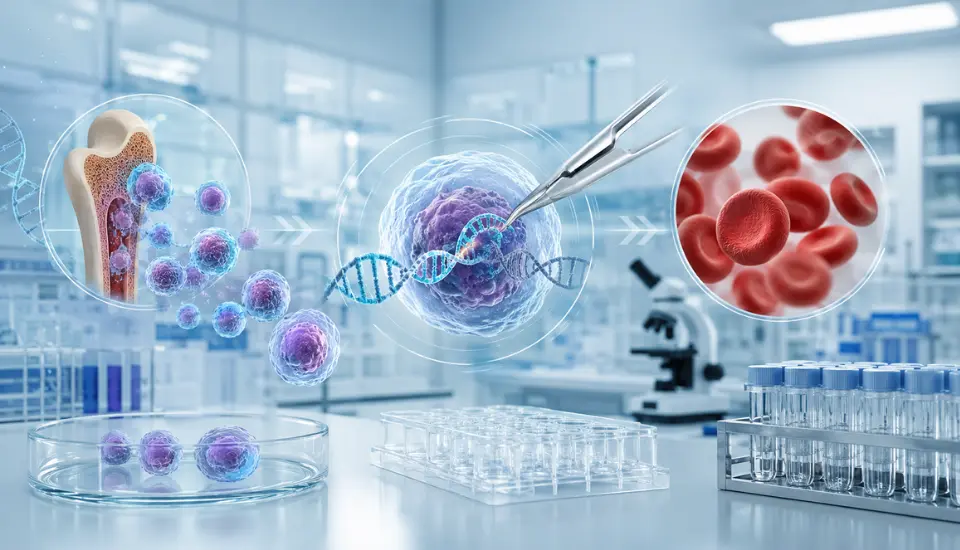
Casgevy is also known as exagamglogene autotemcel.
The treatment begins with hematopoietic stem and progenitor cells. These are the blood-forming stem cells found mainly in the bone marrow. They are responsible for producing red blood cells, white blood cells and platelets.
In this therapy, the patient’s own cells are used.
The cells are collected from the patient and sent through a controlled laboratory process. During that process, CRISPR/Cas9 technology is used to edit the cells. After editing and preparation, the cells are given back to the same patient.
This is called an autologous therapy.
The patient is the cell source. The patient is also the recipient.
That point is important because many people hear “stem cell therapy” and imagine donor cells or a ready-made product. Casgevy works differently. It is personalized. Each treatment is manufactured from the individual patient’s own blood-forming stem cells.
The aim is not simply to add cells to the body.
The aim is to return edited cells that can settle in the bone marrow and produce blood cells with higher fetal hemoglobin levels.
The Two Diseases in the Approval
The FDA expansion covers two inherited blood disorders.
The first is sickle cell disease with recurrent vaso-occlusive crises.
In sickle cell disease, red blood cells can become stiff and sickle-shaped. These cells may block small blood vessels. When that happens, patients can experience severe pain episodes called vaso-occlusive crises. Over time, the disease can also affect organs and quality of life.
The second condition is transfusion-dependent beta thalassemia.
In beta thalassemia, the body does not make enough functional hemoglobin. Hemoglobin is the protein inside red blood cells that carries oxygen. In severe forms, patients may need regular blood transfusions, often beginning in childhood.
Those transfusions can be life-sustaining. They also bring a long-term burden.
Repeated transfusions may lead to iron overload. Patients may need chelation therapy and regular monitoring of organs such as the heart and liver. The disease becomes part of the family’s routine, not only the child’s medical record.
This is why the lower age range matters.
For selected children, the option of earlier treatment may change the discussion. Instead of waiting until adolescence, families and physicians may now consider whether treatment should happen earlier in the disease course.
But eligibility and timing are not simple decisions.
A child may be approved by age range and still need a very careful clinical evaluation before treatment is considered.
How the Treatment Works
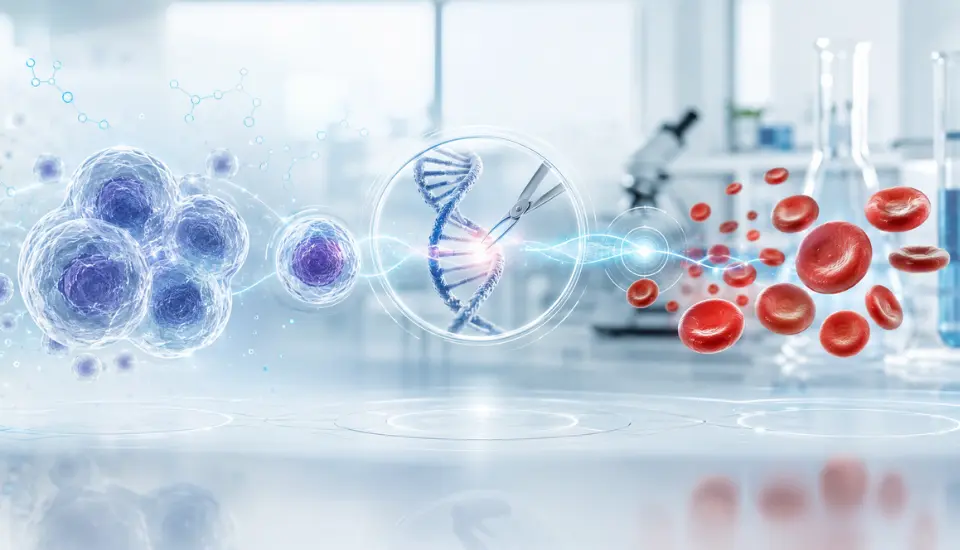
Casgevy does not directly repair the original mutation that causes sickle cell disease or beta thalassemia.
The strategy is different.
It focuses on fetal hemoglobin.
Fetal hemoglobin is the type of hemoglobin the body produces before birth. After birth, fetal hemoglobin usually decreases and adult hemoglobin becomes dominant.
In sickle cell disease and beta thalassemia, increasing fetal hemoglobin can help reduce the impact of the disease.
In sickle cell disease, higher fetal hemoglobin can make red blood cells less likely to sickle.
In beta thalassemia, higher hemoglobin production can reduce the need for regular blood transfusions.
Casgevy uses CRISPR/Cas9 to edit the patient’s blood-forming stem cells in a way that increases fetal hemoglobin production after the cells return to the body.
The treatment process has several steps.
First, the patient’s stem cells are collected.
Then the cells are edited outside the body.
Before the edited cells are returned, the patient receives myeloablative conditioning. This usually means high-dose chemotherapy. The purpose is to make space in the bone marrow so the edited cells can engraft.
Then the edited cells are infused back into the patient.
After that, the medical team waits for the cells to settle in the bone marrow and begin producing new blood cells.
People often call Casgevy a one-time therapy. In one sense, that is true. The edited cells are given once.
But the surrounding process is long. Collection, manufacturing, chemotherapy, infusion, recovery and follow-up are all part of the treatment.
What Changed with the Casgevy Approval
Before July 2026, Casgevy was approved in the United States for eligible patients aged 12 years and older.
The new approval expands the age range to patients aged 2 years and older.
That is the main regulatory change.
The FDA described this as the first gene therapy approved for young children with sickle cell disease. The same expanded age range also applies to transfusion-dependent beta thalassemia.
This does not mean that every young child with these conditions will receive Casgevy. It means the FDA-approved indication now allows specialists to consider the therapy in a younger group.
There is also a detail that should stay visible in the article.
The pediatric data described by the FDA mainly came from children aged 5 years to less than 12 years. For children aged 2 to less than 5 years, the approval relied on available pediatric data and product characteristics.
So the label now includes children as young as two.
But the youngest children were not represented by a large direct clinical dataset in the same way.
That is not unusual in pediatric medicine. It is still something readers should understand.
What the Pediatric Data Showed
The results described by the FDA are encouraging, especially because both diseases are serious.
For sickle cell disease, the FDA described a study that included 11 children aged 5 years to less than 12 years. Eight children had enough follow-up to be evaluated for efficacy.
All eight were free from protocol-defined severe vaso-occlusive crises for at least 12 consecutive months within the first 24 months after infusion.
For a child who has lived with repeated severe pain crises, that is not a small outcome.
For transfusion-dependent beta thalassemia, the FDA described a study that included 15 children aged 5 years to less than 12 years. Nine children were evaluable for efficacy.
Eight of those nine achieved transfusion independence for at least 12 consecutive months. The median duration of transfusion independence was reported as 20.1 months.
For a family built around transfusion schedules, hospital visits and iron monitoring, transfusion independence can mean a major shift.
Still, the numbers are small.
These were selected patients. They were treated in a specialized setting. The results support the expanded approval, but they do not mean every patient will have the same outcome.
That is the line a medical news article has to hold.
The data are strong enough to matter.
They are not broad enough to simplify the decision.
Why Earlier Treatment Could Matter

The idea of earlier treatment is easy to understand.
Sickle cell disease and beta thalassemia are not only about individual episodes. They can cause damage over years.
A child with sickle cell disease may miss school because of pain. Families may organize plans around the possibility of a crisis. There may be emergency visits, hospital stays and concerns about long-term organ health.
A child with beta thalassemia may grow up with regular transfusions as part of life. The transfusions help, but they also create another medical burden. Iron overload, chelation treatment and organ monitoring can continue for years.
If a therapy can change blood production earlier, it may reduce part of that long-term burden for some patients.
That is the hopeful side of the approval.
The harder side is the treatment itself.
Casgevy requires conditioning chemotherapy before the edited cells are returned, and the whole process needs specialist planning and close medical follow-up.
For very young children, those decisions carry a particular weight.
This is why the decision is not automatic. It is not only a question of whether the therapy is approved. It is also a question of timing, disease severity, center experience, family readiness and long-term follow-up.
Why This Is Relevant to Regenerative Medicine
Casgevy is relevant to regenerative medicine because it uses blood-forming stem cells in a very defined way.
The cells are not being used as a broad promise. They are collected from the patient, edited for a specific biological purpose and returned so they can rebuild blood production with higher fetal hemoglobin.
That is a precise use of stem cell biology.
It also shows how regenerative medicine now overlaps with gene editing and transplant medicine. The field is not only about whether cells can repair tissue. In some areas, the question has become much more specific: how can cells be prepared, changed and followed as a regulated therapy?
Casgevy is one of the clearer examples.
It is not related to exosome therapy. It is not a mesenchymal stem cell treatment. It does not belong to anti-aging or wellness medicine.
It belongs to inherited blood disorders, hematology and advanced cell and gene therapy.
That distinction is useful for readers. It helps separate regulated medical progress from loose stem cell language.
What This Approval Does and Does Not Show
The approval shows that CRISPR-edited blood stem cell therapy is moving into younger pediatric care for selected patients with serious inherited blood diseases.
That is significant.
It also shows that the FDA was willing to expand the age range based on pediatric data in 5- to 11-year-old children and supporting product information for the younger group.
That is also significant.
But the approval does not answer every question.
It does not tell us yet how children treated at very young ages will do over decades. It does not remove the complexity of the treatment pathway. It does not solve questions of access, cost or treatment-center capacity.
Families may still face difficult decisions.
A therapy can be scientifically impressive and still hard to choose.
That is especially true when the patient is a young child.
What to Watch Next
The next years will be important for follow-up.
Doctors will want to see how durable the responses are in younger patients. Families will want to know whether pain crises remain absent, whether transfusion independence lasts and whether quality of life improves over time.
The youngest age group will need careful observation.
Since the direct pediatric data described by the FDA mainly came from children aged 5 to less than 12 years, real-world experience in children aged 2 to 4 will be watched closely.
Access will also be part of the story.
Cell and gene therapies require specialized centers, manufacturing slots, hospital coordination and long recovery planning. Approval does not automatically mean easy availability.
For some families, the science may move faster than the healthcare system around it.
That is why Casgevy is both a medical news story and a practical healthcare story.
The Larger Message
Casgevy’s expanded pediatric approval is one of the strongest recent examples of how stem cell science is changing.
The treatment starts with the patient’s own blood-forming stem cells. It adds CRISPR editing. It returns the cells with the aim of changing blood production over time.
That is not simple medicine.
But it is real medicine.
For sickle cell disease and beta thalassemia, the approval gives selected younger patients another regulated option. For regenerative medicine, it shows how far the field has moved from general ideas about cells toward defined, evidence-based therapies.
The news deserves attention because it is specific.
A specific therapy.
A specific cell type.
A specific edit.
A specific patient group.
And a specific medical goal: to reduce the burden of two severe inherited blood disorders by changing how the patient’s own blood-forming system works.
FAQ: Casgevy and CRISPR-Edited Stem Cells
What is Casgevy?
Casgevy is a CRISPR-edited cell therapy made from a patient’s own blood-forming stem cells. Its scientific name is exagamglogene autotemcel.
What changed with the new FDA approval?
The FDA expanded Casgevy’s approval to include younger children. The therapy can now be used in eligible patients aged 2 years and older with sickle cell disease or transfusion-dependent beta thalassemia.
Which diseases is Casgevy approved for?
Casgevy is approved for two inherited blood disorders: sickle cell disease with recurrent vaso-occlusive crises and transfusion-dependent beta thalassemia.
Does Casgevy use donor stem cells?
No. Casgevy uses the patient’s own hematopoietic stem and progenitor cells. These cells are collected from the patient, edited outside the body and then returned to the same patient.
How does Casgevy work?
The therapy is designed to help the body produce more fetal hemoglobin. This can reduce red blood cell sickling in sickle cell disease and may reduce the need for regular transfusions in beta thalassemia.
Does Casgevy directly correct the disease-causing mutation?
Casgevy does not directly repair the original mutation. Instead, it edits the patient’s blood-forming stem cells in a way that increases fetal hemoglobin production.
Why is this approval important for children?
Both sickle cell disease and beta thalassemia can affect children from an early age. Expanding the approval to younger patients may allow specialist teams to consider treatment earlier in selected cases.
Were children aged 2 to 4 directly studied?
The FDA-described pediatric clinical data mainly came from children aged 5 to less than 12 years. The expansion to children as young as 2 was supported by available pediatric data and product characteristics.
Is Casgevy a simple stem cell treatment?
No. Casgevy is a personalized gene-edited stem cell therapy. It involves collecting the patient’s own cells, editing them in a laboratory and returning them in a specialized medical setting.
Is Casgevy related to exosome therapy?
No. Casgevy is not an exosome therapy. It is a CRISPR-edited autologous hematopoietic stem cell therapy used for specific inherited blood disorders.
Sources
- U.S. Food and Drug Administration. FDA Approves First Gene Therapy for Young Children with Sickle Cell Disease.
- Vertex Pharmaceuticals. Vertex Announces U.S. FDA Approval for Expanded Use of CASGEVY for the Treatment of People Ages 2 Years and Older With Sickle Cell Disease or Transfusion-Dependent Beta Thalassemia.
- U.S. Food and Drug Administration. CASGEVY product information.
- DailyMed. CASGEVY prescribing information.