Clinical Insights from Prof. Dr. Serdar Kabataş, MD, PhD (C)
Before Choosing an Intermittent Fasting Routine
“I used to recover quickly. Now everything takes longer.”
I need to understand what “recover” means here before we discuss intermittent fasting.
What takes longer?
Recovering after exercise?
Getting over an infection?
Feeling rested after a busy week?
A person may use the word “recovery” because they cannot quite describe what has changed. For example, they may now need a rest halfway through a walk they used to finish comfortably. Or they have stopped doing certain things without really noticing it.
Perhaps someone suggested intermittent fasting to them: “It gives your body time to repair.” They have come to ask whether there is something in that idea.
“Could intermittent fasting help me?” is a reasonable question. Changing food intake does affect cell behaviour. Working out what that means for a person’s health takes more investigation.
“Tell me about the tiredness first,” would be my response. When did it begin? Was there an illness beforehand? Did medication change? “Are you eating and sleeping as usual?”
We may eventually discuss an eating schedule. First, there is something to find out about the person who wants to follow it.
Table of Contents
Making Room for Meals During 16:8 Fasting
“Tell me what you ate yesterday. Include the things you had after dinner.”
This can produce a different answer from asking about breakfast, lunch and dinner.
There may have been tea with biscuits, a few nuts later and something before bed. None of it felt like another meal, so it was not mentioned at first.
For this person, an evening stopping time could remove quite a lot of unplanned eating.
Now imagine someone with little appetite. They live alone, rarely bother with lunch and find cooking tiring. By the time dinner is ready, they do not want much of it.
Before taking another meal away, I would want to know why they have so little appetite.
Under 16:8 fasting, you could eat breakfast at ten and finish dinner by six, leaving sixteen hours without calories. A 14:10 arrangement gives you another two hours for meals. With 5:2 or alternate-day fasting, intake changes across the week.
I would write down when the person can actually eat.
“What do you take with breakfast?” comes before deciding to move that meal. I also need to know whether lunch is possible at work and whether someone can eat adequately around an evening exercise session.
An intermittent fasting schedule should leave enough opportunity to eat. Completing the hours is only one part of it.
What Happens During Intermittent Fasting?
“What keeps me going if I have not eaten?”
There is still fuel available. Your liver helps keep glucose in circulation, and the body draws increasingly on stored fat. Ketone production may rise as the interval without food continues.
Think about what came before the fast. A long walk and an early dinner leave a different starting point from sitting through the day and eating late at night.
The supply of nutrients also gives cells information. Their internal signalling responds, affecting energy use, growth and the handling of material that needs replacing.
This is where the discussion becomes relevant to cellular maintenance.
However, I would be careful with a chart that assigns a particular event to every hour of a fast. It may be easy to follow, but it cannot describe precisely what is happening in an individual’s organs.
Your liver, blood cells and nervous system have different tasks. We cannot assume they respond in the same way at the same moment.
Autophagy: What Is Actually Being Cleared Away?
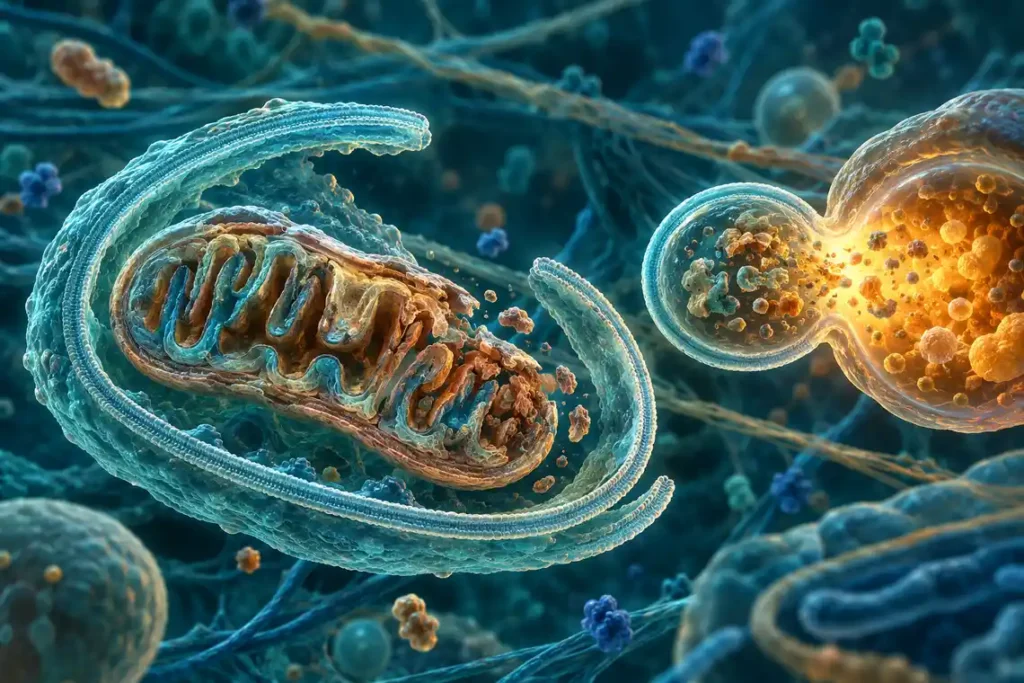
A cell has work to do even when you are resting.
Proteins become damaged. Internal structures need replacing. Some material can be broken down so that useful components are recovered.
Autophagy contributes to this work. In a major form of the process, material is enclosed and delivered to lysosomes, where enzymes break it down.
Mitochondria need maintenance too. They participate in energy production, but they can become damaged themselves. Their selective removal is called mitophagy.
This is particularly interesting to me as a neurosurgeon. Many nerve cells must keep functioning for decades. They maintain long connections, use substantial amounts of energy and need ways to handle damage inside the cell.
Understanding these processes may help explain why cells become vulnerable. It does not establish fasting as a treatment for neurological damage.
“Cellular recycling” is a reasonable description of autophagy. I would also explain that it is already happening during normal life. Breakfast does not bring it to a halt.
And it is different from removing senescent cells. Breaking down material within a cell and eliminating an entire cell are separate biological processes.
How Long Would You Have to Fast?
“Is sixteen hours enough, or should I try eighteen?”
If the aim is increased autophagy, there is no universal number I can give.
Measuring the process in humans is difficult. A protein associated with autophagy may increase without showing how much material has completed the recycling pathway. Researchers therefore examine autophagic flux, meaning activity through the process.
There is some human evidence to consider. In a 2025 exploratory analysis, researchers measured this process in blood cells from 121 adults with obesity. At six months, the group following the combined fasting approach had a different result from the group receiving standard care.
The finding needs careful interpretation. Part of the difference may have reflected a decrease in the comparison group.
The eating plan also matters. On three non-consecutive days each week, participants ate a prescribed reduced amount before noon, followed by a twenty-hour fast. They were not simply free to eat anything during four hours.
This gives researchers something useful to investigate. It leaves me unable to tell a patient exactly how their brain or muscles will respond to daily 16:8 fasting.
“I am becoming weaker. Should I keep going?” would lead me to stop and review the routine. We cannot establish that they are approaching a more beneficial stage of repair.
Intermittent Fasting Benefits: What Would We Follow?
“I have lost weight since I stopped eating late.”
My next question would be what changed in the evening.
Perhaps the biscuits disappeared. They might also say, “I sit down for dinner now, and I take lunch to work.” Their walking routine may have changed too.
I need that information before judging what the fasting hours contributed.
The studies also ask different questions. In adults with metabolic syndrome, one trial added a personalised eating window to usual care and found a small improvement in HbA1c.
The 2024 trial approached timing more directly. Participants received comparable calories and nutrients but ate on different schedules. Under those conditions, restricting the eating window offered no additional weight loss or improvement in glucose regulation.
So meal timing does not explain every improvement.
For the person who keeps returning to the kitchen, a stopping time may be easier to remember than a daily calorie total.
But someone else may say, “By noon, I am so hungry that I eat much faster than usual.” I would want to hear about that before recommending they continue.
I want to hear about that experience as well as the weight change. Depending on the original concern, we can follow appropriate blood measurements, waist measurements and physical function.
I would judge intermittent fasting benefits by what has actually improved for that person.
Longevity Is Also About Keeping Your Strength
“I am pleased with the weight loss, but my legs feel weaker.”
I would take the weakness seriously.
Has carrying shopping become harder?
Does the person need their arms to get out of a low chair?
Have they begun avoiding steps?
If some of the lost weight was muscle, stairs may become harder despite the person being lighter. An older adult with little physical reserve needs that change assessed.
Poor appetite may have a fairly ordinary explanation. “Does chewing hurt?” is worth asking. A sore tooth or a denture that no longer fits can make someone reluctant to eat. Standing in the kitchen hurts, so cooking is postponed.
These are the sorts of details I want to hear before suggesting that another meal should be delayed.
I would look at the meals themselves and ask about protein, overall intake and strength exercise. The advice needs adjusting to the medical history; someone with kidney disease may need a specific nutritional plan.
“Will this help me live longer?” is harder to answer. A lower biological-age estimate cannot tell us how many additional years a person will live, and human research has not established life extension from a particular fasting schedule.
What does longevity mean to you?” A patient may answer, “I want to keep going out on my own.”
Walking, strength and confidence then give us something to assess now. The question should be: “Can this help me by healthy aging?”
Where Stem Cells and Exosomes May Fit in Anti-Aging Research

“Could a treatment help me regain some function?”
“Which part of your day has become harder?” would be my next question.
“Are you hoping to walk further after being ill?” is one possibility. Persistent fatigue is another. A healthy person asking about future aging has a different starting point again.
“What are these stem cells meant to do?”
With MSCs – mesenchymal stromal cells, often called mesenchymal stem cells – researchers are examining their interaction with immune responses and inflammatory signals.
For example, studies are looking at people with frailty. Walking ability and physical quality of life can be followed, giving investigators outcomes connected to daily living.
Exosomes are also being studied. They are small extracellular vesicles carrying biological material between cells. Their contents depend on the cells producing them and on the preparation obtained.
Before discussing a possible benefit, I need to know what the proposed product actually is. The name of the treatment alone gives me too little information.
I start with the preparation itself. What evidence applies to its intended use? What would we assess afterwards?
For someone seeking general anti-aging treatment, I would explain that this remains an investigational use. Any discussion of a supportive role needs an individual medical evaluation first.
I would also check that their usual medical treatment, rehabilitation and nutritional care continue while these options are being considered.
What Can Regenerative Medicine Honestly Promise?
“If I have this treatment, what should improve?”
The answer should be clear enough for the patient to recognise a result.
Someone may say they want to feel younger.
I would ask what that would look like in their day.
Having more energy?
Walking comfortably to the shops?
Returning to an activity they have stopped doing?
That gives us something to come back to when assessing the outcome.
A study may report an improvement without showing that an organ has been rebuilt or aging reversed. Findings involving an MSC preparation cannot establish the effects of an exosome product that was not tested. Neither approach has demonstrated general life extension in healthy people.
That does not remove the reason to investigate specific clinical problems. For the patient, I want to keep returning to the original concern: what has become difficult, and what might reasonably help?
Can I Keep Intermittent Fasting During Regenerative Treatment?
“Could doing both give me a better result?”
Metabolism, inflammation and tissue signalling appear in both research areas. There are biological questions worth investigating.
However, a study examining the body’s own stem cells during fasting is not testing an administered MSC preparation. Changes in naturally circulating vesicles cannot establish whether an exosome treatment works better during a fast.
I cannot tell a patient that fasting will strengthen the effect of these treatments for anti-aging. We do not have enough clinical evidence to recommend it for that purpose.
There is still a practical question: “I already do intermittent fasting. Do I need to stop for treatment?”
I would review how much they are eating and drinking, when they take their medicines and what the procedure involves. Someone already losing weight needs a different discussion from someone eating adequately and maintaining their weight. The schedule may need adjusting or pausing.
If anaesthesia is involved, follow the fasting instructions given for that procedure exactly.
There is no established advantage to adding a longer fast in the hope of obtaining a stronger regenerative effect.
When I Need to Review Intermittent Fasting Before It Starts
“I take my diabetes medicine with breakfast. What happens if I eat at noon instead?”
I would check the medicine before moving that meal.
With insulin or certain diabetes tablets, postponing food may bring glucose too low. That is something to discuss with the clinician managing the diabetes, including when to take the medicine and when to check glucose. Do not experiment with a different dose yourself.
I would also ask about recent weight.
Have you lost any?
Were you trying to?
“What did you manage to eat yesterday?”
A patient who is underweight or frail may need help fitting in enough food already. An existing illness may add nutritional needs that a shorter eating window makes harder to meet.
If someone is pregnant or breastfeeding, I would begin with whether their nutritional needs are being met. For a teenager, this requires age-appropriate advice rather than an adult anti-aging fasting schedule. A previous eating disorder also needs to be raised before introducing restrictions.
“I keep getting dizzy, but there are two hours left.”
“Please do not try to push through that,” would be my response. Stop fasting and have recurring dizziness or marked weakness checked.
Fainting or confusion calls for urgent medical help, especially if low blood glucose is possible. Do not postpone getting help until the fast is due to end.
What I Would Want to Understand First
I would begin with the change that brought the person to the consultation.
When did the change begin? What was happening then? “What do you now leave out of your day that you used to enjoy?”
We may end up talking about food. We may also find that sleep, pain, medicines or another medical problem needs attention before changing meal times.
Before I can discuss stem cells or exosomes sensibly, I need that same understanding of the person’s difficulty. It tells us which evidence might be relevant and what a realistic treatment discussion should include.
The research can involve complicated measurements. The patient’s hope may be easier to describe: going out again, recovering enough strength to cook, or managing at home with less help.
I want to know what matters to them before deciding what to do next.
Frequently Asked Questions on Intermittent Fasting and Anti-Aging

“Would you tell me to stay with fourteen hours?”
If that routine is comfortable, I would first check whether you can eat enough, take your medicines appropriately and assess whether it is helping. A longer fast is not automatically a better choice.
“Can I tell whether autophagy has increased?”
You cannot judge it from hunger. It is already part of normal cell maintenance, and there is no routine home test showing whole-body repair.
“I am losing weight. Why do I feel weaker?”
We need to review what you are eating and the weight loss itself. Weakness is not something you should simply accept while waiting to adjust.
“Should I fast before stem cell or exosome treatment?”
Only as instructed by the treating team. Explain your usual eating routine, medicines and any recent weight changes before the treatment day.