Training & Education


MedClinics News & Blog
Stem cell therapy for degenerative disc disease is being studied as a possible way to reduce the pain and limitations associated with damaged spinal discs. One question still open is whether adding exosomes to the cells offers anything extra.
A study from Medellín, Colombia, followed 125 people after treatment with Wharton’s jelly-derived mesenchymal stromal cells. Some received the cells on their own. The rest received the same type of cells together with an exosome preparation.
Both groups reported less pain and fewer problems with everyday activities during the following six months. The disability results favoured the combination: patients treated with cells and exosomes more often reached a level of improvement considered meaningful in ordinary life.
There is good reason to pay attention to that result, although it came from routine clinical care rather than a randomized trial. The study can show how the two groups progressed; it cannot settle how much of the difference belonged to the exosomes.
Alejandro Toro-Rivera and colleagues reported the findings in Biomedicines on 2 October 2026. The treatments took place at BioXcellerator in Medellín, and most of the authors were affiliated with BioXcellerator or BioXtech.

Of the 125 patients, 69 were in the cell-only group. The other 56 received WJ-MSCs supplemented with exosomes. The cells came from Wharton’s jelly, the connective tissue found inside donated umbilical cords, rather than from the patients themselves.
The preparations were injected directly into the affected thoracic or lumbar discs. Researchers checked the patients’ progress at month three and again at month six.
One measure was a visual pain scale. The other was the Oswestry Disability Index, usually called the ODI.
Rather than asking only how badly the back hurt, the ODI asks what the back allowed. Could the patient remain seated, stand comfortably, lift something, sleep, travel or manage personal care? The final score reflects how deeply the condition has entered daily life.
Pain and disability improved in both treatment groups. Adding exosomes did not produce an equally clear advantage in the pain scores. The more noticeable separation appeared in the ODI results.
Across the follow-up period, the combined group had a 52.5% higher adjusted probability of reaching a clinically meaningful improvement in disability. At six months, those patients were approximately twice as likely to reach that threshold as those who had received WJ-MSCs alone.
For somebody living with disc-related back trouble, that difference is easy to understand. Pain does not always need to disappear before life becomes more manageable. Sitting through a meal, walking farther or sleeping with fewer interruptions may be the change that counts.
The published results give us group averages and statistical comparisons. They do not describe how the six months unfolded for each person. We cannot see how many patients experienced a striking improvement, how many noticed a modest change or whether some felt no better at all.
The procedures were carried out between October 2024 and August 2025. No allocation schedule created the two groups. The researchers observed patients who had already received one of the clinic’s two approaches.
There was no sham injection and no separate group managed with rehabilitation, medication or other standard care alone.
That makes the comparison less controlled than it would have been in a randomized clinical trial. The researchers adjusted their analysis for age and sex, but a medical record cannot capture every difference that may shape recovery.
The number of treated discs, earlier procedures, medication, rehabilitation and the severity of the original condition may all have varied. Expectations can influence patient-reported scores as well, particularly when everybody knows which treatment was given.
None of this makes the ODI difference unimportant. It changes the question that can be answered. The study found a stronger functional result among the people who received exosomes. A randomized comparison is still needed before the exosomes themselves can be credited with causing it.
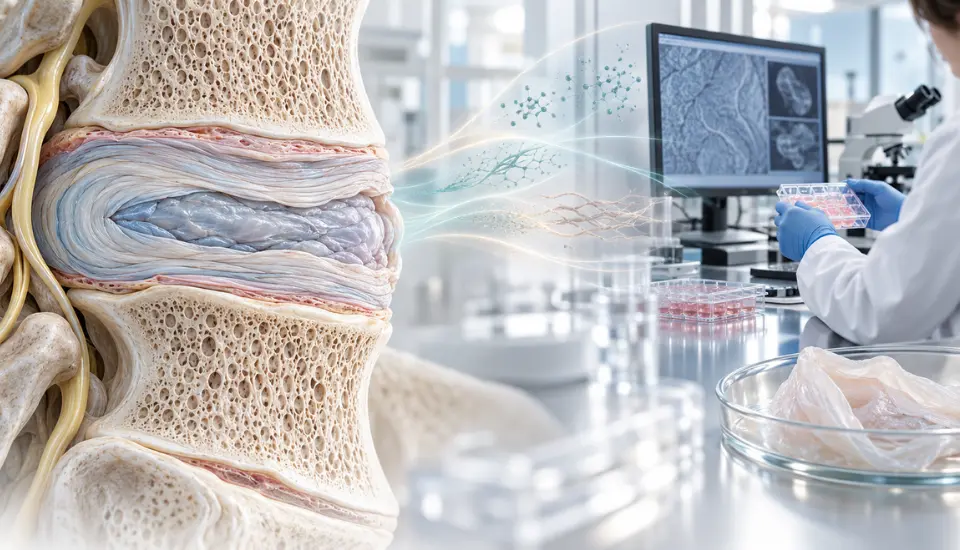
An intervertebral disc is a difficult place for living cells. It has little direct blood supply, receives limited nutrients and remains under mechanical pressure throughout the day.
As degeneration progresses, the disc matrix loses part of the organization that helps it retain water and absorb load. Collagen, proteoglycans and the cells responsible for maintaining that matrix no longer work together as effectively as they once did.
WJ-MSCs are not expected to settle into this environment and construct a complete replacement disc. Much of the interest lies in what the cells release. Their proteins, growth factors and other signals may interact with inflammation, local cell survival and the continuing breakdown and renewal of the matrix.
The researchers did not follow the injected cells inside the body, so the study cannot tell us how long they stayed in the discs or how active they remained.
Exosomes offer another part of the same biological conversation. These small membrane-bound particles carry proteins, lipids and RNA from one cell to another. Researchers are interested in them because they can transport some of the signals normally released by MSCs without being complete living cells themselves.
In this study, the combined treatment placed the WJ-MSCs and a prepared dose of exosomes into the disc at the same procedure. The intention was to give the local tissue the cells together with a concentrated selection of their signalling material.
The clinical records cannot tell us exactly what happened next. The exosomes may have strengthened the signals coming from the cells, acted earlier than the cells or affected the disc through partly separate routes.

The research team also examined the contents of the exosome preparation. Proteomic analysis identified 1,018 proteins.
Several were connected with the extracellular matrix. COL2A1 is associated with type II collagen, an important component of disc tissue. Lumican is involved in the way collagen fibres are arranged. TIMP1 and TIMP2 help regulate enzymes that break down and reshape the matrix.
Other proteins, including CD59 and SERPING1, have roles in immune and complement activity. The mixture therefore contained possible links to matrix biology, tissue remodelling and inflammatory control.
A list of proteins is not a map of what occurred inside each treated disc. Finding COL2A1 or TIMP1 in the preparation does not prove that new collagen formed after injection. Nor does it identify one molecule responsible for the disability result.
The analysis is useful for a different reason. It begins to describe the biological product that accompanied the cells. “Exosomes” is a broad label, and preparations made from different source cells or under different laboratory conditions can carry very different cargo.
The findings from Medellín therefore belong to the product used in this particular study. They should not be extended automatically to every preparation marketed or investigated as MSC-derived exosomes.
The patients were asked about pain and daily function. The study was not designed to demonstrate that damaged discs had grown back.
Standardized MRI measurements were not used to show changes in disc hydration, height or internal structure. There was no tissue analysis capable of showing that the original matrix had been rebuilt.
A patient can nevertheless experience a worthwhile improvement without visible reconstruction of the disc. Changes in inflammation, pain signalling, movement, rehabilitation or medication use may alter how the back feels and what the person can do.
That is why patient-reported function deserves to be taken seriously. Treatment is meant to make daily life easier, not merely to produce a more attractive scan.
Regeneration is a separate and more demanding claim. A future study could place both parts of the story side by side: pain and ODI scores from the patient, with standardized imaging of disc hydration, height and structure.
Follow-up would also need to continue beyond six months. Degenerative disc disease develops over years. Six months may reveal early symptom changes, but it is too short to establish lasting structural recovery.
Several parts of the report deserve a closer look before the findings are carried into wider practice.
The absence of randomization comes first. Since treatment was not assigned by chance, the better ODI result may partly reflect differences already present between the two groups.
The same clinic that provided the treatment also produced most of the research team. BioXcellerator treated the patients, and most authors were affiliated with BioXcellerator or BioXtech. The paper reported no external funding.
A clinical team is often the first to publish experience with the treatment it has developed. Its familiarity with the protocol can provide useful detail. Independent studies are still important, particularly when outcomes depend on clinical decisions and patient questionnaires.
The report recorded 228 adverse-event entries. That number represents individual complaints, not 228 different patients. One person reporting soreness, stiffness and headache would account for three entries.
Temporary back discomfort, stiffness and soreness around the injection site appeared among the more common reports. Headache and nausea occurred less often.
No repeated pattern of serious complications emerged as the defining safety issue in either group. However, the later follow-up contained less complete safety information. The paper therefore gives a clearer picture of early procedural discomfort than of delayed or uncommon problems.
The study offers a useful reason to continue investigating the combination. Both groups improved, and the stronger ODI result appeared among patients who received exosomes with their WJ-MSCs.
The next trial should make the comparison harder to misread. Patients could be assigned randomly to WJ-MSCs alone, WJ-MSCs with exosomes or an appropriate control procedure. Rehabilitation, medication and other care would need to be documented consistently across the groups.
The ODI should remain part of that work because it measures the restrictions that often bring patients to treatment in the first place. Pain ratings, physical-performance tests, medication use, quality of life and MRI findings could fill in the rest of the picture.
One or two years of follow-up would reveal whether the functional improvement lasted. It could also show whether any structural change appeared later than the symptom response.
Researchers will eventually need a dependable way to compare exosome batches as well. Identifying more than a thousand proteins describes the preparation in impressive detail, but clinical manufacturing requires evidence that separate batches have comparable biological activity.
The current findings are encouraging without closing the case. In this group of 125 patients, adding exosomes was associated with a better chance of meaningful functional improvement. A controlled trial now needs to determine whether the extra benefit truly came from the exosomes.
One group received Wharton’s jelly-derived mesenchymal stromal cells injected into the affected spinal discs. The second group received WJ-MSCs together with an exosome preparation.
Pain and disability scores had improved in both groups. Patients given the combined treatment were more likely to reach a clinically meaningful improvement in disability.
Pain improved in both groups, but the difference between them was not as clear as the difference found in disability. The strongest comparative result came from the Oswestry Disability Index.
Not yet. The result supports the possibility that exosomes added something useful, but patients were not randomly assigned to treatment. Other differences between the two groups may have influenced the outcome.
No structural regeneration was demonstrated. The study followed pain and disability and examined the exosome preparation, but it did not show that new spinal discs had grown or that damaged discs had been restored.
Temporary back discomfort, stiffness and soreness around the injection area were reported frequently. Headache and nausea appeared less often. The published total referred to separate adverse-event entries, so one patient could be counted more than once.
WJ-MSC and exosome therapy for degenerative disc disease remains investigational. Randomized clinical trials with longer follow-up are needed before its effectiveness can be established.
This article is for informational purposes and does not replace professional medical advice, diagnosis or treatment.