
Clinical Insights by Prof. Dr. Serdar Kabataş, MD, PhD (C)
Clinical Perspective on Friedreich’s Ataxia
I’m Prof Dr. Serdar Kabataş and I have worked in neurosurgery for over two decades. Trauma, tumors, degenerative spinal disease – these are conditions that often demand immediate action.
Friedreich’s Ataxia does not.
It asks for patience.
And it asks uncomfortable questions.
I remember a young patient – sixteen years old – who asked me not whether she would walk again, but whether she would still be able to travel alone in five years. That difference matters. It tells you how patients think about this disease.
FA does not collapse life overnight. It narrows it slowly.
Families adapt. Then adapt again.
From a neurological standpoint, what we are dealing with is progressive cellular vulnerability. Neurons under metabolic stress do not fail instantly. They deteriorate gradually. That gradual process is where scientific curiosity begins.
If we cannot change the gene, can we at least support the cell?
That is the principle behind regenerative approaches in Friedreich’s Ataxia.
Not repair in the dramatic sense.
Support in the biological sense.
Table of Contents
Friedreich’s Ataxia: Causes, Symptoms and Disease Progression

Friedreich’s Ataxia does not usually reveal itself in a single moment. It tends to surface gradually, and often retrospectively – families look back and realize that something had been changing for longer than they first thought.
A child who was steady becomes slightly uncertain on uneven ground.
I have seen many young patients who cannot explain exactly what feels different. They just say they are “not as steady.” Sometimes they stop participating in sports before anyone understands why. It is subtle enough that teachers may not notice. Parents often think it is temporary.
The underlying cause, however, is anything but temporary.
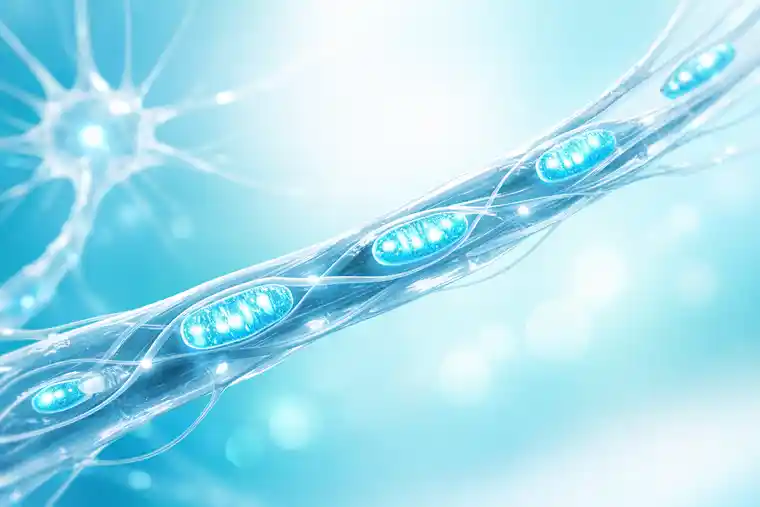
In most cases, Friedreich’s Ataxia is linked to an expansion of GAA repeats in the FXN gene. That expansion reduces the amount of frataxin the body can produce. Frataxin works inside the mitochondria – the part of the cell responsible for energy production and iron balance. When there is too little of it, iron handling becomes unstable. The mitochondria do not function as efficiently. Over time, this creates a kind of chronic metabolic pressure inside the cell.
Nerve cells, especially long spinal pathways, are particularly sensitive to that pressure. They require consistent energy to maintain signal transmission. When that stability weakens, the first changes are often sensory rather than purely motor. Position sense declines. Reflexes may be difficult to elicit. Coordination becomes unreliable before strength is dramatically affected.
It is not a sudden breakdown. It is gradual wear.
Neural tissue is especially sensitive to that burden.
The posterior columns of the spinal cord – responsible for position and vibration sense – are among the earliest structures affected. Spinocerebellar pathways gradually lose integrity. Peripheral sensory nerves become less reliable in transmitting feedback to the brain. The result is not sudden paralysis, but progressive incoordination. Balance worsens. Reflex responses fade. Fine motor precision becomes harder to maintain.
This process unfolds over years, not weeks.
Patients may notice increasing gait instability, difficulty with fine motor tasks, changes in speech clarity, progressive muscle weakness, and reduced vibration sense.
Orthopedic complications such as scoliosis can develop gradually. Cardiac involvement – most commonly hypertrophic cardiomyopathy – is a defining feature of the disease and requires ongoing cardiological supervision. Some patients also develop glucose intolerance or diabetes.
Friedreich’s Ataxia is therefore not simply a movement disorder. It is a systemic neuro-metabolic condition.
Symptoms most frequently begin in childhood or adolescence, although later onset variants exist. The rate of progression varies between individuals, influenced in part by the length of the genetic repeat expansion.
At present, treatment remains supportive. Neurological management focuses on function. Cardiology focuses on prevention of complications. Rehabilitation works to preserve independence for as long as possible.
The central problem – mitochondrial dysfunction caused by frataxin deficiency – cannot yet be corrected directly.
That limitation is what has led researchers to explore whether modifying the cellular environment might influence disease trajectory.
Stem Cell Therapy in Friedreich’s Ataxia: Biological Rationale
There is a misconception that stem cells are used to “replace” damaged nerves. In complex neurodegenerative diseases, this is not realistic.
What mesenchymal stem cells primarily offer is signaling capacity.
Mesenchymal stem cells are known to release growth factors and signaling molecules that influence inflammation, immune regulation and local vascular response. Rather than acting as structural replacements, they function as biological modulators within damaged tissue.
In a disease characterized by mitochondrial dysfunction and oxidative stress, altering the surrounding biochemical environment may help stressed neurons function more efficiently – or decline more slowly.
That distinction is important.
The aim is not regeneration in the classical sense. It is stabilization. Possibly improvement in selected cases. Often subtle.
Delivery methods vary depending on clinical assessment. Intrathecal administration allows proximity to central nervous system structures. Intravenous infusion may support systemic modulation.
But treatment decisions are never automatic. Cardiac stability must be confirmed. Functional stage must be considered. Expectations must be discussed clearly.
Regenerative medicine cannot undo advanced structural degeneration.
It may, however, influence how remaining neural networks perform.
Exosome Therapy and Mitochondrial Support
Exosomes are smaller than cells and more precise in function.
They are vesicles – biological packages carrying RNA fragments, proteins, and regulatory signals from one cell to another. If stem cells can be viewed as biological participants, exosomes are messengers.
In metabolic and mitochondrial disorders, communication inside tissue becomes dysregulated. Exosome-based therapies are being investigated for their ability to influence:
- Oxidative stress pathways
- Inflammatory signaling
- Neuronal survival cascades
- Mitochondrial regulatory mechanisms
They do not insert new DNA or correct the FXN mutation itself. Their role lies in influencing how stressed cells respond to ongoing metabolic pressure.
But they may encourage a cellular environment that is less hostile.
From a scientific standpoint, this aligns with what we understand about Friedreich’s Ataxia: the problem is not sudden cell death. It is prolonged metabolic strain.
Influencing that strain – even partially – may translate into functional stability.
Who May Be a Candidate for Treatment?

Not every patient with Friedreich’s Ataxia should undergo regenerative therapy.
Clinical evaluation is comprehensive. Neurological assessment, cardiological clearance, laboratory analysis, imaging where indicated.
Earlier-stage patients may retain more responsive neural networks. In advanced cases, expectations must be modest.
Sometimes the goal is measurable improvement.
Sometimes the goal is simply preventing further rapid decline.
And in progressive neurological disease, preventing decline can be meaningful.
It is important to emphasize that regenerative therapy is not a substitute for physiotherapy, cardiac care, orthopedic follow-up, or metabolic monitoring.
It is an adjunct. Nothing more. Nothing less.
Regenerative Treatment for Friedreich’s Ataxia in Istanbul
Istanbul has developed into a center for advanced regenerative applications, supported by laboratory infrastructure and interdisciplinary collaboration.
Treatment protocols are individualized. There is no template applied to every patient.
Safety standards in cell preparation are critical. Sterility. Traceability. Controlled administration.
Patients require careful scheduling and structured follow-up planning. Transparency is essential – particularly regarding what regenerative therapy can and cannot achieve.
Medical ethics do not change based on geography.
The Hardest Question Patients Ask
The hardest question families ask is simple:
“Will this stop the disease?”
Today, the honest answer is no – not in the sense of curing it.
But the more nuanced answer is this: influencing disease trajectory is not the same as curing it.
- If progression slows, that matters.
- If balance stabilizes for longer than expected, that matters.
- If fatigue becomes more manageable, that matters.
Medicine often advances not in revolutions, but in increments.
Friedreich’s Ataxia demands realism. It demands restraint in language. It demands that physicians resist exaggeration.
But it also demands that we continue exploring biologically rational strategies that may support neural endurance.
Stem cell and exosome-based approaches represent one such strategy.
Not dramatic.
Not guaranteed.
But grounded in evolving science.
And sometimes, in progressive disease, careful progress is the most responsible form of hope.
Frequently Asked Questions about Stem Cell & Exosome Therapy for Friedreich’s Ataxia

Is there currently a cure for Friedreich’s Ataxia?
No, there isn’t. The genetic change that causes Friedreich’s Ataxia cannot be reversed with the treatments we have today. What we do in practice is manage the consequences – balance problems, cardiac risks, fatigue, orthopedic changes. Regenerative approaches are being studied because they may help support stressed cells, but they do not remove the mutation itself. That part of the disease remains.
Why are both coordination and the heart affected in Friedreich’s Ataxia?
Because the problem is not limited to movement pathways. The underlying issue involves mitochondrial function – essentially how cells handle energy and iron. Tissues that rely on stable energy production suffer first. Long spinal pathways are sensitive, which explains the coordination problems. Cardiac muscle is also energy-dependent, which is why cardiomyopathy is common in this condition. It is one disease, but it shows itself in more than one system.
Can stem cell therapy replace damaged nerve cells in Friedreich’s Ataxia?
No. In this context, stem cell therapy is not intended to replace spinal pathways or regenerate lost structures. The rationale is different. Mesenchymal stem cells are studied for their signaling properties – their ability to influence inflammation, oxidative stress, and tissue support mechanisms. The goal, when considered, is stabilization or functional support, not structural reconstruction.
Who may realistically be considered for regenerative therapy?
There is no automatic answer. Some patients are medically stable and in earlier stages, with enough preserved function that biological support might be reasonable to consider. Others are dealing with advanced structural changes where expectations must be very modest. Cardiac status is especially important. Every case requires individual evaluation. Regenerative therapy, if discussed, is added to standard care – never used instead of it.
What is a realistic expectation from exosome or stem cell therapy?
The most realistic goal is not dramatic recovery. It is stability. In some cases, patients may report modest improvements in coordination, fatigue, or endurance. In others, slowing progression may itself be considered meaningful. Friedreich’s Ataxia progresses gradually, and any intervention must be evaluated over time, not days.