Written by Dr. Bürkan Berkay Baş (DentSpa)
What Exactly Is a Dead Tooth and Why Does It Happen?
Your tooth may also “die,” just like any other part of your body.
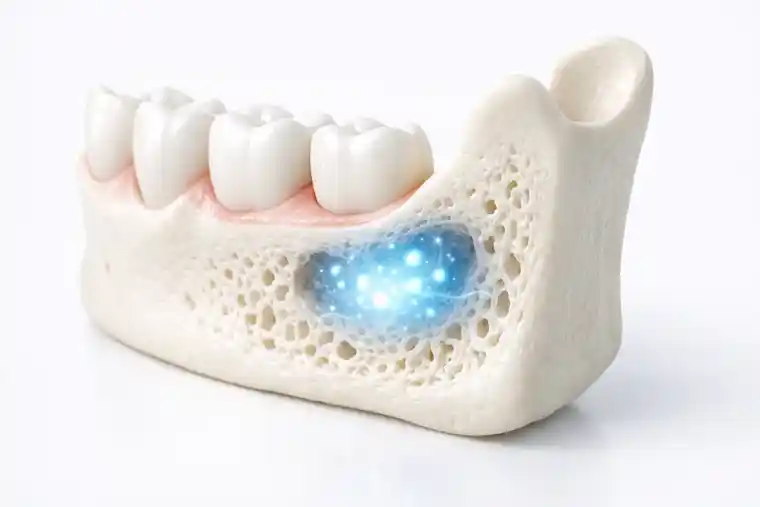
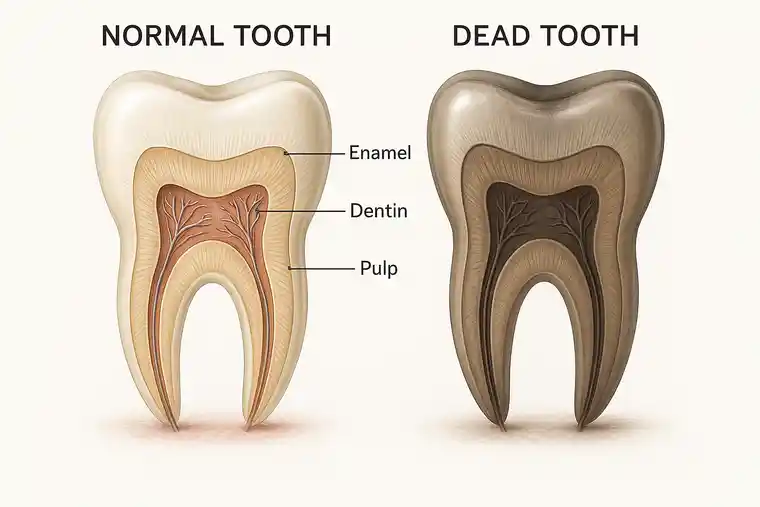
But, how does that even occur? A tooth “dies” when all of its internal pulp has been completely destroyed. The internal pulp is composed of blood vessels and nerves that supply the tooth with necessary oxygen and nutrients.
The good news? A dead tooth doesn’t necessarily have to be discarded. Under the right conditions and treatment, it can still be restored.
So, how will you know for sure whether your tooth is dead? Most importantly, what are the potential treatments for a dead tooth? In this article we will help you find out those answers, along with others.
Table of Contents
What does it mean for a tooth to die?
A dead tooth is one that has stopped receiving fresh blood supply. This usually happens when the pulp, enamel, and sometimes, the dentin have deteriorated or gotten infected. The process can happen suddenly or gradually, depending on several underlying factors that we’ll discuss later in this article
Regardless of how or when it occurs, one fact is for sure — An untreated dead tooth is a pretty bad thing to experience. From the constant pain and discomfort to the bad breath and the discoloration – You are in for a long, rough ride.
How do you know your tooth is dying?
Without a formal diagnosis, a dead tooth condition can be mistaken for gum disease and other dental conditions. So, to avoid confusion, here are some of the dead giveaways of a dying tooth.
The colour of the tooth changes
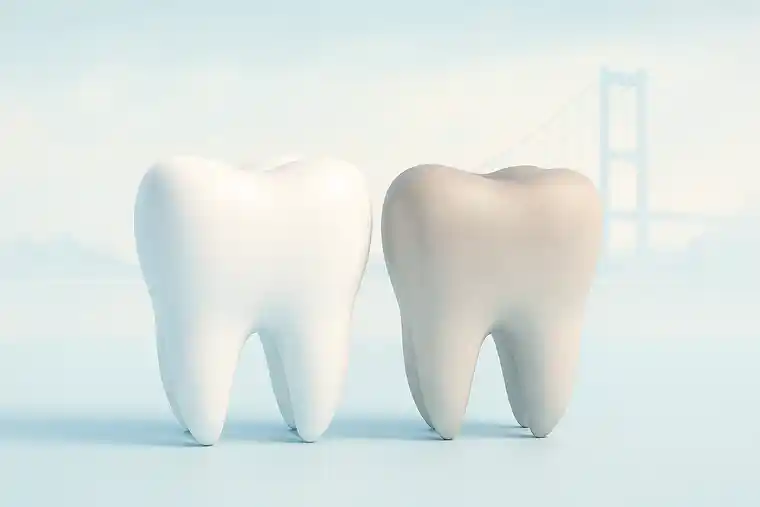
This is one of the most obvious signs of a dead tooth. When the pulp dies, the red blood cells in your teeth start to decompose and discolor the tooth from the inside out. When this happens, your teeth will change color to either gray, brown, or even black. This kind of discoloration tends to happen gradually, unlike regular surface stains.
Incessant gum pain
Although not every patient experiences this, constant gum pain is yet another strong indicator that all may not be well with your tooth. This discomfort usually happens when an infection or swelling inside the tooth irritates the surrounding nerve endings.
However, the pain level is not exactly consistent; it increases depending on the severity of the damage to the pulp.
Small Appearing on the Gum (Parulis)
If you notice a little pimple like bump developing on your gum that may be a warning sign of a tooth that is either going to die or has already died. The pimple like bump is known as parulis (also referred to as a gum boil) and tends to leak a little bit of pus from time to time.
Toothache that suddenly stops
If you have been experiencing pain in your tooth for a while, and out of nowhere and without any treatment, it stops. I hate to break it to you, but that could be your nerves getting damaged. A good rule of thumb is to always consult your dentist whenever tooth pain lingers or changes unexpectedly.
Increased Tooth Sensitivity
Another early indicator of a tooth that will die or has died is a tooth sensitivity. How do you know your tooth has become overly sensitivity? It’s easy; when you take a sip of your drink and you get a slight sharp tingling sensation in your teeth, that is your indication.
Bad breath that won’t go away.
When the pulp nerves within a tooth die, bacteria begin to degrade the surrounding tissues. As the decay progresses, the mouth will start producing foul odors, leading to persistent bad breath.
Now, here is the worst part; No matter how hard or how long you brush, this smell will not go away! And we all know how quickly this can ruin one’s confidence!
Sometimes No Symptoms at All
You may be shocked to know this: but you may have a dead tooth and not experience any of the obvious symptoms.
You will just wake up one day, feel something is off, and from the oral assessment, find out that your tooth is long dead and needs to be removed.
What Causes a Dead Tooth? (Underlying Factors)
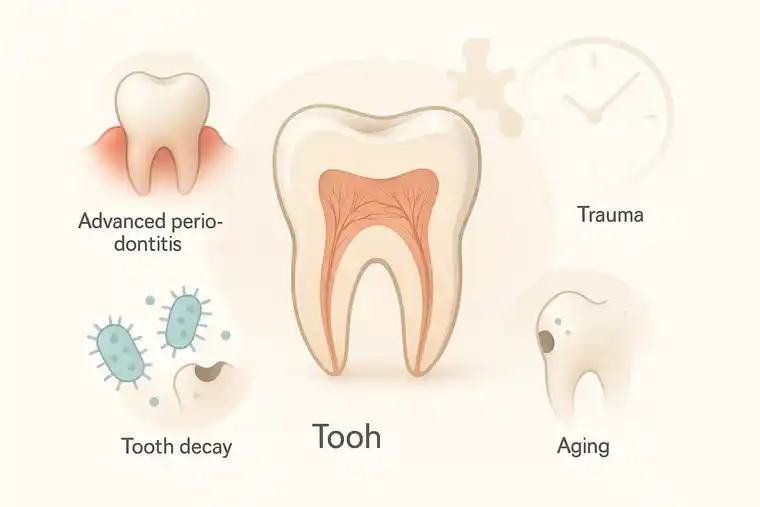
There are many external and internal factors responsible for the death of a tooth. In this blog section, we are going to look at some of them so you will have a better understanding of how they happen and how to prevent them.
Advanced periodontitis
Periodontitis is a severe gum disease that, if left untreated, can damage the bone supporting your teeth. Once this happens, deep pockets form around the teeth, allowing bacteria to invade and infect the pulp.
This is exactly why maintaining good oral hygiene is vital. Regular brushing and flossing, along with periodic professional cleanings can go a long way in keeping your gum healthy.
Trauma and dental injuries
These two are arguably the most common causes of tooth death. Injuries from sports, car accidents, and even simple falls can damage the blood vessels inside your tooth.
What is even more troubling is that old injuries that you barely remember can still cause problems years later. As Dr. Mehmet Kalcay, an Endodontic Specialist at DentSpa, explains, “I see many patients who had a sports injury years ago. They didn’t think much of it at the time. But the trauma slowly damaged the tooth’s blood vessel, and now it’s non-vital’
Aside from injuries, botched oral procedures as well as nonstop teeth grinding can also damage the nerve.
Untreated tooth decay and Cavity damage
If a decaying tooth is not extracted on time, the bacteria can spread deep into the pulp chamber and start destroying the soft tissues inside. The somewhat good news here is that the bacteria will not kill the pulp nerves immediately, it can take weeks or even months before it reaches the pulp chamber.
This means that proactive measures like regular dental checkups and also good oral hygiene can save your tooth from dying.
Age-Related Vulnerability
Old age doesn’t directly make a tooth “die.” Rather, all it does is open the door for bacteria that causes tooth decay and gum diseases to come in and do their damage.
Can a dead tooth be saved?
When a Dead Tooth Can Be Restored
- The decay has not done a lot of damage to the tooth structure.
- The surrounding jawbone has not deteriorated.
- The tooth root is long enough to support the restoration that will be done.
- The condition affecting the tooth can be cleared with treatment.
Treatment option for dead tooth
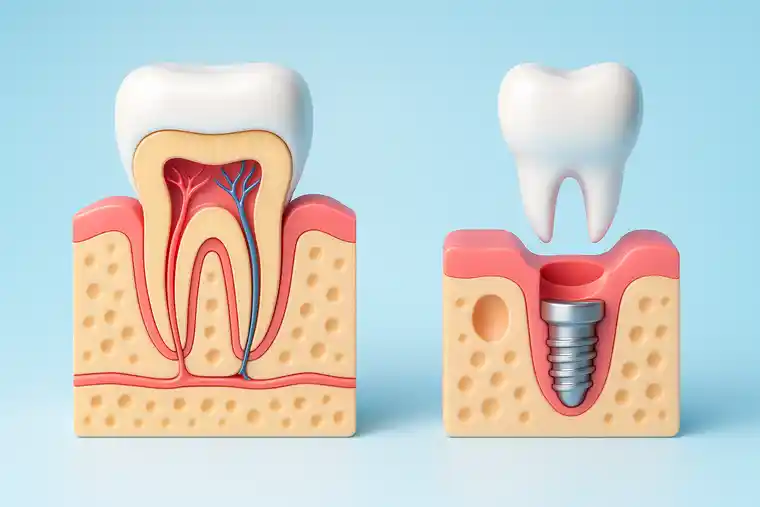
If your dead tooth is considered salvageable, here are some of the treatment options available for you:
Root canal treatment
Root canal therapy is widely regarded as the most effective treatment for a dead tooth. As Dr. Mehmet Kalcay of DentSpa explains, ”Over the years, there have been all sorts of false narratives peddled against root canal therapy. But the truth is that this is still the best treatment available; it allows us to remove the infection from the source itself.
That said, below are the steps involved in the treatment:
- The dead pulp (dead blood vessel and infected tissue) is first removed from the inside.
- The root canals will then be thoroughly cleaned and disinfected.
- The next step would be to fill the empty space (where the pulp was removed) with rubber-like material called gutta-percha material.
- The space is then sealed using adhesive cement called a sealer. This sealer prevents bacteria from entering the surgery site.
- To strengthen the structure and functionality of the tooth, a custom dental crown is placed on it.
Complete tooth removal and replacement
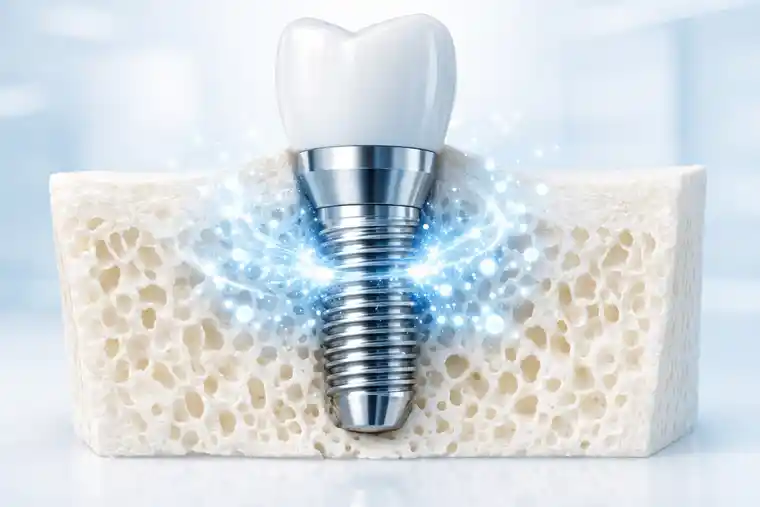
If the condition of your tooth has gone beyond saving, the next sensible thing would be to have it removed. Here, your dentist will place you under local anesthesia and use their specialized tool to remove the dead tooth. After the removal, a custom dental implant will be used to replace it
Get expert help and save your tooth.
So can a dead tooth be saved? In most cases, absolutely yes. With proper treatment, your natural tooth can be preserved and remain functional for many years.
But here is the thing—regardless of which protocol you choose, only a certified and experienced oral surgeon can handle it to near perfection. From root canal treatments and complete tooth extraction to comprehensive oral maintenance, precision and expertise make all the difference.
In istanbul, Turkey, DentSpa has become a household name in dental restoration. Their reputation for excellence speaks for itself. With hundreds of success stories and a long list of happy customers from all around the world, it is no surprise they were recently named the Best Dental Clinic in Europe.
Book a consultation with DentSpa today.
For those who are inspired by this MedClinics blog, remember that your path to a new smile is just a phone call away. Anyone interested in finding out more should contact MedClinics. There you will be in the best hands.
Get a free consultation and a no-obligation quote now!
Stay Updated
Follow our blog for the latest in medical and aesthetic treatments, tips for maintaining healthy teeth, and inspiring patient success stories.
FAQ’s regarding Dead Tooth Treatment in Istanbul, Turkey
Can a Tooth Die?
Yes, it can. A tooth is considered dead if all of its internal pulp, such as the blood vessels and nerves, has been destroyed. This happens when the pulp gets disconnected from the nutrients it needs to survive.
Is Tooth Decay the Same as Tooth Death?
No, it is not. However, tooth decay is one of the leading causes of tooth death because it can reach the tooth pulp and cut it off from the blood supply. This leaves the pulp without nutrients, which leads to tooth death.
How Can I Tell If My Tooth Is Dying or Dead?
The colour of the tooth changing to brown, gray, or black; incessant or recurring gum pain and bad breath; small bumps or boils showing up on your gums; A sensitive tooth means you’re about to – or have lost – a tooth.
What Can Cause a Tooth Death?
Untreated advanced periodontitis, tooth decay and cavity damage, dental trauma injuries, and old age are all vices that can cause tooth death.
How Can I Treat a Dead Tooth?
First, see your dentist to find out if it can be saved. After, you might have to go through one of two procedures: a root canal treatment or a complete tooth removal and replacement.