Clinical insights by Op. Dr. Melihcan Sezgiç
What Are You Expecting From Breast Augmentation by Fat Transfer?
“How much of the fat am I going to lose?”
That question belongs in the consultation, while you are still deciding whether to have the breast augmentation. Some of the transferred fat will be absorbed. A photograph taken five days afterwards would also include swelling. It would be a poor basis for deciding how much of the graft has survived.
When I plan a breast augmentation by fat transfer, I ask you to describe the result you would be happy to live with. If you are hoping for a large increase, I need to hear that early because it affects whether fat alone is a sensible option.
You might show me a bra that fitted before pregnancy and now gaps along its upper edge. Perhaps one breast has always been smaller. You may also be comparing fat with an implant and wondering how far we could go without one.
When you bring a reference photograph, point out what caught your eye. I may notice the overall size while you mean the curve above the nipple. “Natural” on its own leaves a lot open. A photograph will not tell me much about softness, though. If you are worried about how the breast will feel, please say so.
Table of Contents
When Breast Augmentation Without Implants May Require a Lift
There may be enough breast tissue already, but it sits lower than you would like. In that situation, putting more fat into the breast can leave the main concern unresolved.
I examine the nipple position and the skin as well as the volume. After pregnancy, for example, there may be some loss of fullness together with loose skin. Fat can address the volume, but a lift may be needed to change the position.
This is often where the conversation turns to scars. You may have chosen fat transfer partly because you hoped to avoid breast lift scars. I can explain what improvement seems possible with fat alone, but I cannot promise the result of a lift through injections.
Breast augmentation without implants may still involve a lift. In some cases, combining the two makes sense; in others, the additional surgery would be more than you want.
You are allowed to think about that. Asking for an assessment does not commit you to having every procedure we discuss.
“Can You Use the Fat Around My Waist?”
Possibly. I would need to examine the area, including any places treated with liposuction before.
At the examination, I can check your waist and abdomen, and look at the thighs if appropriate. There has to be enough for the transfer, but the amount we leave behind also matters. Taking a little more may be technically possible and still leave a contour you would dislike. We have to consider what that extra collection would do to the donor area.
If there is very little donor fat, it may be enough to fill one part of the breast, although the amount would be too small for the overall enlargement you have pictured. A photograph alone rarely settles that question.
There is also a difference between the amount collected and the amount available for injection. Liposuction removes fluid along with fat. The material is prepared before transfer, and some of what was collected is discarded.
Please mention any ongoing weight loss. Suppose you are still working towards a weight considerably below your current one. By the time you reach it, there may be less fullness in the breasts and less tissue to collect. I would rather assess you once those changes have finished.
And please do not assume you should gain weight for the operation. Tell me your usual weight and what you intend to do afterwards before making that decision.
What Happens to the Fat in Its New Position?
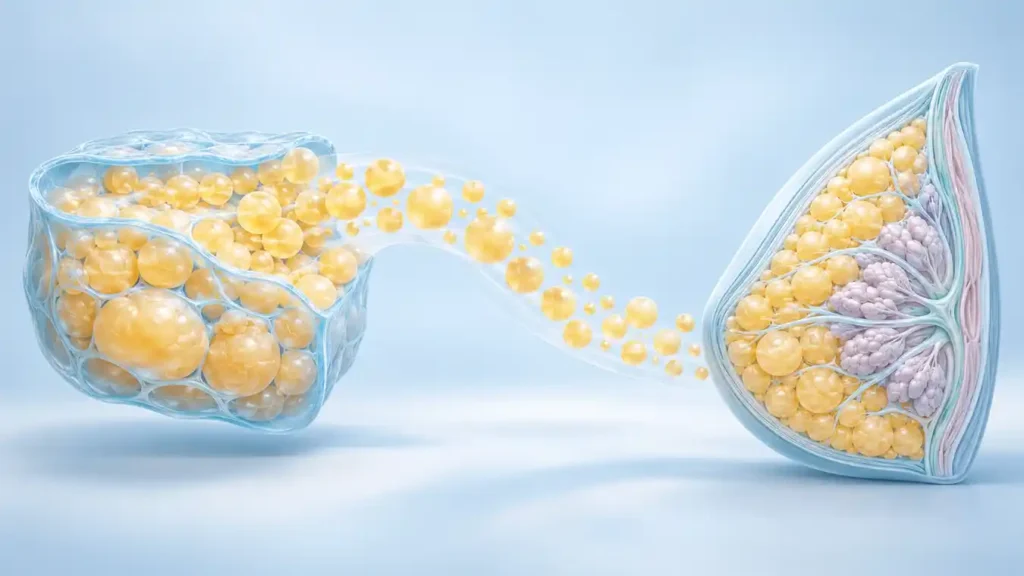
During breast augmentation by fat transfer, the fat is distributed in small amounts through the areas being treated. It needs contact with the surrounding tissue, which supplies nutrients while a blood supply develops.
You can see why there is a limit to what can be transferred at once. There may be plenty of fat available at the waist, but the breast still has to support what is placed into it.
Some fat cells survive. Others are lost during healing. Fat that does not survive may be absorbed, or it may leave an oil cyst or a firm area of fat necrosis.
That is why “How much will you inject?” only answers part of the question. It is possible to inject more and then lose more of it during healing.
A published retention figure is easier to understand if you can see how the authors arrived at it. I look for the follow-up period and the way breast volume was measured. The range of results within the study is useful too; the average can hide women who retained much more or much less.
As a broad guide, around 60% of the transferred fat volume remains. Some women retain more, others less. Knowing that average helps with planning. Your own retained volume will only become clear after healing, which is one reason to discuss the possibility of a second procedure before the first one.
When Can We Judge Your Breast Augmentation Results?
You might like the fullness you see shortly after surgery. Then, as the weeks pass, the bra starts to feel less full.
Some of that change comes from swelling settling. Some comes from fat absorption. Looking from one day to the next makes it difficult to judge either.
We allow several months for your breast augmentation results to settle, sometimes around six. During that time, the reviews are an opportunity to examine healing and follow the changes. They are also the time to show me anything that worries you.
At the later review, we can look at your breast augmentation results together and discuss anything you still want changed. If you are considering another transfer, I can examine what more we could achieve. That depends on the donor tissue still available and the breast itself.
The surviving fat can remain for years, although the breast will continue to change. Weight loss can reduce its volume. A later pregnancy can alter the breast again, and weight gain may affect fullness. Ageing continues after surgery.
The graft may still be there even when the breast no longer has its postoperative shape.
Looking at the Stem Cells in Fat
Fat contains a mixture of cells. Alongside the mature fat cells are cells associated with blood vessels, immune cells and stromal cells. The latter include adipose-derived stem cells.
Researchers are interested in what these cells do around a healing graft. Among other activities, they release signals that affect nearby cells. This has led to work on whether changing the cellular content of a graft could help more of it survive.
I co-authored a review of fat grafting in breast surgery in 2019. We examined cell enrichment, graft survival and the questions that arise during breast imaging afterwards. These subjects are connected: the transferred tissue has to heal, and the breast must remain suitable for ongoing assessment.
If you are offered “stem cell breast augmentation,” ask how the fat will be prepared.
An ordinary fat graft already contains several cell populations. Cell-assisted lipotransfer includes an additional preparation in which more cells are added. One approach uses stromal vascular fraction, or SVF, a mixed population obtained from fat. Another uses selected stromal cells that have been expanded in a laboratory.
If we are comparing studies, we have to check which preparation each research team actually used.
A trial published in 2020 found improved retention with expanded stromal cells. In a small trial published in 2022, ten women received enriched fat in one breast and standard fat in the other. At one year, enrichment had not improved retention.
For me, the question is what a particular preparation has been shown to do. I would need more detail than the treatment name before advising you about it.
Exosomes and the Blood Supply Around a Graft
Blood supply is one concern in a newly transferred graft. That is why research on exosomes is relevant here. Cells release these small vesicles, which carry proteins and other biological material to other cells. Researchers are investigating whether some of those messages might help small vessels develop around a graft.
In a 2025 experiment, human fat was combined with a control preparation, SVF cells or exosomes obtained from adipose-derived stromal cells. The tissue was transplanted into mice and examined over the following weeks. More volume remained in the exosome group than in the controls at weeks four and eight. The researchers also examined blood vessel formation and inflammation.
Before applying that finding to breast augmentation by fat transfer, I would want to see what happens in women followed for longer. The experiment tells us about those grafts in mice. It cannot establish how much fat a woman would retain or the long-term safety of the procedure.
The product being considered would need to be identified, including the source of its exosomes. Results obtained with a particular adipose-derived product cannot simply be assigned to something from another source.
If an exosome treatment appears on your quotation, ask for its details. I would want to know what human research supports adding that preparation to this operation and what additional uncertainties it brings. An explanation of how exosomes work in cells would only answer part of that enquiry.
Breast Augmentation Recovery: Getting Back to Everyday Life
During breast augmentation recovery, bending to put on trousers may make you more aware of the liposuction than of the breasts. The donor area is recovering as well.
There may be bruising and swelling there, and patches of skin may feel numb for a while. The incisions may be small, but the area treated beneath the skin can be much larger. The extent of the liposuction therefore needs to be considered when we plan your time away from work.
Do you lift a child? Carry boxes at work? Describe those duties when we talk about returning. It helps me give you advice that fits your day rather than simply putting a date on a form.
Ask which bra and garments you will need during breast augmentation recovery before buying them. You should leave with instructions for each treated area, including sleeping and exercise. A garment suitable for the place where fat was collected may be unsuitable over the breasts.
Between appointments, contact us about pain that is getting worse, spreading redness, fever or a sudden increase in swelling. Do not save those symptoms for the next review. Chest pain or difficulty breathing needs urgent medical attention.
Breast Screening and a New Lump After Breast Augmentation by Fat Transfer
Even when a lump is close to an area where fat was injected, it needs to be examined. Oil cysts or fat necrosis can explain some findings. Please do not assume that the operation explains every new change.
At a mammogram or ultrasound appointment, tell the team about your breast augmentation by fat transfer and provide the operation details if you have them. A finding may need additional imaging or, occasionally, a biopsy before the breast team can tell you what it is.
Bring previous breast reports to the consultation too. I need to know about past biopsies and any breast cancer in your family. That history, together with your age and examination, helps determine the investigations needed before surgery. If you have been treated for breast cancer, planning should involve your breast specialists.
There is also the consent discussion for the operation itself. Infection or bleeding can occur, the two breasts may heal differently, and a donor area can be left uneven. We will go through the complications that matter for your proposed procedure, including how they would be investigated and treated.
If You Are Coming to Turkey for a Breast Augmentation by Fat Transfer
When you send photographs to begin an assessment in Istanbul, mention any previous liposuction as well as breast operations. Include your medication list. A donor area that looks suitable in a photograph may have been operated on before, and I need that information.
I can discuss an initial proposal from the photographs. The examination allows me to assess the tissue by touch and check the possible donor sites, so you should allow for the proposal to change after we meet.
“How many days should I book?”
Let us arrange the assessment and early reviews before you commit to flights. You also need to know how to reach the team from home and what to do if a concern needs an examination after you have left Turkey.
Read your quotation alongside the proposed operation. Ask whether it covers the liposuction areas we discussed and the planned reviews. If a later transfer is being considered, clarify how that would be arranged and charged. The first price should not leave you guessing about a possible second operation.
Frequently Asked Questions on Breast Augmentation by Fat Transfer

Why are my breasts already looking smaller?
Some reduction in fullness is expected as swelling settles, and some fat will also be absorbed. An early photograph cannot tell us how much of each is happening. At the review, tell me when you noticed the change and whether you have had any pain or redness with it.
Could you still collect enough fat if I am slim?
Possibly, especially for a small correction. I need to examine the donor areas and know how much change you want. We might find enough for one area of the breast and still be unable to achieve the overall enlargement you have in mind.
Why would you suggest coming back for another transfer?
Sometimes it is better to let the first graft heal before adding more. Less fat may also have remained than expected. A further operation needs something specific to improve; I would want to show you what that is at the examination.
Is a “stem cell” fat transfer better than an ordinary one?
Send me the description you have been given. I need to know whether it means SVF, laboratory-expanded cells or simply the cells already present in fat. Those are different preparations, so I cannot compare them from the phrase “stem cell” alone.