Training & Education

Some operations are easier to explain than to teach.
Sleeve gastrectomy is one of them.
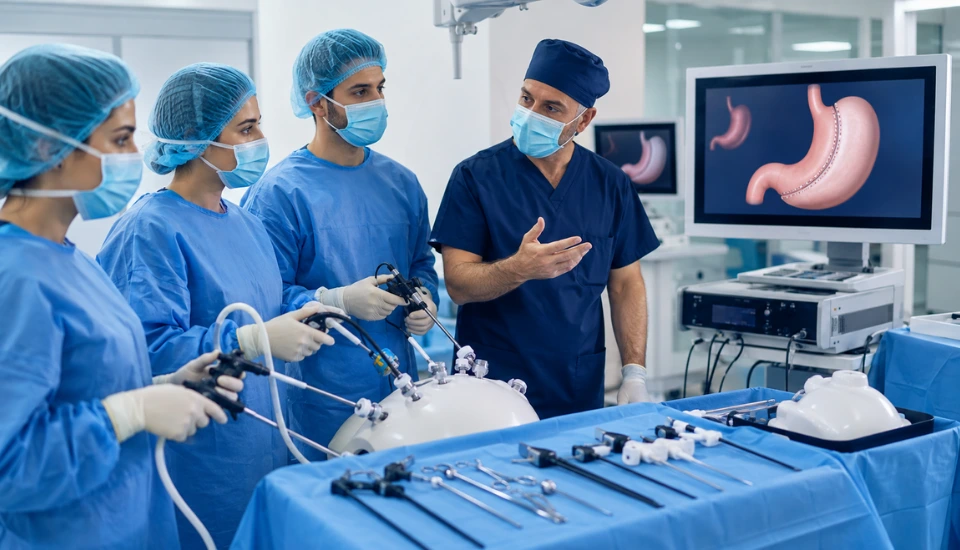
On a surgical video, the sequence can look controlled from beginning to end. The stomach is mobilized. The short gastric vessels are divided. The fundus is freed. The calibration tube is placed. The stapler moves along the planned line. The staple line is checked, reinforced when needed and tested before the case is closed.
Anyone with a bariatric surgery background knows the order.
The difficult part is learning where the operation becomes less obvious. A view that looks acceptable may not be enough for safe stapling. A fundus that seems mobilized may still be pulling at the top. A sleeve that appears straight from one angle may look different after inspection. Bleeding from the staple line may be minor, but it still asks for a decision.
That is the part of the operation that needs practice.
The Advanced Sleeve Gastrectomy Course will take place in Istanbul, Turkey, on 20–21 November 2026. This two-day sleeve gastrectomy course combines theoretical sessions, dry lab training and hands-on porcine wet lab practice for surgeons who want focused bariatric surgery training in a structured setting.
The course covers standardized laparoscopic sleeve gastrectomy, short gastric vessel division, fundus mobilization, stapling strategies, sleeve creation, staple line reinforcement, hemostasis and leak testing.
📌 Format: Theory, dry lab and wet lab
📅 Date: 20–21 November 2026
📍 Location: Istanbul, Turkey
🧪 Training model: Hands-on porcine wet lab
👨⚕️ Main procedure: Standardized laparoscopic sleeve gastrectomy
👥 Participant limit: 21 participants
🎓 Certificate: Certificate of Completion
💳 Course fee: USD 2,900
✅ Included: Theoretical sessions, dry lab training, porcine wet lab practice, expert faculty supervision, personalized surgical scrubs and membership
📞 Contact: For registration details and availability, our medical education coordination team is available by WhatsApp at +90 537 977 89 84.
Sleeve gastrectomy is often described in a neat order. In real cases, the learning happens inside the details.
The first issue is exposure. If the liver is not retracted well, or the port placement does not support the working angle, even routine steps become harder. The surgeon may still complete the operation, but with more tension, less control and less confidence in the view.
Then comes mobilization.
The greater curvature has to be opened with steady traction. The short gastric vessels need careful division. The fundus has to be released properly, not almost properly. This part of the operation can change the final sleeve shape more than it may seem in a lecture.
Stapling brings another layer of judgment. Cartridge choice, tissue thickness, alignment and sleeve direction are not cosmetic decisions. They shape the procedure. The sleeve should not be narrow where it should be open, or loose where it should be controlled. The staple line needs a careful look before the surgeon moves on.
This is why the course is built around theory, dry lab and wet lab work. The same operation is studied from different angles: first as a clinical decision, then as anatomy, then as a technical sequence, and finally as a hands-on exercise with tissue.
The first day begins with the clinical side of bariatric surgery.
The opening session covers obesity and metabolic surgery, patient selection, indications and contraindications, preoperative assessment, optimization and the multidisciplinary bariatric approach. These subjects can sound general, but they are closely tied to operative planning.
A sleeve gastrectomy should match the patient, not only the surgeon’s technical ability.
The program includes real-life case selection strategies so that the discussion does not stay at the level of definitions. Patient selection is often where the first surgical decision is made. Risk, timing, preparation and follow-up all sit inside that decision.
The next session moves into anatomy and setup.
Participants work through upper gastrointestinal anatomy, gastric blood supply, greater curvature anatomy, key landmarks, port placement, operating room setup, instrument selection and ergonomics. These points are familiar to most surgeons, but they are also where many difficult cases begin.
A poorly chosen port position may not look like a problem at the start. Later, it can make stapler access uncomfortable. A weak view of the fundus may not seem dramatic until the surgeon begins to shape the sleeve. The course uses video-based learning to connect these setup decisions with the operation that follows.
The main procedural session on Day 1 focuses on the sleeve itself.
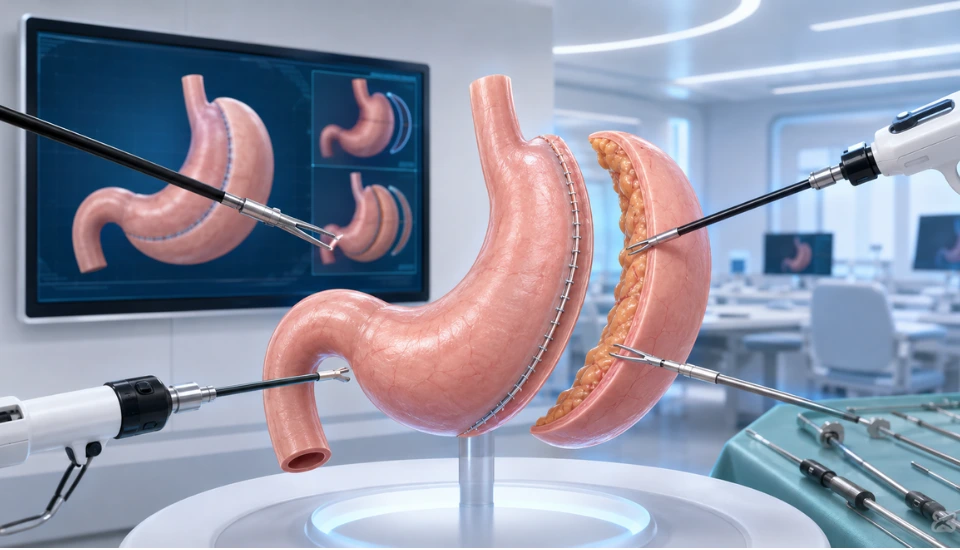
The program covers gastric mobilization, division of the short gastric vessels, calibration tube positioning, stapler selection, cartridge choice, staple line creation and technical ways to avoid twisting and stenosis.
This is not presented as a race through the steps.
The operation is broken down so that each part can be looked at more closely. Where does the mobilization become difficult? How is the fundus handled? What does the calibration tube help with, and what can it not solve? How should the stapler approach the stomach? What should be checked before the next firing?
The session includes a complete sleeve gastrectomy video, critical operative steps and technical pearls from expert surgeons.
Video is useful here because it gives participants a chance to watch the operation with the pauses included. Not only the clean parts, but also the moments where the surgeon has to decide how to continue.
Before the lab work begins, the course also includes a session on complications and expert discussion.
This part of the program covers strategies for preventing and managing intraoperative problems, staple line reinforcement, leak prevention and postoperative management.
For sleeve gastrectomy, complication awareness belongs inside the technique. Bleeding control, reinforcement and leak testing are not separate from the operation. They are part of how the sleeve is finished.
The expert panel gives room for the questions that often matter most in practice: what to do when the fundus is difficult, how to approach staple line bleeding, how to think about reinforcement, and where technical caution can reduce avoidable risk.
The afternoon of Day 1 moves into dry lab training.
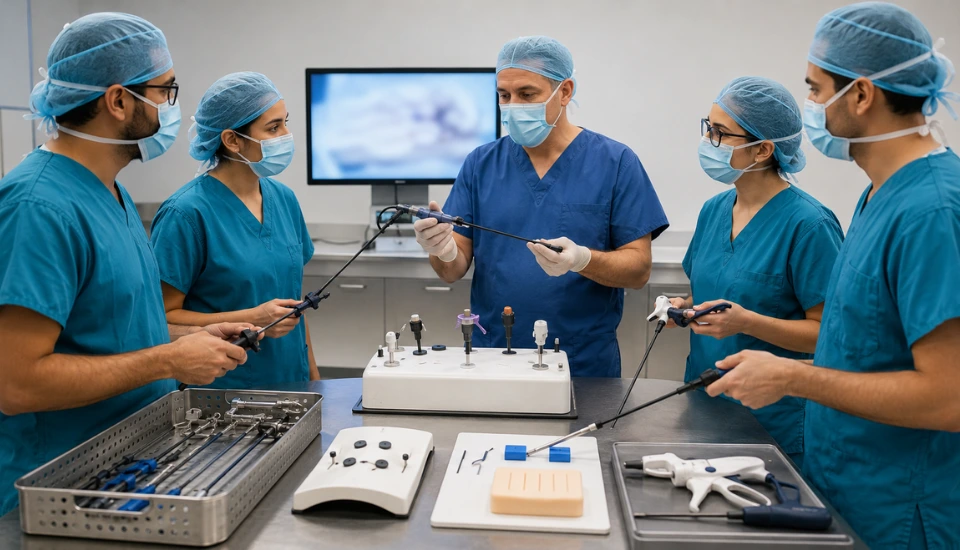
The dry lab includes camera navigation, ergonomics, tissue handling, intracorporeal suturing and stapling simulation exercises.
This section gives participants time to work on the movements behind the procedure. The camera hand, the angle of approach, the way tissue is held, the rhythm of stapling and the comfort of laparoscopic suturing all affect how the surgeon performs later in the wet lab.
Dry lab work is useful because small habits become visible there.
A camera view that drifts. A hand position that limits movement. A stapler angle that feels awkward. These can be corrected more easily before the next day’s porcine wet lab.
Day 1 ends with discussion, key learning points and preparation for the practical session.
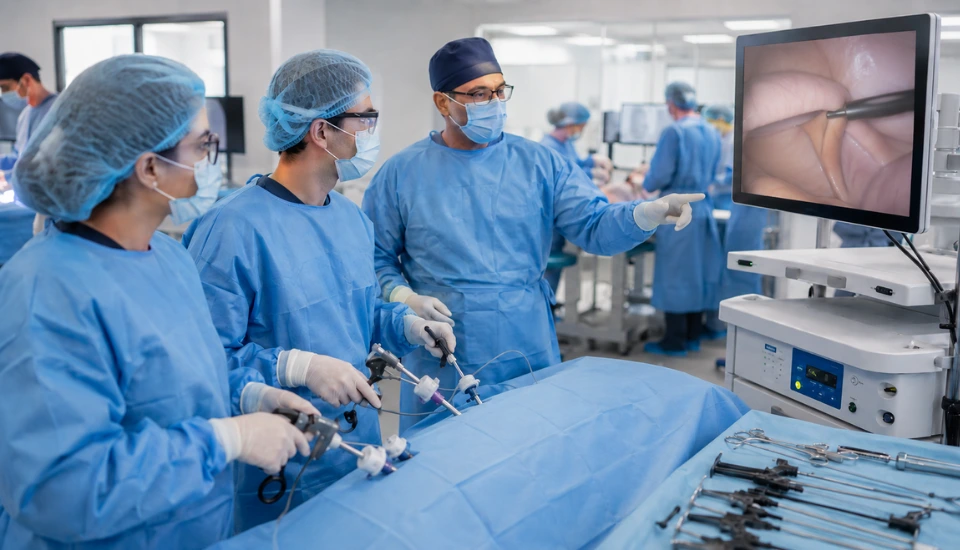
Day 2 begins with a veterinary surgeon briefing on porcine upper gastrointestinal anatomy and wet lab safety protocols.
The briefing covers relevant porcine anatomy, anatomical differences from human anatomy, wet lab rules, instrument handling and laboratory workflow. It also helps define the model correctly. A porcine wet lab is not the same as an operating room case, but it gives surgeons a controlled educational setting for practicing important steps.
The first wet lab session is dedicated to sleeve gastrectomy.
During the session, participants work through patient positioning, port placement, liver retraction, exploration of the upper abdomen, greater curvature mobilization, short gastric vessel division, complete fundus mobilization, calibration tube guidance, stapler alignment and firing, sleeve creation, staple line inspection, hemostasis, reinforcement and leak testing.
The value is in doing the steps with supervision.
The tissue moves. The exposure changes. The stomach has to be held correctly. The stapler has to be introduced with care. The staple line has to be inspected slowly enough to learn from it.
That is difficult to recreate in a lecture room.
The afternoon session gives participants another round of supervised bariatric procedure practice.
This part of the course focuses on repeated sleeve gastrectomy steps, difficult anatomy management, staple line bleeding control, reinforcement techniques, intraoperative troubleshooting and technical refinement.
A second pass through the procedure is often where the teaching becomes more specific.
During the first attempt, much of the attention goes to the order of the steps. During repeated practice, the surgeon can begin to notice the quality of the exposure, the direction of traction, the stapler angle, the way the fundus is released and the appearance of the staple line after firing.
The course ends with evaluation, certificate ceremony and group photo.
This sleeve gastrectomy course is intended for surgeons with a laparoscopic background who want focused training in bariatric surgery.
It may be suitable for general surgeons, bariatric surgeons, digestive surgeons, upper gastrointestinal surgeons, minimally invasive surgeons and surgical fellows who want more structured practice in laparoscopic sleeve gastrectomy.
The course may also be useful for surgeons who want to strengthen specific parts of the operation, including short gastric vessel division, fundus mobilization, stapling strategy, staple line reinforcement, hemostasis, leak testing and intraoperative troubleshooting.
It is not planned as a first introduction to laparoscopy. Participants should already be comfortable with basic laparoscopic principles before joining the training.
The Advanced Sleeve Gastrectomy Course in Istanbul brings the main parts of sleeve gastrectomy training into a compact two-day program.
The first day is built around patient selection, bariatric fundamentals, operative anatomy, procedure planning, step-by-step technique, complications and dry lab training. The second day is centered on porcine wet lab practice, with supervised work on sleeve gastrectomy steps and technical refinement.
For surgeons looking for hands-on bariatric surgery training, the course offers a practical setting to study laparoscopic sleeve gastrectomy from planning to leak testing.
The aim is not only to see how the sleeve is done.
It is to understand the operation closely enough to make better decisions when the view, tissue or next step becomes less straightforward.
For doctors who want to follow surgical training opportunities, medical education programs and healthcare developments in Turkey, MedClinics also shares regular updates through its Medical News & Blog section.
It is a two-day bariatric surgery course in Istanbul focused on laparoscopic sleeve gastrectomy, with theory, dry lab work and porcine wet lab practice.
The course will take place on 20–21 November 2026.
The main procedure is standardized laparoscopic sleeve gastrectomy. The program also covers short gastric vessel division, fundus mobilization, stapling strategies, staple line reinforcement, hemostasis and leak testing.
Yes. The course includes dry lab training and hands-on porcine wet lab practice under expert faculty supervision.
It is suitable for surgeons with a laparoscopic background who want focused training in bariatric surgery and sleeve gastrectomy technique.
Yes. The course includes a Certificate of Completion.