Proofread by Op. Dr. Melihcan Sezgiç
MedClinics News & Blog
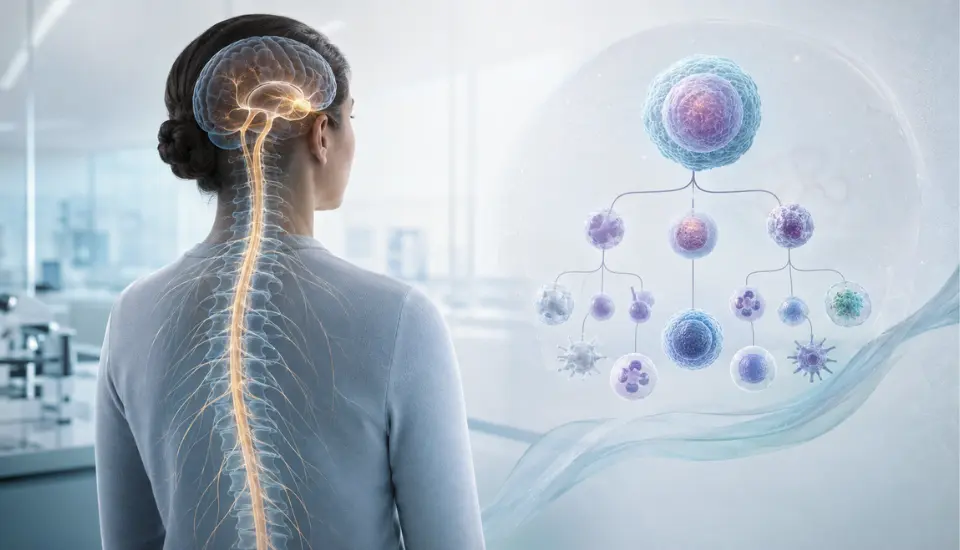
Stem cell-derived extracellular vesicles for wound repair are being studied because a wound is not healed just because the surface has closed.
That is often the part people miss.
A wound can look better from the outside while the tissue underneath is still fragile. It can shrink for a few weeks, then open again. It can stay inflamed long after inflammation should have settled. In diabetic wounds, pressure injuries, vascular ulcers and complicated surgical wounds, healing is not only delayed. The whole local repair environment can become stuck.
This is why wound repair has become an interesting area for cell-free regenerative medicine.
A 2026 paper published in npj Regenerative Medicine looked at stem cell-derived extracellular vesicles and artificial nanovesicles as possible tools for wound repair. It was not a new patient trial. It did not announce a finished treatment. Its value is quieter than that. The paper brings together a growing body of research and asks how vesicle-based approaches could be moved closer to real clinical use.
That is a useful question.
Regenerative medicine has spent years talking about stem cells. But many researchers now look just as closely at what stem cells release. The secretome, extracellular vesicles, exosomes, nanovesicles, biomaterial delivery systems – these are not side details anymore. They are becoming part of the product-design conversation.
Wounds make that conversation concrete.
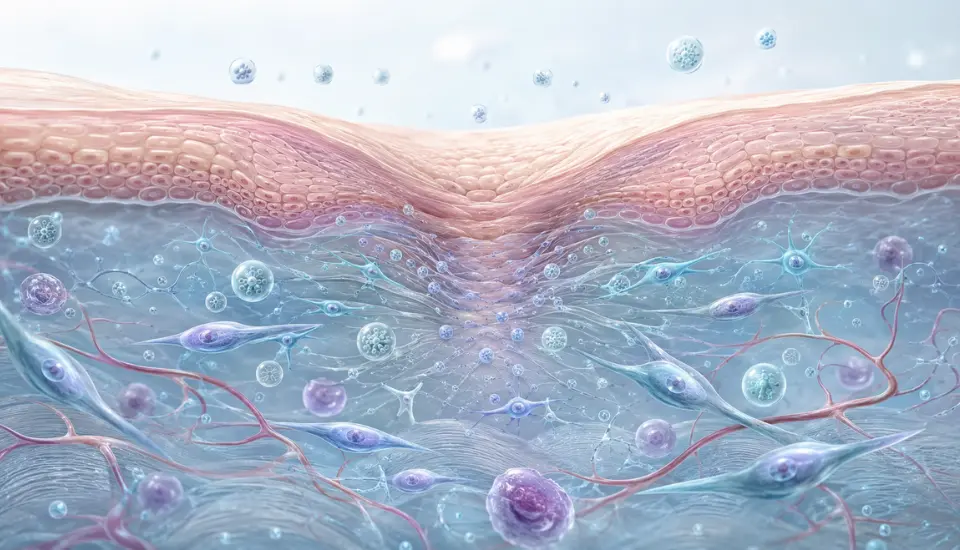
A wound needs communication between immune cells, skin cells, fibroblasts, blood vessels and the extracellular matrix. When that communication becomes disordered, the wound may not move forward. Stem cell-derived extracellular vesicles are being studied as one possible way to influence that conversation.
Not by replacing the whole repair process. By trying to guide it.
Table of Contents
Why Difficult Wounds Do Not Heal Normally
Simple wounds can make healing look efficient.
A cut forms a clot. Inflammation starts. New tissue fills the gap. The surface closes. The scar slowly changes. The body is doing a lot, but from the outside it can look almost routine.
Chronic wounds are different.
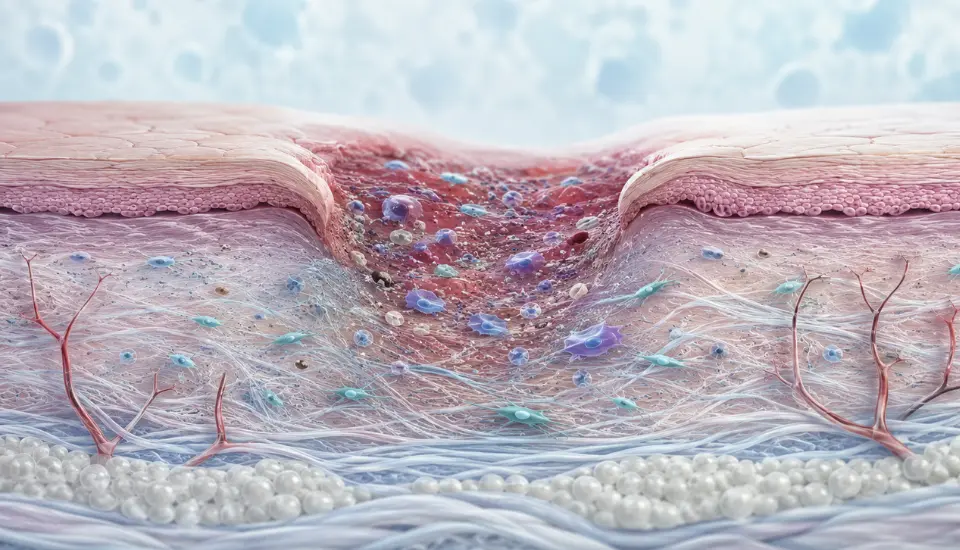
They may remain in a state that looks busy but not productive. Inflammation stays active. New blood vessel growth may be weak. Cells that should migrate into the wound bed may respond poorly. The extracellular matrix may be degraded, stiff, disorganized or rebuilt in the wrong way.
Clinically, this is frustrating because the wound is not just open. It is biologically uncooperative.
This is why chronic wound care cannot be reduced to “make the skin close.” Closure matters, of course. But the quality of the new tissue matters too. So does whether the wound stays closed, whether infection is controlled, whether pain improves, whether dressing burden decreases and whether the patient can return to normal movement.
A wound that closes and reopens has not really solved the problem.
For regenerative medicine, that makes wound repair a hard test. Laboratory results have to face an environment with fluid, bacteria, enzymes, poor oxygenation, inflammation, pressure and repeated dressing changes. A biological product may work neatly in a cell culture dish and still struggle in that setting.
That is why the new paper is worth attention. It looks beyond whether extracellular vesicles can change a marker in the laboratory. It asks how these products might be developed, delivered and measured in a way that matches the reality of wound repair.
Stem Cell-Derived Extracellular Vesicles for Wound Repair
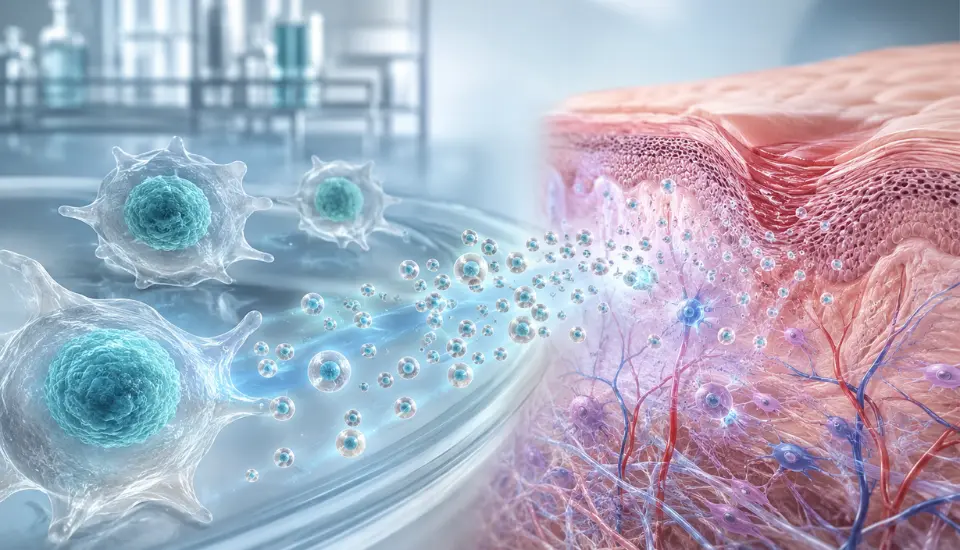
Stem cells release many signals into their surroundings. Some of these signals are carried in extracellular vesicles.
Extracellular vesicles are tiny membrane-bound particles released by cells. They can contain proteins, lipids, RNA and other molecules. Exosomes are one type of extracellular vesicle, although in many research settings the broader term EV is more accurate.
In wound repair, these vesicles are being studied because they may act on several parts of healing at once.
They may influence inflammation. They may support angiogenesis, the formation of new blood vessels. They may affect fibroblasts, keratinocytes, endothelial cells and immune cells. They may also influence extracellular matrix remodeling and scar-related pathways.
This multi-signal nature is part of the appeal.
A chronic wound rarely fails for one reason. It is usually a mixture of excessive inflammation, weak vascular support, poor cell migration and impaired matrix remodeling. A product that carries several biological signals may fit that complexity better than a single isolated molecule.
But this is exactly where careful language matters.
“Stem cell-derived extracellular vesicles” is not one product. It is a category.
The parent cell matters. Bone marrow-derived cells, adipose-derived cells and umbilical cord-derived cells can produce different vesicle profiles. Culture conditions matter. Isolation methods matter. Storage matters. Dose matters. The delivery material matters. A vesicle preparation from one study should not be treated as identical to another preparation from a different lab.
That may sound like a technical detail, but it is central.
If this field is going to move toward clinical wound care, researchers need defined products. They need to know what is being produced, what it contains, how consistent it is and what biological activity it is supposed to have.
Without that, the field stays interesting but difficult to translate.
The Cell-Free Idea Is Not a Shortcut
Cell-free regenerative medicine can sound simpler than cell therapy.
No live stem cells placed into the tissue. No expectation that cells will engraft or become part of the wound. Instead, researchers focus on the signals that cells release.
For wound repair, this is an attractive idea. A vesicle-based product could potentially be applied locally. It could be combined with a gel, dressing, scaffold or other biomaterial. It could be designed for a wound bed rather than for systemic delivery.
Still, cell-free does not mean easy.
A vesicle product still has to be manufactured. It has to be characterized. It has to remain stable. It has to be delivered in a practical way. It has to reach the right cells and stay active long enough to matter.
Then it has to prove something clinically meaningful.
A study showing that vesicles change inflammatory markers may be useful. A study showing that cells migrate faster in vitro may be useful. But wound care will need more than that. Researchers will have to show better wound closure, stronger tissue, improved vascularization, better scar quality, reduced recurrence or other outcomes that matter to clinicians and patients.
This is one of the strengths of the 2026 paper. It does not treat molecular activity as the finish line. It places extracellular vesicles inside a larger translational path.
In regenerative medicine, early excitement can make a concept sound closer to the clinic than it really is. Wound repair is less forgiving. The wound either improves in a durable, useful way or it does not.
Where Artificial Nanovesicles Fit In
The paper also discusses artificial nanovesicles.
These are vesicle-like particles produced through engineering or processing methods. They are related to the extracellular vesicle field, but they are not the same as naturally released EVs.
Researchers are interested in artificial nanovesicles for practical reasons. They may offer higher yield. They may be easier to scale. They may be modified more deliberately. They may help solve some of the manufacturing problems that come with naturally secreted vesicles.
But manufacturing convenience is not the same as clinical value.
Natural EVs may preserve parts of the parent cell’s communication system. Artificial nanovesicles may be more controllable. Both routes have advantages. Both also raise questions.
- What is inside the vesicle?
- How reproducible is it?
- How does it behave in the wound bed?
- Does it carry the intended biological activity?
- Does it improve healing beyond standard care or beyond a simpler delivery product?
These questions are not academic. They decide whether a vesicle-like product can become more than a clever platform.
For wound repair, artificial nanovesicles may become important if they help the field produce more consistent, scalable and adjustable products. But they will still need the same level of safety testing, potency testing and clinical evidence.
Including artificial nanovesicles is useful because it shows where the field is heading. Researchers are not only collecting vesicles and asking whether they work. They are beginning to ask how vesicle-like products should be designed.
Why Delivery Systems Matter in Wound Repair
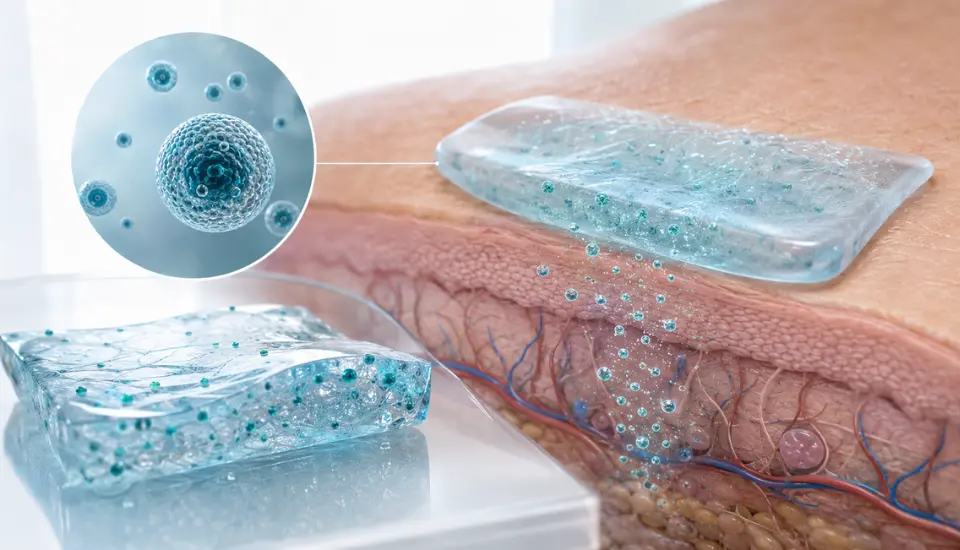
A chronic wound is a difficult place to put a biological product.
The surface can be wet. Dressings are changed. Enzymes can degrade material. Bacteria may be present. The wound may be poorly perfused. The patient may have diabetes, vascular disease or pressure-related injury that continues to affect the tissue.
If extracellular vesicles are applied directly, they may not remain in the wound long enough to do much.
This is why delivery systems are becoming so important.
Hydrogels, scaffolds, responsive dressings and other biomaterials are being studied as ways to hold vesicles in the wound bed and release them over time. In some studies, the delivery platform is not just a carrier. It becomes part of the therapeutic design.
This makes sense.
A good delivery system could protect the vesicles, improve retention and make the release more controlled. A poor delivery system could waste a biologically active product before it reaches its target.
For real wound care, practicality will matter. A product has to fit into dressing changes, infection control, patient comfort and clinical workflow. It cannot only work under ideal laboratory conditions.
This may be one of the most important points for the future of vesicle-based wound repair.
The best product may not be the vesicle preparation with the most impressive marker change in vitro. It may be the vesicle-plus-delivery system that survives the wound environment and produces a measurable repair benefit.
What the 2026 Paper Adds
The review does not change clinical practice today. It is more useful as a map.
It brings together naturally derived extracellular vesicles, artificial nanovesicles, wound-healing biology, delivery systems and translational endpoints. That combination matters because these topics are often discussed separately.
- A wound article may focus on inflammation.
- An extracellular vesicle article may focus on cargo.
- A biomaterials article may focus on hydrogels.
- A translational paper has to ask how all of this would come together as a real product.
That is why this research is worth covering now. It shows a field becoming more organized. Not complete. More organized.
For MedClinics, the topic also fits a broader pattern in regenerative medicine. The field is moving from broad stem cell language toward more specific biological tools. Secretomes, extracellular vesicles, exosomes, nanovesicles and engineered delivery systems are becoming part of how researchers think about tissue repair.
Wound healing is a good example because the outcome is concrete. The wound closes or it does not. The tissue becomes stronger or it does not. The repair lasts or it does not. That gives the science a clear test.
What Comes Next
Stem cell-derived extracellular vesicles for wound repair remain a research direction, not a routine wound care treatment.
The next stage will need better product definitions, stronger comparisons between vesicle sources, more consistent manufacturing, relevant wound models and delivery systems designed for real clinical use.
Human studies will eventually need to look beyond short-term closure. They will need to ask whether the tissue is durable, whether recurrence is reduced, whether infection risk changes, whether pain improves and whether the patient’s care burden becomes lighter.
That is a high bar and it should be.
Chronic wounds are difficult for a reason. A new regenerative product has to show that it can help in that difficult environment, not only in a controlled experiment.
Still, the direction is meaningful. Wound repair depends on signals moving between cells. Stem cell-derived extracellular vesicles are one way researchers are trying to understand and possibly shape those signals.
The 2026 review does not offer a finished answer. It makes the next questions clearer.
In regenerative medicine, that can be real progress.
Frequently Asked Questions About Stem Cell-Derived Extracellular Vesicles for Wound Repair
What are stem cell-derived extracellular vesicles?
They are tiny particles released by stem cells. They can carry proteins, lipids, RNA and other biological signals. In wound repair research, they are studied because they may influence how cells communicate during healing.
Why are they being studied for difficult wounds?
Difficult wounds often involve persistent inflammation, weak blood vessel growth and poor tissue remodeling. Extracellular vesicles may carry signals that affect several of these repair processes.
Was the 2026 review a human clinical trial?
No. The 2026 npj Regenerative Medicine article was a review, not a new human clinical trial. It discussed the research landscape and the translational challenges around vesicle-based wound repair.
What are artificial nanovesicles?
Artificial nanovesicles are vesicle-like particles made through engineering or processing methods. Researchers are studying them because they may be easier to produce, scale or modify than some naturally released extracellular vesicles.
Are these products ready for routine wound care?
No. More research is needed on safety, consistency, dosing, delivery and clinical effectiveness. At this stage, stem cell-derived extracellular vesicles and artificial nanovesicles remain important research directions.
Sources
- “Stem cell-derived extracellular vesicles and artificial nanovesicles: a translational framework for cell-free wound repair.” npj Regenerative Medicine. 2026.
- PubMed record: “Stem cell-derived extracellular vesicles and artificial nanovesicles: a translational framework for cell-free wound repair.”
- “Stem Cell-Derived Exosomes in Wound Healing and Skin Regeneration: Emerging Therapeutic Strategies and Mechanisms.” Cells. 2026.
- PubMed record: “Stem Cell-Derived Exosomes in Wound Healing and Skin Regeneration: Emerging Therapeutic Strategies and Mechanisms.”
- “Stem cell-derived nanovesicles delivered by responsive hydrogels for refractory wound therapy.” Journal of Materials Chemistry B. 2026.