

MedClinics News & Blog
MSC-based therapy for knee osteoarthritis is receiving attention because the condition remains difficult to treat beyond symptom control.
For many patients, it becomes part of ordinary life. Stairs are slower. Walking distance becomes shorter. The knee feels different in the morning. Exercise becomes something to negotiate with pain.
The frustrating part is that treatment often sits between two ends.
On one side, there are conservative options: physiotherapy, weight management, pain medication, anti-inflammatory treatment and injections. These can help. Sometimes they help a lot.
On the other side, there is joint replacement for advanced disease.
Between those two points, many patients spend years looking for something better than temporary symptom control but less final than surgery.
This is the space where regenerative orthopedics has attracted attention.
It is also the space where the language can become too easy.
“Stem cell therapy for knee arthritis” sounds simple. The biology is not simple. Osteoarthritis is not only a worn cartilage surface. It is a whole-joint disease. Cartilage changes, but so do bone, synovium, meniscus, alignment, inflammation and mechanical load.
A recent first-in-human study on OSCA is interesting because it does not treat the problem as a general stem cell story.
It tests a defined MSC-based product.
OSCA combines osiramestrocel, an allogeneic mesenchymal stromal cell product, with cartilage acellular matrix. The product is injected into the knee joint. The idea is not only to place cells into the joint, but to pair them with a cartilage-related matrix.
That is the part worth noticing.
Not because the study proves a new treatment for knee osteoarthritis.
It does not.
But because it shows a more specific direction for MSC research in orthopedics: a defined product, a defined joint disease stage and measured follow-up in patients.
Table of Contents
The Problem OSCA Is Trying to Address
Cartilage is often at the center of knee osteoarthritis conversations.
That makes sense. Cartilage loss is visible. It is easy to explain. People understand the idea of a joint surface becoming thinner and less smooth.
But the knee is not only cartilage.
A painful osteoarthritic knee may also involve synovial inflammation, changes in the bone under the cartilage, meniscus damage, muscle weakness, altered walking patterns and uneven load across the joint.
This is one reason treatment is difficult.
A painkiller may reduce symptoms without changing the joint. An injection may calm pain for a period. Physiotherapy may improve function by strengthening the muscles around the knee. Joint replacement may solve advanced structural damage, but it is not the right answer for every patient at every stage.
What is missing is not simply another way to reduce pain for a few weeks.
The larger need is a treatment that may influence the joint environment more deeply.
That is why MSC-based therapies keep coming back into the discussion. MSCs are studied for their biological signaling, immune-modulating effects and possible role in tissue repair environments.
Still, the question is not whether MSCs sound promising.
The question is what exactly they are being asked to do inside an osteoarthritic joint.
OSCA gives one possible answer: combine the cell component with a cartilage-derived matrix and test whether that co-formulation can be used safely in humans.
What OSCA Is
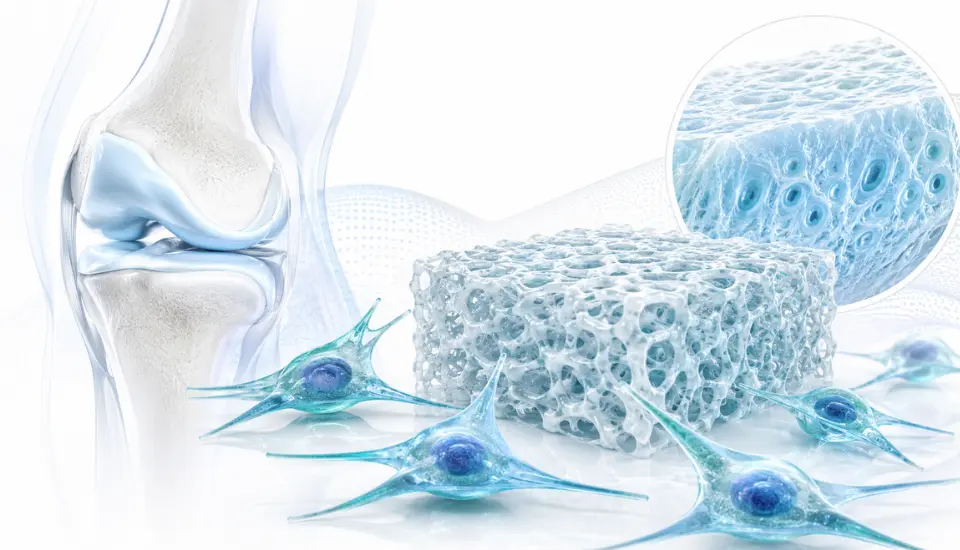
OSCA is not a cell-only injection.
It has two parts.
The first is osiramestrocel. This is an allogeneic mesenchymal stromal cell product. Allogeneic means the cells come from a donor source rather than from the patient being treated.
The second part is cartilage acellular matrix.
That means cartilage-derived matrix material with the cells removed.
This difference matters because cartilage is not just a place where cells sit. Its matrix is part of what gives cartilage its structure. It helps the tissue handle pressure, movement and load. In osteoarthritis, that matrix becomes damaged and less organized.
The OSCA approach is built around the idea that MSCs and a cartilage-relevant matrix may work better together than cells alone.
The cells may influence the local biological environment.
The matrix may provide a more suitable setting for cartilage-related repair signals.
That is the concept.
It is not the same as saying the concept has already been proven in routine clinical care.
At this stage, OSCA is still investigational. What makes the study notable is that it evaluates MSCs within a defined product design, combining the cell component with a cartilage-related matrix rather than studying the cells in isolation.
What the First Human Study Looked Like
The study was published in Experimental & Molecular Medicine.
It was a first-in-human, multicenter, open-label, dose-escalation Phase 1 trial.
That sounds technical, but the meaning is straightforward.
This was an early human study. It was mainly looking at safety and tolerability. It was not built like a large placebo-controlled trial designed to settle the question of effectiveness.
The study included 12 patients with Kellgren–Lawrence grade 2 or 3 knee osteoarthritis. In practical terms, these were patients with mild-to-moderate radiographic disease, not the most advanced form of knee destruction.
Each patient received one intra-articular OSCA injection.
The patients were divided into three dose groups:
- 25 million cells
- 50 million cells
- 100 million cells
The cartilage acellular matrix amount was kept the same across the groups.
The follow-up period was 24 weeks.
During that time, the researchers looked at safety first. They also followed pain, function and imaging-based measures of the knee.
For a first human study, that is a reasonable place to begin.
But it also explains why the results have to be read carefully. Twelve patients is a very small group. There was no placebo arm. The study was open-label. Six months is not long for a disease that develops over years.
So the study gives a first clinical signal.
It does not give the final word.
What the Data Showed

The main finding was safety.
OSCA was reported as well tolerated in this small group. The study did not report dose-limiting toxicities. Treatment-emergent adverse events occurred in 3 of the 12 patients and were described as mild to moderate.
That is the first step for a therapy like this. Before asking whether a product can change osteoarthritis, researchers need to know whether it can be administered in humans without an early safety barrier.
The study also reported improvements in pain and function scores over 24 weeks, especially in the mid-dose and high-dose groups.
MRI-based findings were also followed. The paper reported improvement in MOCART total scores in 70% of patients and improvement in WORMS cartilage integrity in 50%. Kellgren–Lawrence grades remained stable in 80% of patients over the follow-up period.
These numbers are interesting.
They are also early.
A small open-label study can show improvement for reasons that are not only biological repair. Pain changes over time. Activity changes after treatment. Patients may expect improvement. Imaging signals can be difficult to interpret without longer follow-up and a comparison group.
That does not make the findings meaningless.
It means they should be placed where they belong: early Phase 1 data that support more research.
The OSCA study is strongest when read this way.
It shows that the product could be given in this early setting. It shows pain, function and imaging signals worth following. It does not show that cartilage regeneration has been proven.
The Cartilage Matrix Is the Interesting Part

The most useful part of the OSCA story may be the matrix.
In many public conversations, the word “stem cell” carries too much of the weight. It becomes the whole story. But in tissue repair, the environment around the cells matters.
Cartilage has a difficult environment.
It is exposed to load every day. It has limited self-repair capacity. In osteoarthritis, it sits inside a joint that may also be inflamed, mechanically stressed and structurally changed.
A cell placed into that environment does not enter a blank space. It enters a diseased joint.
That is why the cartilage acellular matrix component is important. OSCA is not only asking whether MSCs can help. It is asking whether MSCs may act more meaningfully when delivered together with a cartilage-related matrix.
This makes the study feel more mature than a general “stem cells for arthritis” claim.
The product is trying to match the biology of the tissue.
That is still a hypothesis.
But it is a better clinical question.
Why This Matters for Regenerative Orthopedics
Regenerative medicine has a credibility problem in orthopedics.
Not because the field is unimportant.
Because the demand is high and the wording is often too broad.
Patients with knee osteoarthritis are in pain. Many want to avoid or delay surgery. Many are ready to believe that a biological treatment might repair what has been damaged. That makes the area attractive for research, but also vulnerable to overstatement.
This is why studies like OSCA are useful.
They do not prove everything. They do not close the debate. But they force the conversation to become more specific.
- What cell product was used?
- What was it combined with?
- Which patients were treated?
- How was it injected?
- What was measured?
- How long were patients followed?
Those are the questions that separate serious regenerative medicine from vague marketing.
OSCA is relevant because it gives answers to those questions, even if it does not yet give the final clinical answer.
That is how the field should move.
A product is defined. A patient group is selected. The dose is tested. Outcomes are measured. Limitations are kept visible.
That is slower than a promise.
It is also more useful.
What This Means for Patients
For patients, the message should be careful.
OSCA should not be understood as a routine treatment option based on this study alone. It is still investigational. Larger controlled trials are needed before anyone can say whether it truly works, how long any benefit lasts or which patients are most likely to respond.
This is especially important in knee osteoarthritis because not all knees are the same.
A patient with grade 2 disease and preserved joint space is different from a patient with advanced narrowing, deformity or severe mechanical overload. A patient whose symptoms are mainly inflammatory may not be the same as one whose pain is driven by alignment and bone changes.
Regenerative treatments may eventually need very careful patient selection.
That would not be surprising.
Most serious treatments in medicine do not work equally for everyone. They become useful when doctors understand where they fit.
The OSCA study does not answer that yet.
It simply begins the process.
What Needs to Happen Next
The next question is not mysterious.
OSCA needs larger, controlled studies.
A placebo or standard-care comparison would help show whether the symptom changes are really related to the product. Longer follow-up would help clarify whether imaging changes are temporary signals or meaningful structural changes. More patients would make it easier to understand safety, dose and response patterns.
The paper also notes that longer-term follow-up is ongoing and that a Phase 2a trial involving 108 patients has started.
That is where the story becomes more important.
Phase 1 studies open the door. They do not decide the future alone.
For OSCA, the next studies will need to show whether the early signals hold up when the treatment is tested in a more demanding way.
- Does pain improve more than it would with placebo?
- Does function improve in a way patients can feel in daily life?
- Do MRI changes matter clinically?
- Does the benefit last?
- Which patients respond best?
- Can the treatment change the course of knee osteoarthritis, or does it mainly affect symptoms?
Those are the questions doctors and patients will care about.
The Larger Message
The OSCA study is not a dramatic breakthrough story.
It is more useful as a careful early step.
Knee osteoarthritis needs better options. Current treatments can help, but many patients still live for years between conservative care and surgery. Regenerative orthopedics may eventually fill part of that space, but only if the evidence becomes more disciplined.
OSCA points toward that discipline.
It is a defined MSC-based product. It is combined with cartilage acellular matrix. It was tested in a first human study. It showed early tolerability and exploratory clinical and imaging signals.
That is enough to make it worth watching.
Not enough to call it proven.
For regenerative medicine, that balance matters.
The strongest message from the OSCA study is not that stem cells can now repair knee arthritis. The stronger message is that researchers are asking a better question.
Can an MSC-based product be designed around the tissue environment of osteoarthritis, then tested step by step in patients?
That question is still open.
But it is the right kind of question.
FAQ: OSCA and MSC-Based Therapy for Knee Osteoarthritis
What is OSCA?
OSCA is an investigational therapy for knee osteoarthritis. It combines osiramestrocel, an allogeneic mesenchymal stromal cell product, with cartilage acellular matrix.
Is OSCA a stem cell therapy?
OSCA is an MSC-based therapy. MSCs are often described as mesenchymal stem or stromal cells. In this study, the MSC component was combined with cartilage-derived matrix material.
What was the purpose of the Phase 1 study?
The main purpose was to evaluate safety and tolerability in humans. The study also collected early data on pain, function and MRI-based joint findings.
How many patients were treated?
The study included 12 patients with Kellgren–Lawrence grade 2 or 3 knee osteoarthritis.
Did OSCA prove cartilage regeneration?
No. The study reported early clinical and imaging signals, but it was too small and too early to prove cartilage regeneration.
Is OSCA available as a standard treatment?
Based on this Phase 1 study, OSCA should be understood as investigational. Larger controlled trials are needed before routine clinical conclusions can be made.
Why is the cartilage matrix part important?
The cartilage acellular matrix is meant to provide a cartilage-related environment for the MSCs. This makes OSCA more specific than a simple cell-only injection.
Is OSCA related to exosome therapy?
No. OSCA is not an exosome therapy. It is an MSC-based cellular product combined with cartilage acellular matrix.
Sources
Experimental & Molecular Medicine. First-in-human and multicenter phase I study of OSCA therapy for knee osteoarthritis.
PubMed. First-in-human and multicenter phase I study of OSCA therapy for knee osteoarthritis.
PMC. First-in-human and multicenter phase I study of OSCA therapy for knee osteoarthritis.
ClinicalTrials.gov. NCT05944627.