Clinical insights by Dr. Tengiz Tkebuchava, MD, PhD
Why Patients Choose Stem Cell Injections for Hip and Knee in Georgia
I’m Dr. Tengiz Tkebuchava. Most patients do not start by asking for stem cell therapy.
They come because their knee has been hurting for months. Or the hip has become stiff enough that getting up from a chair feels different from it used to. They have often already tried to ignore it, reduce activity, use medication from time to time, or wait for it to calm down on its own.
Sometimes it does not.
That is usually when the conversation changes. Patients stop asking whether the pain is temporary and start asking what can actually be done without ending up in surgery.
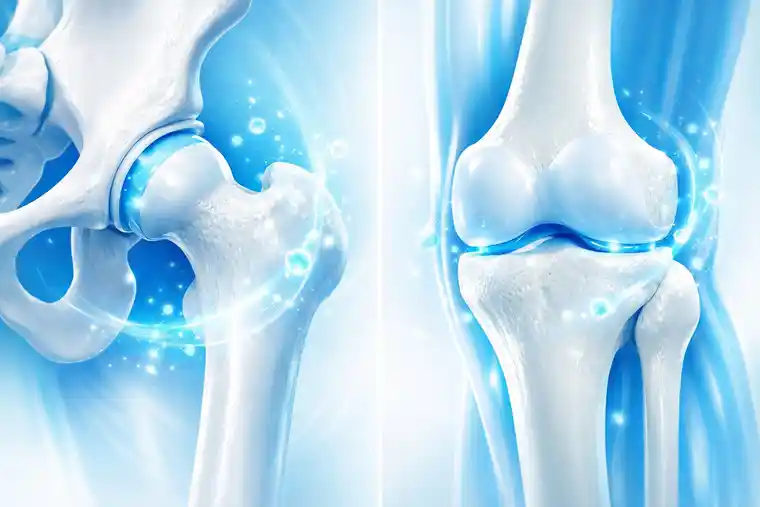
For the right patient, stem cell injections can be one of those options. In hip and knee joints, regenerative treatment is used to support cartilage tissue, reduce inflammation, and improve joint function without surgery or other invasive procedures. The treatment is performed with injections and usually requires only one session.
Patients can go home the same day and continue their stay in Georgia with no limitations.
Table of Contents
When Hip and Knee Pain Stops Being Just Discomfort
Hip and knee problems are common for a simple reason: these joints do a lot of work, and they do it every day.
The knee takes repeated load. The hip carries weight, stabilizes movement, and absorbs force over years. A joint can tolerate a surprising amount for a long time, but not forever. Cartilage begins to lose quality. Small inflammatory changes become more constant. A patient starts moving differently without fully noticing it.
That is how it often begins.
Not with one dramatic collapse, but with small changes. A person walks less. Avoids stairs. Thinks twice before a longer trip. Stops trusting the joint in the same way.
I hear very similar descriptions in clinic. Patients say the knee feels unreliable. Or the hip feels tight, heavy, blocked, not free. They often do not use technical language, but they describe the problem very accurately.
Why Cartilage Damage in the Hip and Knee Becomes a Long-Term Problem
Cartilage has very limited healing capacity. That is one of the main reasons joint degeneration becomes such a persistent problem.
When soft tissue elsewhere in the body is irritated, the body often mounts a stronger repair response. In cartilage, this is much weaker. Once damage begins, the process tends to continue unless the joint environment changes in some meaningful way.
That is why so many patients get stuck in the same loop. Painkillers help for a while. Rest helps a little. Sometimes standard injections reduce symptoms temporarily. But the underlying joint biology remains poor, and the same complaints come back.
This is exactly where regenerative medicine became clinically interesting.
What Stem Cell Injections for Hip and Knee Are Actually Trying to Do
I usually explain it very simply.
The point is not to numb the joint. It is not to hide the symptoms for a week and call that treatment. The real aim is to improve the conditions inside the joint so the tissue has a better chance to recover function.
In hip and knee treatment, stem cell injections are used because of their regenerative potential. They may help support cartilage tissue, influence inflammation, and create a better biological setting for repair.
This is why patients who want to avoid surgery are often interested in the treatment. They are looking for something that does more than temporary symptom control.
That does not mean every painful joint can be regenerated. It means that in properly selected patients, there is a reasonable non-surgical option that tries to work with the biology of healing rather than around it.
Not Every Hip or Knee Joint Needs the Same Regenerative Material
That part matters more than many people think.
Patients sometimes speak about “the stem cell injection” as if it were always the same thing.
In reality, treatment planning is more flexible.
The treatment plan depends on the condition of the joint and the severity of cartilage loss. Also the age and activity of the patient are important factors which decide what kind of regenerative strategy makes the most sense in that case.
At our clinic, the regenerative components can be selected in different ways.
Some patients prefer autologous options, meaning materials obtained from their own body.
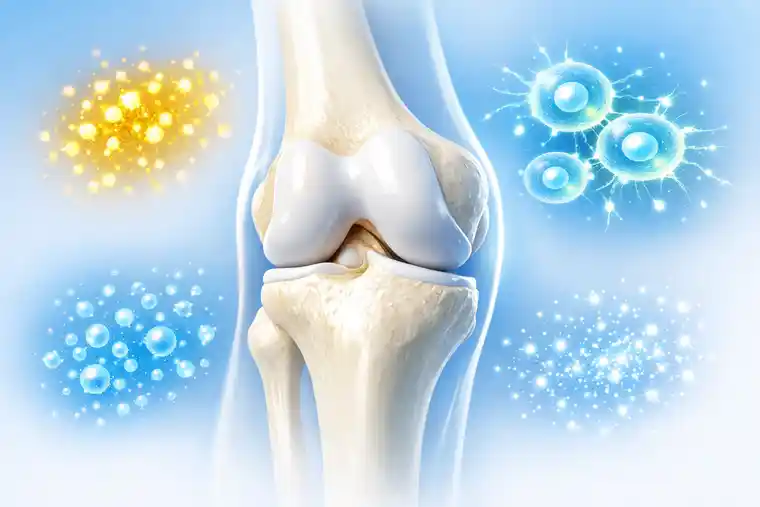
This may include PRP, which is platelet-rich plasma prepared from the patient’s blood and used for its concentration of growth factors, PRF, which is platelet-rich fibrin and provides a more fibrin-rich healing matrix, or stem cell-based preparations where appropriate. Other patients may choose umbilical stem cells or exosomes, which are tiny signaling particles that help cells communicate and support repair processes, as part of the treatment concept. In some cases, these are combined with supportive therapies such as ozone therapy, used to support the local tissue environment, red light therapy, applied to encourage cellular activity and recovery, or shockwave therapy, which uses acoustic waves to stimulate healing responses in the treated area.
That is not done to make the treatment sound more advanced. It is done because joints are biologically complex, and sometimes one element alone is not enough.
Why Combination Treatment for Hip and Knee Joints Often Makes Sense
A painful hip or knee is rarely dealing with one issue only.
There may be inflammation, poor tissue signaling, reduced joint tolerance, mechanical irritation, changes in gait, and a long period of overload behind the symptoms. So if we want to treat the joint seriously, it often makes more sense to build a regenerative environment rather than rely on a single isolated method.
That is why combination therapy is frequently used.
PRP may support healing signals by delivering concentrated growth factors. PRF may broaden the autologous regenerative effect by offering a more stable fibrin scaffold. Stem cells may contribute regenerative potential more directly. Exosomes may support cellular communication and biological signaling. Ozone therapy may help optimize the tissue environment. Red light therapy may support cellular metabolism and recovery. Shockwave therapy may stimulate circulation and healing activity in the affected area.
When these methods are chosen carefully, they do not compete with each other. They reinforce each other.
How Stem Cell Injections for Hip and Knee Joints Are Performed
Patients are often relieved when they see how straightforward the procedure actually is.
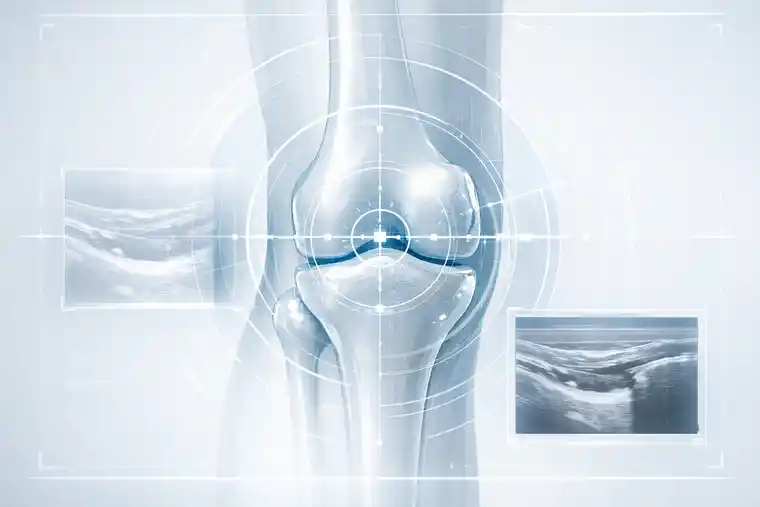
The treatment is performed under ultrasound guidance. I consider that important. Joint injections should be precise. The regenerative material needs to be placed where it is intended to act, and ultrasound gives that control during the procedure.
This also makes the treatment feel more concrete for patients. They know the injection is guided, targeted, and not performed blindly.
From their side, the experience is usually much easier than expected. It is an injection-based procedure, not surgery. There is no large incision, no implant, and no hospital-style recovery process afterward.
Why Many Patients Look for Stem Cell Injections Before Joint Surgery
Some people arrive convinced they must already be close to a joint replacement. Often that is not actually the case.
What they are really reacting to is the exhaustion of chronic pain. Once discomfort has lasted long enough, surgery starts to feel inevitable even when the joint may still have a reasonable window for regenerative treatment.
This is where proper assessment becomes important.
There is a large group of patients who are not in the earliest stage anymore, but are also not yet at the point where surgery is the only realistic choice. They want to walk more comfortably, reduce daily pain, and keep their own joint for as long as possible. For those patients, stem cell injections can be a very valuable option.
I do not present this as a miracle or as a replacement for all orthopedic surgery. That would be irresponsible. But I do see many patients for whom invasive treatment is simply not the first thing that should happen.
Can Stem Cell Injections Help Avoid Surgery?
In the right case, yes, they can.
I prefer to say that carefully because medicine should be careful. No one should promise that stem cell injections can help avoid surgery or that surgery will never be needed under any circumstance. But many patients do not actually need that promise. What they want is a serious chance to improve pain and function enough that surgery can be postponed or avoided.
That is a very reasonable goal.
And sometimes that is exactly what happens. The joint becomes calmer. Mobility improves. Pain decreases. Daily life becomes manageable again. The patient no longer feels pushed toward an operation as the next unavoidable step.
That kind of result matters, even when it is described modestly.
Why Stem Cell Injections for Hip and Knee Are Popular in Georgia
Patients do not only think medically. They also think practically.
That is one reason this treatment has become so popular in Georgia. It is minimally invasive, usually performed in one session, and does not typically require a hospital stay. Most patients can return home the same day. Many can also continue their visit and explore the country without major restrictions.
That changes the entire treatment experience.
A patient who would hesitate over surgery is often much more open to a regenerative procedure that fits into a short medical trip. The logistics are easier. The interruption to life is smaller. The psychological barrier is lower as well.
Sometimes that practical side is what allows treatment to happen at all.
What Recovery After Stem Cell Injections for Hip and Knee Usually Looks Like
Recovery after injection-based regenerative treatment is usually simple compared with surgery.
That does not mean nothing should be taken seriously. The joint still needs sensible aftercare. Temporary soreness is possible. Activity may need to be adjusted for a period depending on the hip, the knee, and the exact combination of therapies used.
But overall, patients are not dealing with the burden that follows an operation. No prolonged hospitalization. No wound management. No heavy rehabilitation process in the surgical sense.
For many patients, that difference is decisive.
Who May Be a Good Candidate for Stem Cell Injections for Hip and Knee
Good candidates are often patients with hip or knee pain related to cartilage wear, degenerative joint change, chronic inflammation, or overload who want a non-surgical solution before moving toward invasive procedures.
Still, patient selection is everything.
The condition of the joint has to be evaluated properly. Imaging matters. Previous treatment matters. Severity matters. Expectations matter. A painful joint alone is not enough information. Regenerative medicine works best when it is matched carefully to the actual stage of the problem.
That is how it should be practiced.
My Clinical View on Stem Cell Injections for Hip and Knee Joints
Over the years, I have seen how easily patients are pushed into two extremes.
Either they are told to simply manage the symptoms and live with it, or they are told to start thinking about surgery. But real clinical life is often more nuanced than that. There is a middle zone where the joint is damaged, yes, but still biologically worth treating in a regenerative way.
That middle zone is important.
It is where stem cells, PRP, PRF, exosomes, and supportive therapies can offer something meaningful: not cosmetic improvement, not false hope, but a real attempt to preserve joint function with the least invasive approach possible.
For many patients, that is exactly the right moment to act.
FAQs About Stem Cell Injections for Hip and Knee Joints in Georgia
Is one session really enough for hip or knee stem cell treatment?
In many cases, yes.
That is one of the reasons patients are so interested in this type of treatment. The procedure is usually done in one session, and for many patients that is enough as a starting treatment. It does not mean every joint reacts in exactly the same way, and it does not mean every patient has the same degree of damage. But in everyday practice, one session is often the standard approach.
What matters more is not the number itself, but whether the treatment fits the stage of the joint properly.
How long does the procedure take?
The procedure itself is usually not very long.
Most patients are surprised by how straightforward it is. The joint is assessed, the treatment material is prepared if needed, and the injection is performed under ultrasound guidance. The goal is precision, not speed for its own sake, but this is still a treatment that usually fits into the same day quite easily.
It is not the kind of process patients imagine when they hear the word procedure.
Is the injection painful?
Most patients tolerate it well.
Of course, no joint injection is something a person would describe as pleasant. But this is usually much easier than patients fear beforehand. The procedure is controlled, targeted, and does not involve open surgery or a large invasive step. In many cases, the anxiety before the injection is worse than the injection itself.
Afterward, there can be some soreness for a while, but that is very different from surgical pain.
How soon can I walk after the treatment?
Usually on the same day.
This is one of the reasons many patients choose this treatment in the first place. It is not surgery, so people are usually back on their feet much sooner than they expect. That does not mean the joint should be pushed immediately, but most patients are able to stand and walk again quite quickly after the injection.
What matters afterward is a bit of common sense. Walking is usually possible early. Overloading the joint too early is a different matter.
How do I know if I am a good candidate?
That cannot be decided by pain alone.
A painful hip or knee does not automatically mean stem cell treatment is the right step. The condition of the joint has to be looked at properly. How advanced is the degeneration? How much function is still there? What has already been tried? Is the joint still in a stage where regenerative treatment has something real to work with?
That is why proper evaluation matters first. The best candidates are usually those whose joint is already causing real problems, but not yet too far gone to benefit from a non-surgical approach.
Final Thoughts on Stem Cell Injections for Hip and Knee in Georgia
When hip or knee pain becomes part of daily life, patients start looking for more than temporary relief. They want a treatment that makes clinical sense, fits into real life, and does not immediately force them toward an invasive procedure.
Stem cell injections for hip and knee joints in Georgia offer that kind of option for selected patients.
The treatment is non-surgical and performed under ultrasound guidance. According to the individual case it may be combined with PRP, a platelet concentrate from the patient’s own blood, PRF, a fibrin-rich regenerative blood product, exosomes, which support cellular communication, ozone therapy, red light therapy, or shockwave therapy as supportive measures to improve the tissue response.
Mostly, even one session is enough, no hospitalization is needed. Patients can return home the same day.
That is one of the main reasons this approach continues to attract so much attention.
Not because it sounds futuristic, but because for the right patient, it is practical, targeted, and clinically meaningful.