Regenerative Medicine


Clinical Insights by Op. Dr. Hilmi Karadeniz
Orthopedic Surgeon & Sports Medicine Physician
Some changes in the body arrive quietly.
They do not start with sharp pain or dramatic loss of function. They begin as small compromises: a joint that feels “different,” a movement that requires more effort than before, a recovery that takes longer than it used to. Patients often ignore these signs – not out of carelessness, but because life continues, and the body adapts.
In orthopedic and sports medicine practice, this silent phase is often the most important one. It is the window in which biological support can still influence the course of a condition – before structural damage becomes permanent, before surgery becomes inevitable.
This is the space where SVF and exosome therapy belong.
Not as a promise of reversal.
Not as a shortcut.
But as a way to give the body back the conditions it needs to repair itself – if it still can.
I am Op. Dr. Hilmi Karadeniz, an orthopedic surgeon and sports medicine physician. Over the years, I have treated professional athletes, active individuals, and patients whose daily independence depends on joint health that cannot be taken for granted.
What all these patients share is not the same diagnosis – but the same concern:
“How far can we go before we cross a line we cannot return from?”
In conditions involving joints, bone, cartilage, or connective tissue, timing matters more than technology. Too early, and intervention is unnecessary. Too late, and biology can no longer compensate for mechanical failure.
Regenerative medicine does not replace orthopedic surgery.
It complements it – when used responsibly, and at the right moment.
Many patients come with expectations shaped by headlines or social media. They hear words like “stem cells” or “exosomes” and imagine regeneration as something fast, visible, and guaranteed.
In reality, regenerative medicine is slow. It is subtle. And it demands patience — from both the physician and the patient.
Unlike surgery, which changes anatomy directly, regenerative therapies aim to change tissue behavior. They influence inflammation, eg joint inflammation, blood supply, cellular communication, and repair signaling. They work with the body’s own logic, not against it.
This is precisely why they must be applied carefully.
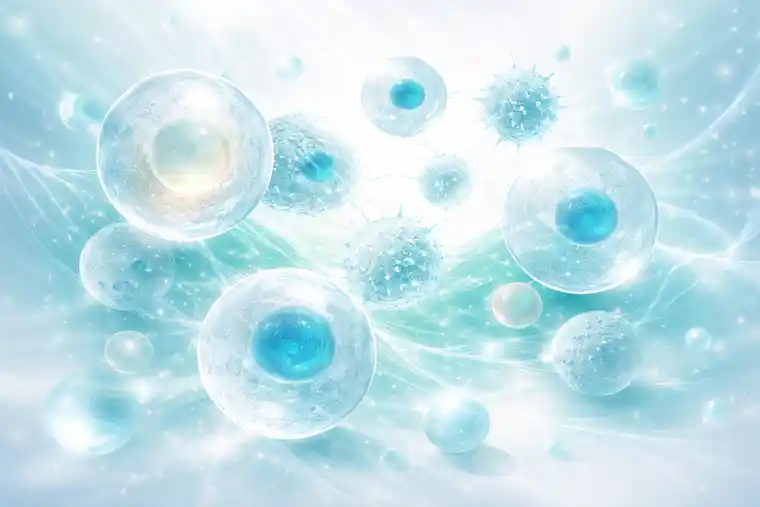
SVF stands for Stromal Vascular Fraction, a biologically rich component derived from a patient’s own adipose tissue.
It is often described as “stem cell therapy,” but this is an oversimplification that misses its real value.
SVF is a living cellular ecosystem.
It contains:
Together, these elements interact continuously — not to rebuild tissue instantly, but to restore a biological environment that has become hostile to healing.
SVF therapy begins with a small-volume fat harvest, usually from the abdominal region. This is done under local anesthesia using gentle techniques designed to preserve cell integrity.
The harvested tissue is then processed under sterile conditions to isolate the stromal vascular fraction. Importantly, this is not laboratory expansion. The cells are not grown, altered, or stored. They are prepared and used within the same clinical session.
The resulting SVF is then applied to the target area – often intra-articularly or into surrounding tissues, depending on the indication.
The entire process respects one principle:
minimal manipulation, maximum biological compatibility.
SVF does not replace damaged structures.
It does not reverse collapse.
It does not ignore biomechanics.
What it can do is:
In early-stage degenerative conditions, this biological shift can slow progression, improve function, and reduce pain – sometimes enough to postpone or avoid surgery.

Exosomes represent a different layer of regenerative medicine.
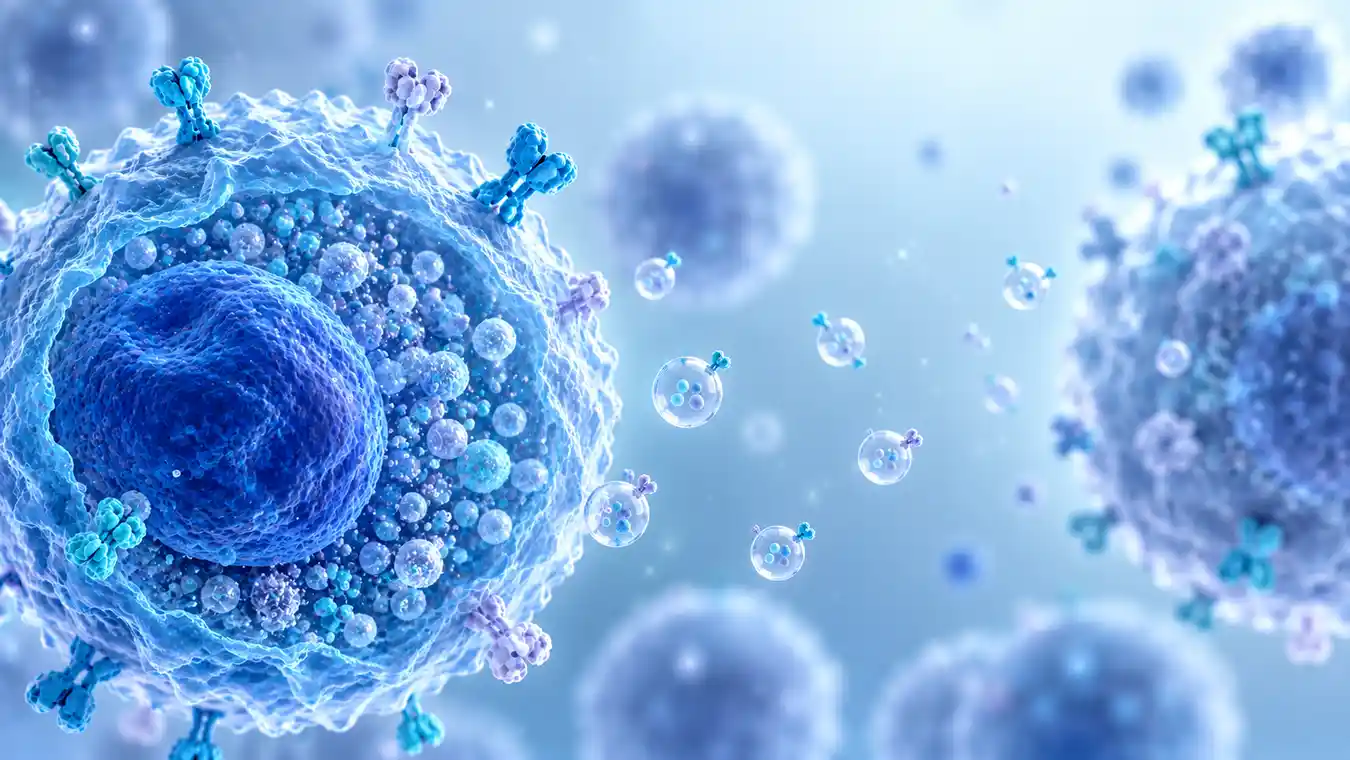
They are cell-derived extracellular vesicles, released naturally by many cell types, including stem cells. Their function is communication – not repair through presence, but repair through instruction.
To understand how SVF and exosome therapy works in joint healing, it is essential to first understand what exosomes actually are.
In our comprehensive scientific guide to exosome structure, contents, and biological function, we explain how these extracellular vesicles act as molecular messengers in regenerative medicine.
Inside exosomes are molecular messages:
Unlike cells, exosomes do not divide, integrate, or persist. They deliver information — and then they are gone.
Exosomes act faster, but shorter.
SVF acts slower, but longer.
Because of their size, exosomes can penetrate tissues more easily and influence cellular behavior rapidly. They are particularly effective in modulating inflammation and immune response — two key drivers of chronic pain and degeneration.
They do not rebuild tissue directly.
They tell tissues how to behave.
When used together, SVF and exosomes form a coherent strategy.
SVF provides:
Exosomes provide:
This combination does not “supercharge” healing. It organizes it.
In my practice, SVF and exosomes are considered only after careful evaluation. They are most relevant in:
They are not suitable for advanced joint destruction, complete collapse, or cases where mechanical correction is unavoidable.
Improvement rarely arrives suddenly.
Patients often describe:
Interestingly, many patients realize improvement only in retrospect — when pain medication becomes unnecessary, or when movement no longer requires conscious protection.

Regenerative therapies fail when they are used too late — or promised too much.
Once mechanical integrity is lost, biology alone cannot restore it. This is not a limitation of SVF or exosomes. It is a reality of orthopedic physics.
Responsible regenerative medicine requires honesty, restraint, and proper patient selection.
One of the most important parts of my work is explaining when not to use regenerative therapies.
SVF and exosome treatment are sometimes presented online as universal solutions. They are not. There are situations where biology no longer has enough room to work – and pretending otherwise only delays appropriate care.
Patients with advanced joint collapse, severe deformity, or complete loss of joint space usually require mechanical solutions. In those cases, regenerative therapy does not fail because it is weak, but because the structure it would need to support is already gone.
There are also patients whose expectations do not align with the nature of biological healing. If the goal is instant relief, immediate performance, or guaranteed reversal, regenerative medicine will disappoint.
Being selective is not limitation.
It is responsibility.
Patients often ask a very practical question:
“How will I know if this is actually doing something?”
Most expect a clear signal. Stronger muscles. Better range of motion. Something obvious they can point to. That’s rarely how it starts.
What usually comes first is much easier to miss. A joint that feels less irritated at the end of the day. Pain that doesn’t flare up as quickly after activity. Mornings that feel a little less stiff than before.
Some patients don’t notice any single big change at all. They notice that they stop thinking about the joint quite so much. That constant background awareness fades. And only then do they realize something has shifted.
In chronic orthopedic problems, pain is rarely just a result of “damage.”
It’s the result of a cycle.
Inflammation changes how tissue behaves. That altered behavior changes how load is distributed. And abnormal load keeps inflammation active. Over time, the joint becomes trapped in that loop.
When regenerative therapy helps, the first success is often not repair — it’s interruption. The cycle slows down. The tissue becomes calmer. Load is tolerated a little better. That alone can change how a joint functions, even before anything measurable appears on imaging.
Another point that needs to be clarified early is the role of rehabilitation.
SVF and exosome therapy do not replace movement. They don’t replace physiotherapy. And they certainly don’t work well in isolation.
What they do is change how tissue responds to movement. But movement still has to happen. Carefully. Progressively. With some restraint.
Too much rest, and tissues stay passive.
Too much load, too early, and biology falls behind.
This balance is where experience matters. Regenerative therapy works best when it is followed by structured rehabilitation — not aggressive, not rushed, but consistent. Biology needs movement to organize itself. Without it, even the best signals have nowhere to go.
Because SVF is derived from the patient’s own tissue, and exosomes are biological signaling structures, these therapies are often described as “natural.” That word can be misleading.
Natural does not mean uncontrolled.
Natural does not mean harmless by default.
Sterility, handling, indication, and application technique matter enormously. Poorly performed regenerative treatments do not just fail — they can provoke inflammation, worsen symptoms, or create false confidence.
This is why these therapies belong in medical hands, not commercial settings.
True biological healing is rarely dramatic.
It is measured in weeks, sometimes months.
It progresses unevenly.
It improves function before it improves imaging.
Patients who do best are usually those who stop asking “Is it already working?” and instead notice that daily life has quietly become easier.
That shift — subtle, unforced, sustainable — is often the real outcome.
SVF and exosome therapy are not about replacing surgery.
They are about preserving options.
They do not force the body to heal.
They listen to it.
And when the body is still capable of responding, that conversation can change everything.

SVF is not the same as laboratory stem cell therapy. It is a mixture of different cells taken from a patient’s own fat tissue, including stem-like cells, that work together to support healing.
This is probably the most common misunderstanding. SVF does contain cells with stem-like properties, but it is not a single, isolated cell type. It is a combination of cells that naturally belong together. The effect comes from how these cells interact, not from one “magic” cell.
Exosomes are tiny biological particles released by cells that carry signals to other cells. They are used to influence healing and inflammation without introducing living cells.
Exosomes don’t stay in the body long and they don’t build tissue themselves. Their role is communication. In many chronic conditions, the problem isn’t the lack of cells – it’s that cells are no longer receiving clear instructions. Exosomes help restore that communication.
Most patients do not notice immediate results. If improvement occurs, it usually develops gradually over weeks rather than days.
This is not a painkiller or a steroid injection. Changes tend to be subtle at first. Less irritation after activity. Fewer bad days. More confidence in movement. Many patients realize improvement only after looking back, not overnight.
No. SVF and exosome therapy cannot rebuild destroyed cartilage or reverse advanced joint damage. They may support function and slow progression in earlier stages.
These treatments are often misunderstood as alternatives to surgery in every case. They are not. When structural damage is advanced, mechanical problems need mechanical solutions. In earlier stages, regenerative therapy may help preserve options – not eliminate reality.
Patients with early or moderate joint, tendon, or cartilage problems usually benefit the most. Timing is often more important than the diagnosis itself.
People tend to respond better when tissue structure is still largely intact. Chronic overload, early degeneration, slow recovery after surgery — these are typical scenarios. End-stage joint destruction is not.
Sometimes regenerative therapy does not lead to improvement. This usually means the tissue can no longer respond sufficiently to biological stimulation.
This is a conversation we always need to have upfront. Biology doesn’t follow guarantees. If the body doesn’t respond, it’s not a failure – it’s information. It tells us that a different approach is needed. Regenerative therapy is not a promise. It’s a question we ask the body.